
ALMATY – President Kassym-Jomart Tokayev has called for stronger cooperation within the Shanghai Cooperation Organization (SCO) on security, trade, transport, investment and water, as the organization marks 25 years of development, while experts say its expanding agenda is positioning the SCO as an increasingly important platform in the emerging multipolar international order.
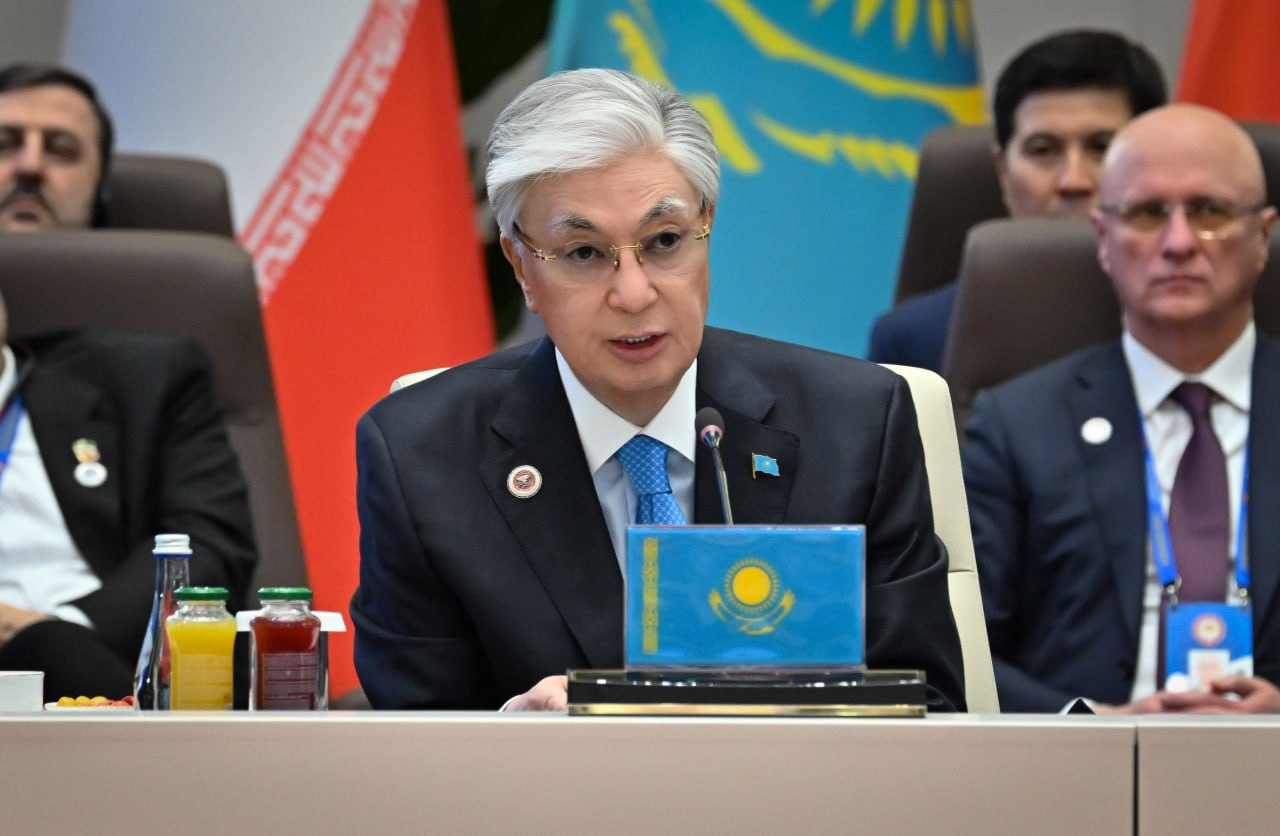
President Kassym-Jomart Tokayev spoke at the Sept. 1 SCO summit in Bishkek. Photo credit: Akorda.
Speaking at the Sept. 1 SCO summit in Bishkek, the Kazakh President described the organization’s evolution from the Shanghai Five into a major international organization spanning much of Eurasia and representing almost half of the world’s population.
“The SCO operates outside the logic of military-political blocs and is not directed against any state. It is based on a completely different political philosophy – the ‘Shanghai Spirit,’ whose foundation is the idea of joint work for the sake of progress,” Tokayev said.
According to Prof. Dr. Zijad Bećirović, director of the International Institute for Middle Eastern and Balkan Studies (IFIMES) in Ljubljana, the organization’s transformation reflects broader changes in the international system.
“The transformation of the organisation reflects the wider transformation of the international system. The SCO has evolved from a regional security mechanism into a broader platform addressing security, trade, energy, investment, connectivity and economic cooperation,” he told the Astana Times.
“Its importance is not simply a matter of size. The organisation brings together major political, economic and demographic centers, making it one of the most significant institutional expressions of the emerging multipolar order,” he added.
From regional security to wider cooperation
Tokayev also called for stronger mutual trust and security cooperation, noting that the SCO brings together major Eurasian powers whose positions influence the emerging international order. He proposed holding an SCO ministerial conference on strategic stability and confidence-building measures in Eurasia, with discussions potentially covering reducing military risks, preventing a new arms race, and avoiding dangerous incidents.
“Of particular concern is the fact that the consequences of armed conflicts are already extending beyond the immediate zones of hostilities, affecting international markets, commercial shipping, and the sustainability of energy and transport links. This has significantly increased the risk of the cross-border spread of crisis phenomena,” Tokayev said.
Connectivity as a practical area of cooperation
Economic and transport cooperation was another major theme of Tokayev’s address. President Tokayev proposed establishing SCO cross-border trade zones based on existing border cooperation centers. Such zones, he said, could test simplified trade procedures, digital processes and modern payment mechanisms.
He also supported creating an SCO Development Bank and proposed directing its resources primarily toward infrastructure, technological and industrial projects.
Bećirović sees connectivity as one area where the SCO can translate its broad political ambitions into practical cooperation.
“The diversity of the SCO is both a challenge and an opportunity. Its members have different strategic priorities and, in some cases, serious bilateral disagreements. But economic cooperation does not require political uniformity. It requires identifiable interests that can be pursued together,” he said.
The strongest potential, in his view, lies in Eurasian transport connectivity.
“The geography of trade is changing rapidly, with new transport corridors, railways, ports, logistics centres, energy infrastructure and digital networks reshaping commercial links across the continent,” Bećirović added.
Kazakhstan links SCO agenda to global governance
Tokayev also used the SCO+ format to present Kazakhstan’s broader vision of the international system. Speaking during the extended meeting, he noted that the world needs an order in which confrontation and the “cult of force” give way to mutual responsibility, joint development and long-term cooperation.
President Tokayev proposed that the key principles of the SCO be reflected in a special UN General Assembly resolution dedicated to the International Day of Multilateralism and Diplomacy for Peace.
“The UN should remain the core of the international system, and its Charter – the universal foundation of international law,” Tokayev said.
Manarbek Kabaziyev, deputy chairman of the Foreign Policy Research Institute under Kazakhstan’s Foreign Ministry, also stressed that the SCO should not be regarded as a replacement for other international organizations, in a conversation with the Astana Times.
“The SCO occupies a somewhat different niche. It is primarily a platform for broad political dialogue and practical cooperation among Eurasian states, bringing together countries with different political systems, economic models, civilizational and cultural characteristics,” Kabaziyev said.
According to Tokayev, strengthening preventive diplomacy should be an important part of reforming global governance.
The Kazakh President also called for SCO support for Kazakhstan’s proposals to establish an International Water Organization under the UN and an SCO Water Issues Analysis Center.
Cooperation without political uniformity
The ability to pursue common economic interests despite political differences may ultimately determine how effective the SCO can become. The organization brings together China, Russia, India, Iran, Pakistan and the Central Asian states, among others, with different foreign policy priorities and economic models. Bećirović does not see this diversity as necessarily preventing cooperation.
“Its strategic value lies in its ability to bring together states with different interests and political systems and provide a framework for dialogue and cooperation,” he said.
Kabaziyev similarly notes that the emerging Eurasian approach should not be understood as a model based on uniformity.
“I would speak not so much of a ready-made ‘Eurasian model’ as of the formation of its individual principles and mechanisms,” he said.
He described the approach as based on “pluralism of development paths,” where countries can maintain their own political and economic systems while developing practical cooperation.
“Therefore, I would call it integration through connectivity, rather than integration through unification,” Kabaziyev said.
The test of the next years
The Bishkek summit therefore comes at a point when the SCO’s main challenge is no longer simply defining its areas of cooperation. Its agenda has already expanded considerably. The question is how effectively its members can turn that broad agenda into mechanisms and projects.
At the global level, Tokayev’s emphasis on multilateralism and the UN reflects Kazakhstan’s effort to position the SCO not as a replacement for existing international institutions, but as a regional platform contributing to a more multipolar system.
Bećirović believes the organization’s ability to maintain dialogue among states with divergent interests may itself become one of its most important functions.
“In an increasingly fragmented international environment this function is becoming more important,” he said.
Twenty-five years after its establishment, the SCO has grown far beyond its original security-focused mandate. Its next stage will depend on whether its members can use that diversity not as an obstacle, but as a basis for practical cooperation across the increasingly interconnected Eurasian space.
