
ALMATY – Kazakhstan’s manufacturing sector has overtaken mining in its share of industrial output for the first time, marking a potentially important shift in the country’s economic structure. But economists say the headline figure should be viewed alongside a second trend: rising demand for imported machinery, equipment and technology as Kazakhstan enters a major investment cycle.
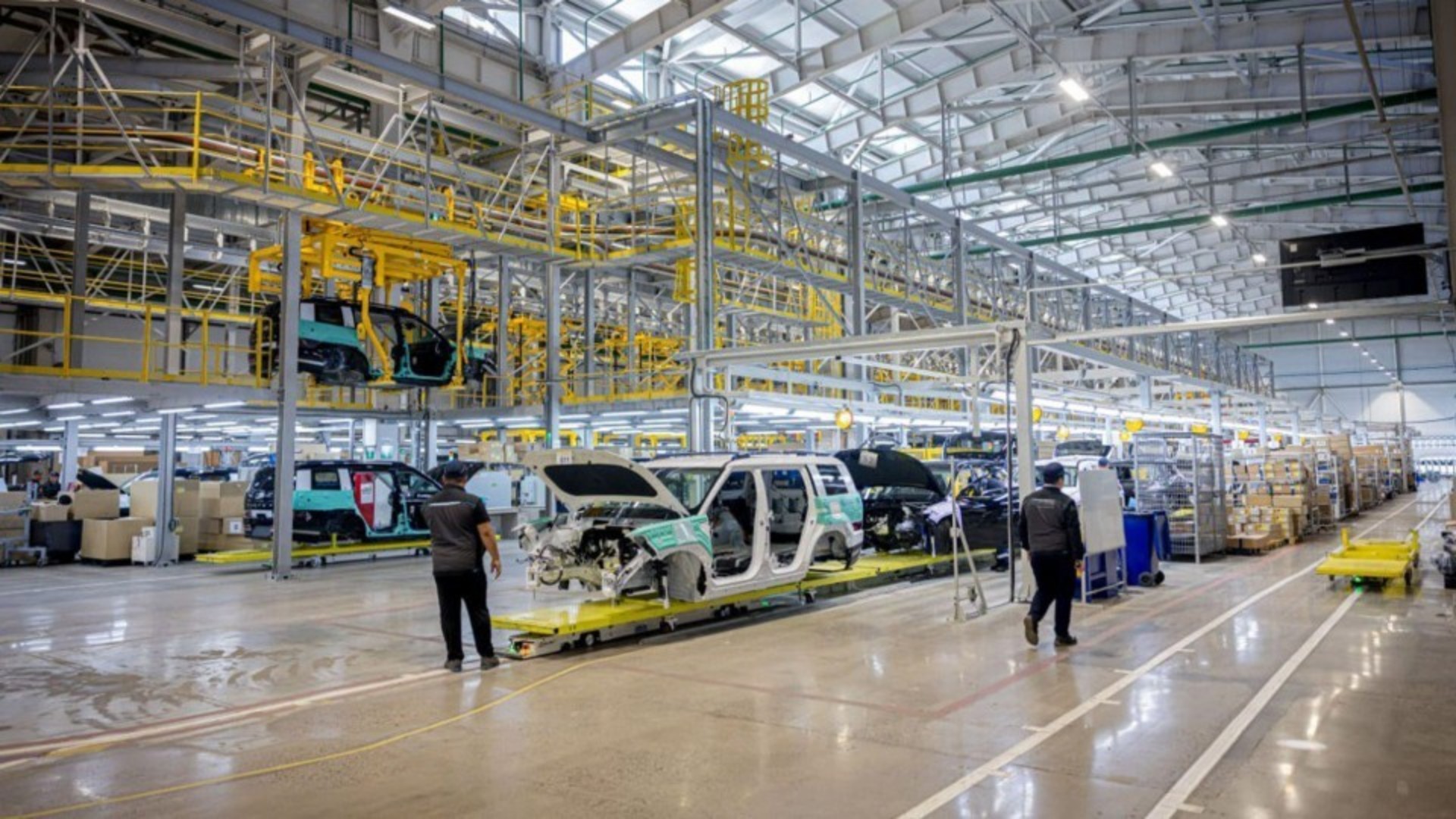
Photo credit: primeminister.kz
Manufacturing accounted for 46.7% of industrial production in January-July 2026, compared with 45.8% for mining, according to the Prime Minister’s press service. Manufacturing output reached 18.8 trillion tenge (US$40.7 billion), increasing 9% compared with the same period last year.
The shift comes as the government seeks to reduce the economy’s dependence on the export of raw materials by encouraging deeper processing, domestic production and higher-value industries. The policy is supported by investment incentives, special economic zones, preferential access to domestic raw materials, offtake agreements and measures designed to increase the participation of Kazakh manufacturers in regulated procurement.
From raw materials to higher-value production
The government’s figures show strong growth across several manufacturing industries. Machine building increased 22% in the first seven months of the year, reaching 3.2 trillion tenge (US$6.92 billion). Metallurgy generated 8.1 trillion tenge (US$17.52 billion), while chemical production increased 26.9% to 1 trillion tenge (US$2.16 billion).
Automotive manufacturing illustrates the direction of the policy particularly clearly. More than 96,000 vehicles were produced during the period, while the share of small-scale assembly reached 28.3%. New production facilities are also creating demand for locally produced tyres, batteries, seats and multimedia systems.
State support creates demand, but competitiveness remains the test
One of the government’s main instruments is an offtake contract, which gives manufacturers a guaranteed buyer for products that are yet to be produced. In the first half of 2026, long-term agreements and offtake contracts involving subsoil users and the quasi-public sector amounted to 466 billion tenge (US$1.01 billion). Samruk Kazyna’s purchases from domestic manufacturers more than doubled and exceeded 2.1 trillion tenge (US$4.54 billion).
Special economic zones provide another layer of support. According to government figures, 577 projects in 18 zones have attracted 11.1 trillion tenge (US$24 billion) in investment and created more than 39,000 jobs. Residents have generated 865.4 billion tenge (US$1.87 billion) in tax revenues, compared with 507.4 billion tenge (US$1.1 billion) in state spending on infrastructure.
However, leading Kazakh financial analyst Rassul Rysmambetov cautioned that the latest figures should not yet be interpreted as evidence of a completed structural transformation.
“First of all, just as an introduction, I would say that we do not yet have a structural shift, but it is beginning. We will probably only be able to speak about a genuine structural shift in several years, after we have sustainably and consistently earned not from oil and not from the extractive sector, but from processing and manufacturing,” he said.
Rysmambetov also highlighted that industrial policy should reach beyond the country’s largest companies and create opportunities for medium-sized businesses.
“Large business is good, but in my view it is better to support 10 medium-sized companies than one large one, because this is classic portfolio management: supporting 10 companies at a medium level is more important than supporting one large company,” he said.
“Can such a model create competitive production in the long term? Well, I think yes, if we manage this portfolio of companies correctly,” Rysmambetov added.
Regional economies are moving at different speeds
The transformation is also uneven across Kazakhstan. Manufacturing growth was particularly strong in the Aktobe Region, where output increased 10.7%, and the Karagandy Region, where it rose 10.6%. These are traditionally industrial regions, meaning that part of the current expansion is taking place on an existing industrial base rather than being built entirely from scratch.
Influential Kazakh economist Ruslan Sultanov points to a contrast between regions whose growth remains strongly tied to commodity exports and those beginning to develop a broader industrial and investment base.
In the Abai Region, for example, exports remain heavily concentrated in raw materials. Copper ore exports to China increased from $24 million to $2 billion over the year, while copper cathodes and molybdenum ore also remain among the region’s main export products, he wrote on his Telegram channel.
At the same time, the Aktobe Region is combining its traditional industrial base with new investment, including imports of Chinese equipment for wind-energy projects.
“One region increases its revenues through commodity exports, while another is simultaneously restructuring its industrial and investment agenda,” he wrote.
This divergence illustrates an important point about Kazakhstan’s industrial transition: the country is not moving away from commodities at the same pace everywhere. Some regions are using their resource base as the foundation for deeper processing, while others remain dependent on the export of relatively unprocessed materials.
The import paradox of industrial growth
There is another side to Kazakhstan’s investment-driven industrial expansion.
According to the government’s approved economic forecast, imports are expected to reach $90.7 billion in 2028, up from an earlier forecast of $87.7 billion. By 2029, imports are projected at $88.4 billion, while exports are expected to reach $88.5 billion, leaving only a marginal trade surplus. The figures are significant because imports are rising at the same time that Kazakhstan is investing heavily in domestic production.
That is not necessarily a negative development. New factories require machinery, industrial equipment, electrical systems, transport equipment, technologies and other goods that Kazakhstan does not yet produce in sufficient quantities.
But it creates an important policy challenge: investment should eventually expand domestic productive capacity rather than permanently increase dependence on imported inputs.
The 46.7% manufacturing share may ultimately prove to be less important than what happens behind the number. Over the next five to 10 years, several indicators will show whether Kazakhstan’s industrial policy has produced a structural transformation: the share of manufactured goods in exports, the depth of local processing, domestic value added, productivity growth, private investment, the development of local suppliers and the ability of new industries to compete without permanent state support.
