
ASTANA – Kazakh President Kassym-Jomart Tokayev called for fair, inclusive and human-centered global governance of artificial intelligence at the opening of the 2026 World Artificial Intelligence Conference in Shanghai on July 17, urging stronger international cooperation and proposing new initiatives to expand AI development, regulation and digital connectivity.
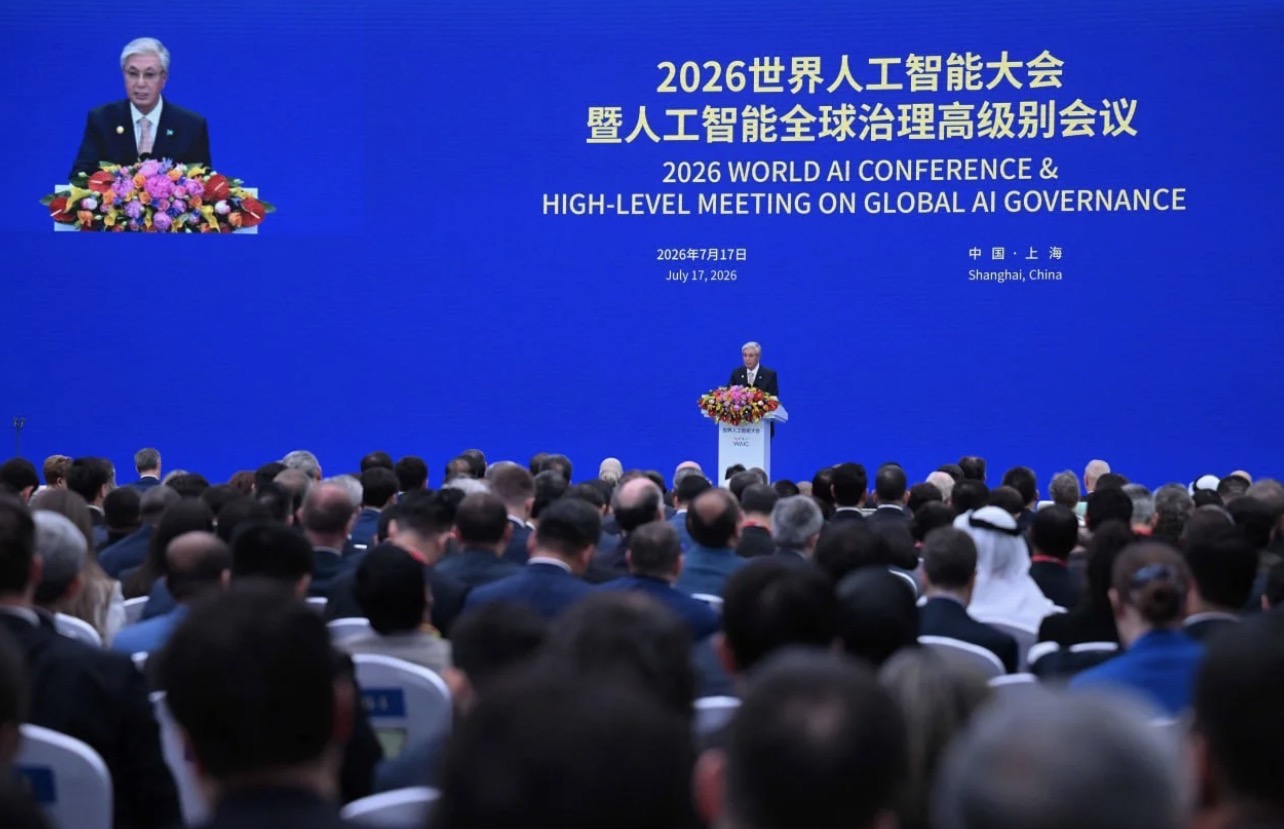
President Kassym-Jomart Tokayev delivers remarks during the opening ceremony of the 2026 World Artificial Intelligence Conference in Shanghai on July 17. Photo credit: Akorda.
AI governance requires global cooperation
Addressing the conference under the theme Global Solidarity in the AI Era, Tokayev endorsed the principles of AI for Good and AI for All, stressing that technological progress should benefit all countries rather than deepen global inequalities, reported Akorda.
“No country should remain merely a consumer of artificial intelligence. Every nation must have the opportunity to develop its own human capital, digital infrastructure and institutional capacity. At its core, this is a matter of fairness and equity. Our shared responsibility is to ensure that artificial intelligence serves the interests of the economy and society. At the same time, AI must remain under responsible and prudent human oversight,” Tokayev said.
He said AI governance should cover the entire technology ecosystem, from semiconductors and data centers to ethics, education and the protection of human dignity. Amid growing geopolitical tensions, he argued that artificial intelligence should be used to strengthen early warning systems, preventive diplomacy, humanitarian response and peacebuilding.
Tokayev also welcomed the establishment of the World Organization for AI Cooperation, describing it as a historic step toward creating a universal global AI governance framework. He proposed holding the organization’s inaugural meeting in Astana and establishing its Central Asian regional office in Kazakhstan.
Kazakhstan positions itself as regional AI and digital hub
Tokayev said Kazakhstan aims to become a regional center for technological connectivity, digital trade and innovation, citing the country’s energy resources, critical minerals, transport corridors and expanding digital infrastructure.
He highlighted Kazakhstan’s national AI agenda, including the declaration of 2026 as the Year of Artificial Intelligence and Digital Development, the adoption of the AI Law and the Digital Code, implementation of the Smart City platform in Astana, and development of Alatau as Central Asia’s first fully integrated digital city under a special legal framework designed to attract global technology companies and investors.
Tokayev also announced that Almaty will host the United Nations ESCAP Asia-Pacific Digital Solutions Center for Sustainable Development.
New Kazakhstan-China AI initiatives
Tokayev proposed launching a Kazakhstan-China Digital Bridge initiative to promote digital trade and deeper integration of the two countries’ digital economies within the Belt and Road Initiative.
He also called for harmonizing AI regulations, developing common standards for testing and certifying AI systems, and strengthening safeguards against cyber threats, deepfakes and digital fraud.
In addition, Tokayev proposed declaring 2027 the Year of Kazakhstan-China Joint AI Initiatives and creating an international network of AI schools, centers of excellence and academic partnerships under the World Organization for AI Cooperation to develop future talent and promote ethical AI development.
