
ASTANA – As fertility rates continue to fall across much of the world, Kazakhstan is among the countries where births are still above the population replacement level. New data, however, indicate that the country is beginning to mirror the broader global demographic slowdown.

Kazakhstan’s population has reached 20.58 million, an increase of more than 76,000 since the start of 2026. Photo credit: Shutterstock
According to the United Nations, the global fertility rate has dropped from around five children per woman half a century ago to roughly 2.2 today, reshaping population structures and creating long-term economic and social challenges for many countries. Much of Europe and East Asia has fallen well below the replacement level of 2.1 children per woman.
Kazakhstan, however, remains above that threshold at 2.57. A continuous belt of countries stretching from Pakistan to Mongolia still records fertility above the replacement level, and Kazakhstan is part of that group.
According to the Bureau of National Statistics, the country’s population has reached 20.58 million, an increase of more than 76,000 since the start of 2026.
Kazakhstan remains a regional demographic leader
Kazakhstan continues to rank among the region’s demographic leaders. According to available estimates, Uzbekistan records one of the region’s highest fertility rates at around 3.45 children per woman, while the Kyrgyz Republic stands at 2.75. Kazakhstan, at 2.57, remains well above Russia’s 1.46, Armenia’s 1.71, and Belarus’s roughly 1.2.
At the same time, birth numbers in Kazakhstan have started to decline from the unusually high levels recorded during and immediately after the COVID-19 period. According to an analysis by Finprom.kz, 74,100 children were born in Kazakhstan in the first quarter of 2026, down from 77,300 in the same period last year, a decline of 4.2%, or around 3,200 fewer births.
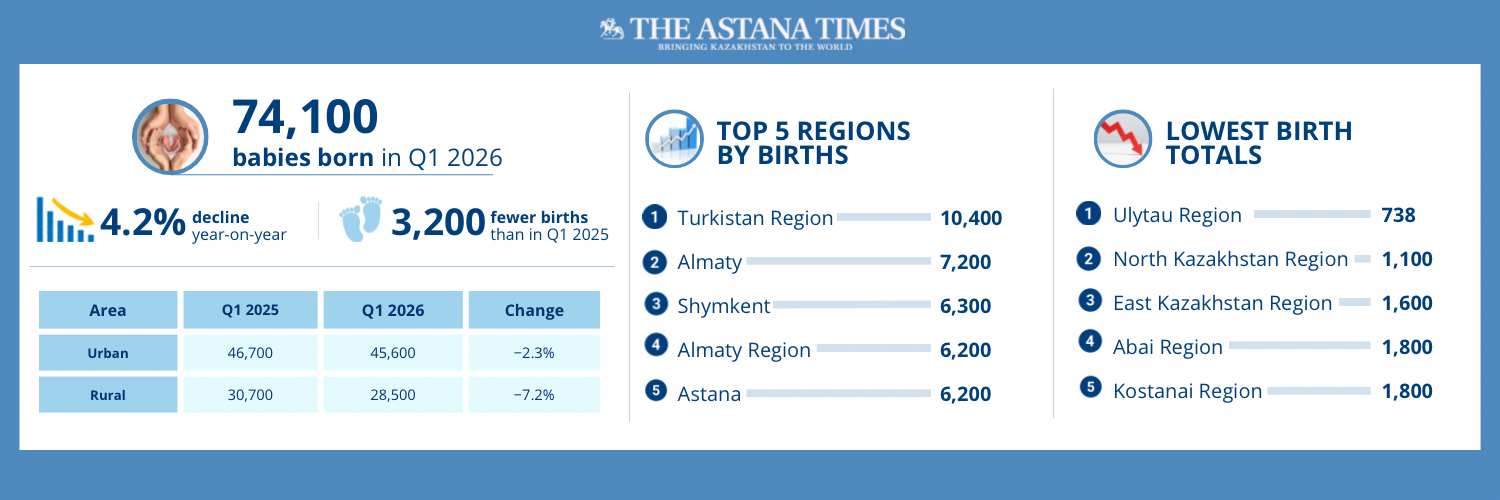
Kazakhstan’s birth statistics for the first quarter of 2026.
The decline affected both urban and rural areas, though it was sharper in the countryside. Urban births fell by 2.3%, from 46,700 to 45,600, while rural births dropped by 7.2%, from 30,700 to 28,500. No major gender imbalance was recorded. In the first quarter of 2026, 38,000 boys and 36,100 girls were born, compared with 39,600 boys and 37,700 girls a year earlier.
Regionally, the largest number of births was recorded in the Turkistan Region with 10,400 newborns, followed by Almaty city with 7,200, Shymkent city with 6,300, and the Almaty Region and Astana city with 6,200 each. The lowest totals were in the Ulytau Region with 738 births, the North Kazakhstan Region with 1,100, the East Kazakhstan Region with 1,600, and the Abai and Kostanai regions with 1,800 each.
Part of a broader global shift
Experts say Kazakhstan’s recent decline should not be viewed as a demographic crisis, but rather as part of the so-called second demographic transition seen in many countries as education levels rise, urbanization accelerates, women’s labor force participation expands, and the cost of raising children increases.
For years, Kazakhstan stood out from that global pattern by maintaining comparatively high fertility even as many countries saw sustained declines.
According to Aslan Temirkhanov, a medical doctor, specialist in molecular medicine and cell biology, and expert in youth reproductive health, the current decline is not critical and should be interpreted in context.

Aslan Temirkhanov, a medical doctor, specialist in molecular medicine and cell biology. Photo credit: Temirkhanov’s Instagram page
“We know that during the COVID-19 period, many countries saw a temporary spike in births because people were staying at home and their lifestyles changed. What we are seeing now is partly an adjustment after that peak,” Temirkhanov told The Astana Times.
In other words, Kazakhstan’s recent decline may say less about a sudden demographic breakdown than about normalization after an exceptional period. The more important measure, he suggests, is not the quarterly number of births alone but the country’s broader fertility trajectory over time.
“If we look not just at the absolute number of births but at broader demographic indicators, Kazakhstan still has a high fertility rate. In Russia, for example, the fertility rate is around 1.3. In the European Union it is roughly 1.5. In South Korea it is below 0.8,” he said.
Temirkhanov noted that economic uncertainty is one of the factors shaping reproductive decisions worldwide. In cities, especially Astana and Almaty, the cost of housing, childcare and everyday life can encourage couples to postpone having children or to have fewer children than earlier generations. Women’s educational attainment and labor force participation have also risen, which is generally associated with later family formation and smaller family size unless strong family support policies are in place.
However, that does not mean Kazakhstan is destined to follow the same path as East Asia or southern Europe. But it does suggest that the country’s demographic future will depend increasingly on how well it manages the social and economic conditions surrounding family life.
Education and healthcare as demographic investments
Temirkhanov said Kazakhstan’s relatively strong fertility rate reflects a combination of factors, including state support for families, cultural norms and the availability of reproductive health education and services. He also pointed to cultural expectations around family, but emphasized that one of the most important factors is comprehensive sexuality education.
“Education affects the quality of family planning, knowledge about contraception, understanding when to see a doctor and awareness of reproductive health services,” he said.
According to Temirkhanov, many young people in Kazakhstan are still unaware that the country has youth health centers offering free counseling and services related to reproductive and mental health.
Kazakhstan has more than 100 youth health centers that provide medical, preventive, psychosocial and legal services to adolescents ages 10 to 18 and young adults ages 18 to 29 on issues related to reproductive and mental health. He cited a 2025 UNFPA study on adolescents and youth ages 15-19 and 20-24, which found low levels of reproductive health knowledge. According to the report, only 11.7% of respondents demonstrated awareness of HIV, including 8.1% of adolescents ages 15-19 and 19.1% of young people ages 20-24.
“Awareness of sexually transmitted infections and their consequences, including infertility if left untreated, was also low. More than 60% of young people do not know enough about these infections, why they need to be diagnosed and treated, or what the consequences can be if they are ignored,” Temirkhanov said.
That matters because untreated infections, misinformation and delayed access to specialist care can all affect fertility outcomes later in life.
Temirkhanov highlighted that Kazakhstan has made notable progress in reproductive healthcare and infertility treatment, particularly through the presidential Ansagan Sabi (long-awaited child) program launched in 2021. The program allocates 7,000 In vitro fertilization (IVF) quotas annually for married couples, with services provided by around 20 clinics nationwide. Over five years, specialists have conducted 28,000 IVF programs, resulting in the birth of 12,000 children, while another 10,000 women are currently pregnant, according to available data. The program’s success rate stands at around 30%, which experts consider high by international standards.
Temirkhanov noted that reproductive health challenges vary significantly between urban and rural areas. In cities, infertility is more often linked to endocrine disorders, stress and physical inactivity. In rural areas, doctors more frequently see advanced inflammatory conditions and untreated pelvic diseases, often due to weaker access to specialized care.
“There is a serious shortage of primary healthcare personnel in villages. Access to specialized care and laboratory testing is generally better in cities,” he said.
Reproductive health myths
Temirkhanov noted that one of the most persistent myths in Kazakhstan is that comprehensive sex education encourages teenagers to become sexually active earlier.
“That is absolutely false. International research consistently shows the opposite: the more informed young people are about reproductive health, infections and consequences, the later their sexual debut tends to be,” he said.
He said Kazakhstan’s average age of sexual debut is currently around 16.8 years, underscoring the need for better education rather than less. Temirkhanov also pointed to misconceptions around HPV vaccination, calling it one of the most important issues in reproductive health.
“The human papillomavirus is a leading cause of cervical cancer, one of the deadliest cancers affecting women. Countries that introduced human papillomavirus (HPV) vaccination programs more than a decade ago, including Australia and Denmark, have dramatically reduced cervical cancer rates,” he said.
Kazakhstan’s demographic advantage remains intact, but it can no longer be taken for granted. Sustaining it will require a more deliberate strategy that treats reproductive health, family well-being, education and regional healthcare disparities as part of the same policy challenge.
