
SAMARKAND – Central Asia could become a key node in a regional power grid, said Leah Gutierrez, director general of the Asian Development Bank’s Central and West Asia Department, as the bank rolls out a multibillion-dollar plan to link electricity networks and expand cross-border energy trade.
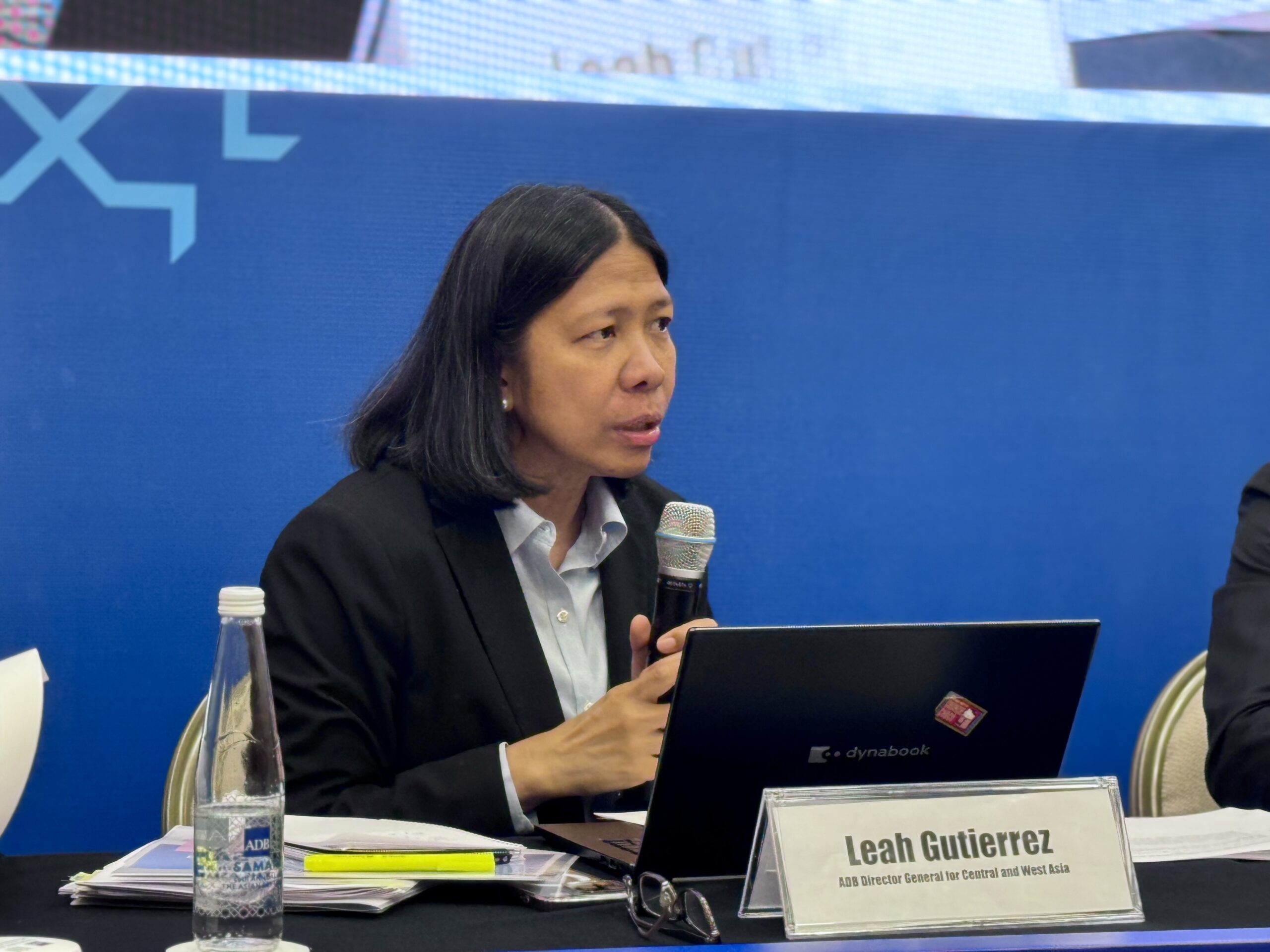
Leah Gutierrez. Photo credit: Assel Satubaldina/ The Astana Times
ADB’s 59th Annual Meeting of the Board of Governors is taking place in Samarkand on May 3-6. Under the theme of Crossroads of Progress: Advancing the Region’s Connected Future, it brings together finance ministers, central bank governors, industry leaders, civil society representatives and media. The gathering is held each year and serves as the bank’s flagship platform to discuss regional economic trends, policy priorities, and development challenges.
The bank plans to invest $70 billion in new energy and digital infrastructure projects by 2035, aiming to connect power grids, expand cross-border electricity trade, and improve broadband access across Asia and the Pacific.
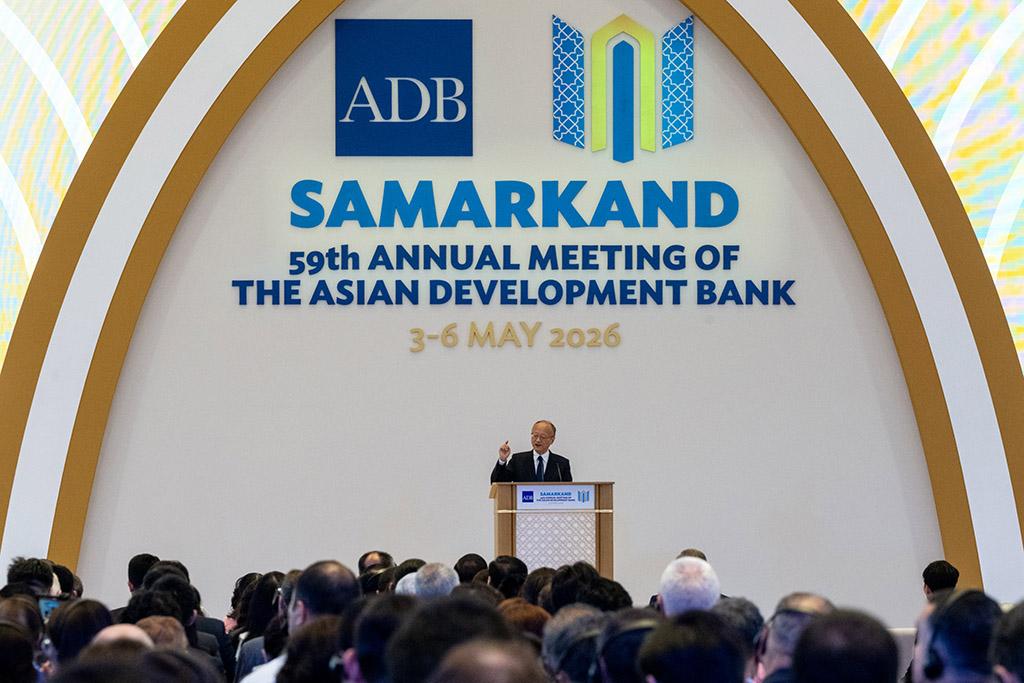
ADB President Masato Kanda. Photo credit: adb.org
“Energy and digital access will define the region’s future,” said ADB President Masato Kanda, presenting the program. “These two initiatives build the systems Asia and the Pacific need to grow, compete, and connect. By linking power grids and digital networks across borders, we can lower costs, expand opportunity, and bring reliable power and digital access to hundreds of millions of people.”
Gutierrez said energy connections across the region and the South Caucasus are largely bilateral. But new projects aim to create a more integrated system.
“Right now, in Central Asia and the Caucasus, interconnections are mainly country to country. If a broader backbone is built and this is where the proposed Caspian Sea Green Energy Corridor comes in, it could serve as a central link where everyone can connect,” Gutierrez said during a May 5 press briefing as part of the bank’s 59th Annual Meeting.
“That would allow countries to start trading power across the region, improving energy security and making electricity supply more reliable,” she added, noting ADB is looking forward to working with member countries to support this effort.
Economic performance across the region
Speaking more broadly about the region’s economic performance, Gutierrez said growth reached 4.6% in 2025, up from 4.2% the year earlier. The figure, however, is expected to ease to 4.2% in 2026 before recovering at 4.4% in 2027.
“Across most of the sub-regions, we saw a high growth and high inflation scenario played out, with growth driven by economic activity in Kazakhstan and other economies and double-digit growth in the Kyrgyz Republic,” she said.
She noted strong momentum across the region but said growth is expected to moderate in Kazakhstan. “Real GDP growth is forecasted to slow down in both years as oil production reaches capacity and private demand softens,” she added.
Inflationary pressures remained strong in 2025, Gutierrez noted, with inflation figures expected to slow down in Kazakhstan stemming from what she described as tight monetary policy.
“The prolonged energy price shock and supply disruptions due to the conflict in the Middle East may lead to higher inflation in the subregion along with heightened macroeconomic vulnerability at least in the short run,” she said.
Risks from the Middle East tensions
Gutierrez emphasized the ongoing escalation in the Middle East represents a new supply shock posing a risk of spilloover effects.
“Since late February 2026, commodity prices have been higher. Higher commodity prices have aided the exporters but hurt importers and further elevated inflation through oil and logistics costs. Risks include tighter global financial conditions, trade logistics disruptions and weaker confidence for foreign direct investment,” she explained.
She advised central banks to “refrain from premature policy tightening but stay vigilant to second round effects”
“Tighten and act decisively if needed. Fiscal support, if required, should be targeted to the vulnerable population and the most affected industries,” she added.
Because the increased fertilizer prices are likely to weigh on agricultural output and elevate food prices, she said boosting domestic food production would be essential.
“In terms of structural priorities, advanced structural reforms in governance and privatization would help lift potential growth and bolster resilience. It would be good to avoid broad stimulus measures, including state-owned enterprise capital expenditure or liquidity injections, which would add to inflation in a supply-constrained environment,” Gutierrez said.
She stressed the region also has significant untapped potential in transport and logistics, highlighting the Trans-Caspian International Transport Route as a key opportunity.
Impact on Kazakhstan is limited
Kazakhstan stands to benefit from higher global energy prices as a major oil exporter, with gains expected in both fiscal revenues and external balances. However, Gutierrez cautioned that these benefits may be limited
“The oil production has plateaued, so this will limit the benefits from the higher prices. There are currently export infrastructure constraints,” she said.
At the same time, risks from a potential global economic slowdown could weigh on demand for hydrocarbons, adding another layer of uncertainty.
Gutierrez underscored that higher energy prices also carry inflationary pressures. Kazakhstan imports a significant share of manufactured goods from energy-importing countries, meaning rising global energy costs can go into domestic inflation through higher import prices.
ADB’s operations in Central and West Asia
Over the past five years, sovereign and nonsovereign commitments from the ADB to Central and West Asia averaged at $5.1 billion annually. Sovereign commitments have been concentrated in public sector management, transport and finance, while private sector operations have focused on energy, finance and agribusiness. The allocation reflects member countries’ priorities, particularly in strengthening regional connectivity.
Gutierrez also noted the bank is expanding its focus on climate finance, particularly in transport and energy, where most funding supports projects and policy reforms aimed at addressing climate change impacts. She added that financing has steadily increased in recent years and is expected to grow further.
Much of this work is coordinated under the Central Asia Regional Economic Cooperation (CAREC) Program, which brings together 11 countries. The platform promotes policy dialogue, supports regional infrastructure pipelines, and advances projects with cross-border impact, particularly in transport corridors that are increasingly being developed into broader economic corridors.
Gutierrez also said the bank is supporting a feasibility study, alongside the Asian Infrastructure Investment Bank, for a proposed Caspian Sea Green Energy Corridor. The project would aim to transport surplus renewable energy from Central Asia to the South Caucasus and onward to Europe via the Black Sea.
Among key highlights of the annual meeting are a new initiative to build critical minerals supply chains, key for batteries, EVs, and clean energy tech, and first disaster relief bonds, targeting risks such as earthquakes and extreme weather in Central Asia.
