
ASTANA – Relations between Kazakhstan and the European Union have reached a state of positive intensity, fueled by high-level diplomacy and a momentum in regional investment, Lithuania’s Ambassador to Kazakhstan Egidijus Navikas said in an interview with The Astana Times.
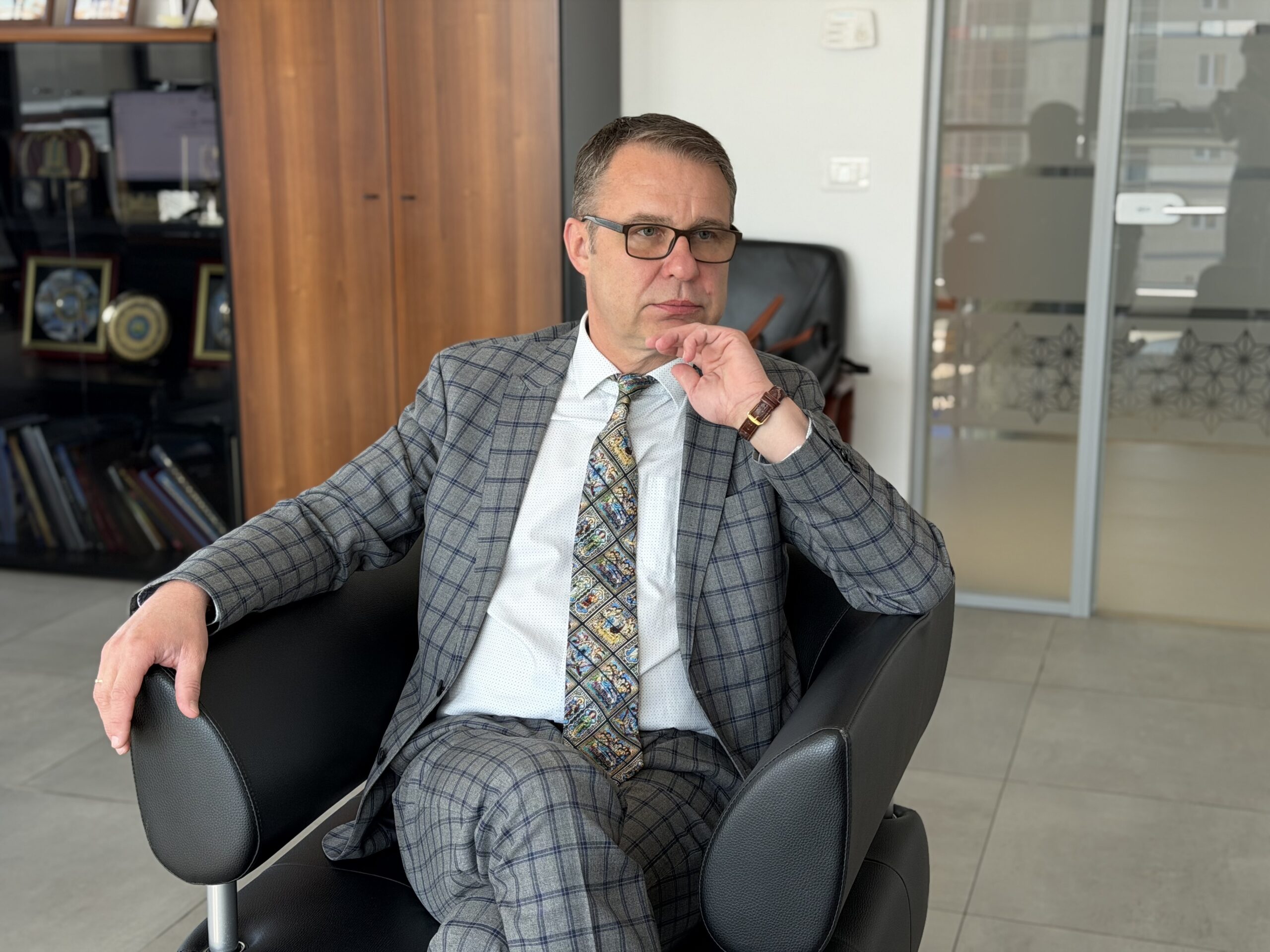
Lithuania’s Ambassador to Kazakhstan Egidijus Navikas. Photo credit: The Astana Times / Nargiz Raimbekova
The ambassador described the trajectory over the past three decades as a gradual but steady intensification of the ties. “The relations are quite intense, in a positive way, intense,” said Navikas.
“A big aspect is economic cooperation. The EU, overall, is the biggest investor in Kazakhstan, as well as the biggest trade partner of Kazakhstan,” he said, adding that maintaining this status while located between Russia and China is a fact that is “quite telling.”
A notable illustration of that deepening engagement is the frequency of high-level visits. Navikas noted that more than 10 heads of state from EU member countries visited Kazakhstan over the past year, reflecting growing engagement between the two sides. At the same time, Kazakhstan’s leadership has maintained regular contacts with Brussels, underscoring a mutual commitment to strengthening ties.
“That is also very important to maintain,” he said. “What is also good is whenever there are some kind of different points of view on some questions, there is also always constructive dialogue and the issues can be constructively addressed and discussed.”
Bilateral trade
Despite a challenging geopolitical climate that has dampened turnover in the last three years, the ambassador described trade between the two nations as “impressive,” anchored heavily by the logistics sector.
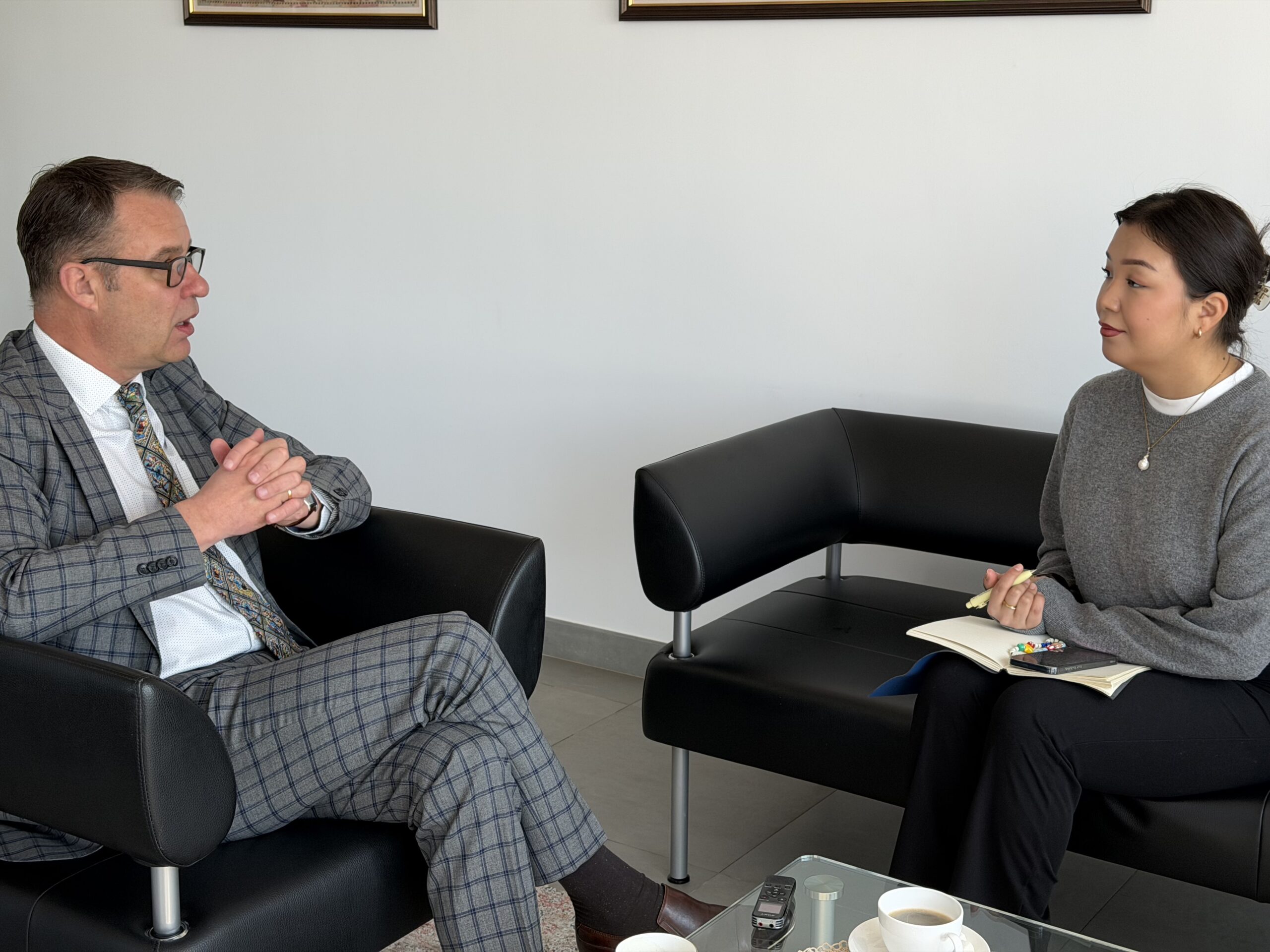
Egidijus Navikas and Assel Satubaldina during a conversation. Photo credit: The Astana Times / Nargiz Raimbekova
According to figures from the Bureau of National Statistics, trade between Kazakhstan and Lithuania hit $140 million in 2025, narrowing from $152 million in 2024. That’s a notable plunge from $585.9 million recorded in 2022.
“One of the most important areas is transport and logistics, including the Trans-Caspian Corridor. (…) There are Lithuanian companies investing in Kazakhstan in the area of transport and logistics. This, of course, means also the trade, because this is about bringing goods here and there,” Navikas explained.
Kazakh companies are encouraged to utilize the Port of Klaipeda on the Baltic Sea.
“It is in our interest that it is used by Kazakh trade companies, mostly those about grain, that you have a lot, and export to Europe as well,” he added.
“I always like to joke in my speech that I have nothing against transport and logistics, but I very much encourage other areas also to open up and develop. But business is business, and it happens when there are potential gains and benefits,” he said.
There is an appetite for further diversification, with opportunities present in food and agriculture, according to Navikas. He pointed out that Lithuanian cheeses and beverages are becoming staples in Kazakh supermarkets.
The ambassador also noted the potential in the digital economy, fintech, and IT.
Digital and first Twinning project
Navikas highlighted two landmark EU-funded initiatives that signal a shift toward high-tech and structural cooperation. Lithuania is a key partner in a 20-million-euro regional project titled Team Europe Initiative (TEI) on Digital Connectivity in Central Asia.
Experts from Lithuania, alongside partners from France, Latvia, Estonia, and Finland, will collaborate on the project to share regional best practices and technical know-how.
“Another EU-funded project is a so-called Twinning project. Twinning means cooperation between specific institutions. In this case, it will be about Kazakhstan’s Constitutional Court, administrative reform and capacity building,” he said.
Budgeted at two million euros, the two-year project will be implemented by Lithuania and Germany. This will be the first Twinning project in Kazakhstan.
Shifting geopolitical landscape
The ambassador bluntly addressed the shifting security landscape in Europe, noting that the “deep shock” felt four years ago has hardened into a policy of self-defense. “In the 21st century, one country attacking another for territory is simply unacceptable,” he said.
A critical pillar of cooperation between Kazakhstan and the EU is dialogue on preventing sanctions circumvention. Following a recent visit with EU Sanctions Envoy David O’Sullivan, the ambassador said the mechanisms in place work well.
“It is not about Kazakhstan joining the EU sanctions regime. It is about preventing circumvention of the sanctions. And it works fairly well. (…) There is already a mechanism established, political will and implementation of these mechanisms by the authorities of Kazakhstan,” he said.
People-to-people contacts
Beyond economics, the ambassador emphasized people-to-people diplomacy through education, visas, and a robust cultural calendar. While political diplomacy often happens behind closed doors, the ambassador noted that culture reaches a broader public.
This outreach is also supported by high-profile events, such as last year’s Mikalojus Konstantinas Čiurlionis exhibition at the National Museum of Kazakhstan in Astana and an upcoming concert by pianist Mūza Rubackytė on April 15 in Astana.
Navikas also mentioned a network of ten honorary consuls across Kazakhstan’s regions that support the growing momentum between the two countries.
A poignant link between the two nations remains the Lithuanian diaspora, with the largest one in Karagandy, the descendants of those deported to Soviet concentration camps, known as Gulags. The ambassador commended the Kazakh government for its support in maintaining historical memory, particularly through the Spassk Memorial, located 30 kilometers from Karagandy, and May 31 as the day of remembrance for political repressions.
“Of course, the majority of those descendants went back to Lithuania during the Soviet occupation, but mostly during the first decade after the 1990s. There are several hundreds remaining here. We maintain good relations with the diaspora there,” said Navikas.
Blend of creative passions
Behind the high-stakes discussions lies a personal philosophy on the nature of diplomacy itself. The ambassador noted that the path to diplomacy was shaped by a blend of early creative passions.
“My dream was always to be a diplomat since my last years in school,” he said. Before that, he considered becoming an actor and a journalist. What might seem, on the surface, worlds away ultimately proved to be the perfect synthesis of the two.
“When I became a diplomat, I understood that I could combine both. Because when you are a diplomat, you have to write a lot and you have to act a lot. Both professions of journalist and actor are within the role of ambassador or diplomat,” said Navikas.
When discussing Lithuania’s national highlights, the ambassador warmly mentioned the nature, the Baltic coast, and its “second religion” basketball.
Navikas also acknowledged that since arriving in Kazakhstan, he has been deeply moved by the local philosophy of hospitality.
“It is not just about a lot of food and a nice dastarkhan [table served with food]. But it is about the sincere approach of the Kazakh people. Wherever I traveled on professional trips or privately, that was always very impressive,” said the ambassador, describing it as a centuries-old mentality to treat guests with a grand gesture of warmth and hospitality.
