
ASTANA – When Yuri Gagarin lifted off on April 12, 1961, from Baikonur Cosmodrome, Kazakhstan became the starting point of the space age — though not yet a space power in its own right. The date would later be marked as Cosmonautics Day, anchoring the country’s place in global space history.

Aida Haidar.
Kazakhstan has long been associated with Baikonur, the legendary launch site of the Soviet space program. But today, the country is trying, deliberately, and not without friction, to build something of its own.
The foundation of that effort was laid in October 1991, when Toktar Aubakirov became the first Kazakh in space, flying aboard Soyuz TM-13 from Baikonur. His mission launched not just a career, but a national trajectory, including early research into biotechnology and the ecology of the Aral Sea region.
He was followed by Talgat Musabayev, whose three expeditions and record-breaking spacewalks secured Kazakhstan a visible place in global space history, and later by Aidyn Aimbetov, whose work aboard the ISS ranged from Coulomb crystal experiments to monitoring Caspian ecosystems.
For years, that was the story: participation, not production. Now, the narrative is shifting.
In Astana, a spacecraft assembly and testing complex, with no real equivalent in Central Asia, marks a move away from dependence on imported systems. Certification by players like Airbus Defence and Space and a localization level of around 30% suggest that Kazakhstan is beginning to assemble, not just operate, its space assets.
Export contracts for Earth observation systems to countries like Congo and Nigeria point in the same direction. So does the development of the OTS-Sat technological satellite within the Organization of Turkic States, and ongoing work on components that could eventually support ultra-light launch vehicles.
If you want to see what that transition actually looks like, beyond strategy papers, it’s happening on factory floors and inside clean rooms. In the special episode for The Astana Times YouTube channel, we go inside one of Central Asia’s most advanced aerospace facilities, follow how satellites are assembled, and speak directly with the engineers trying to close that gap.
An industry that is starting to pay off
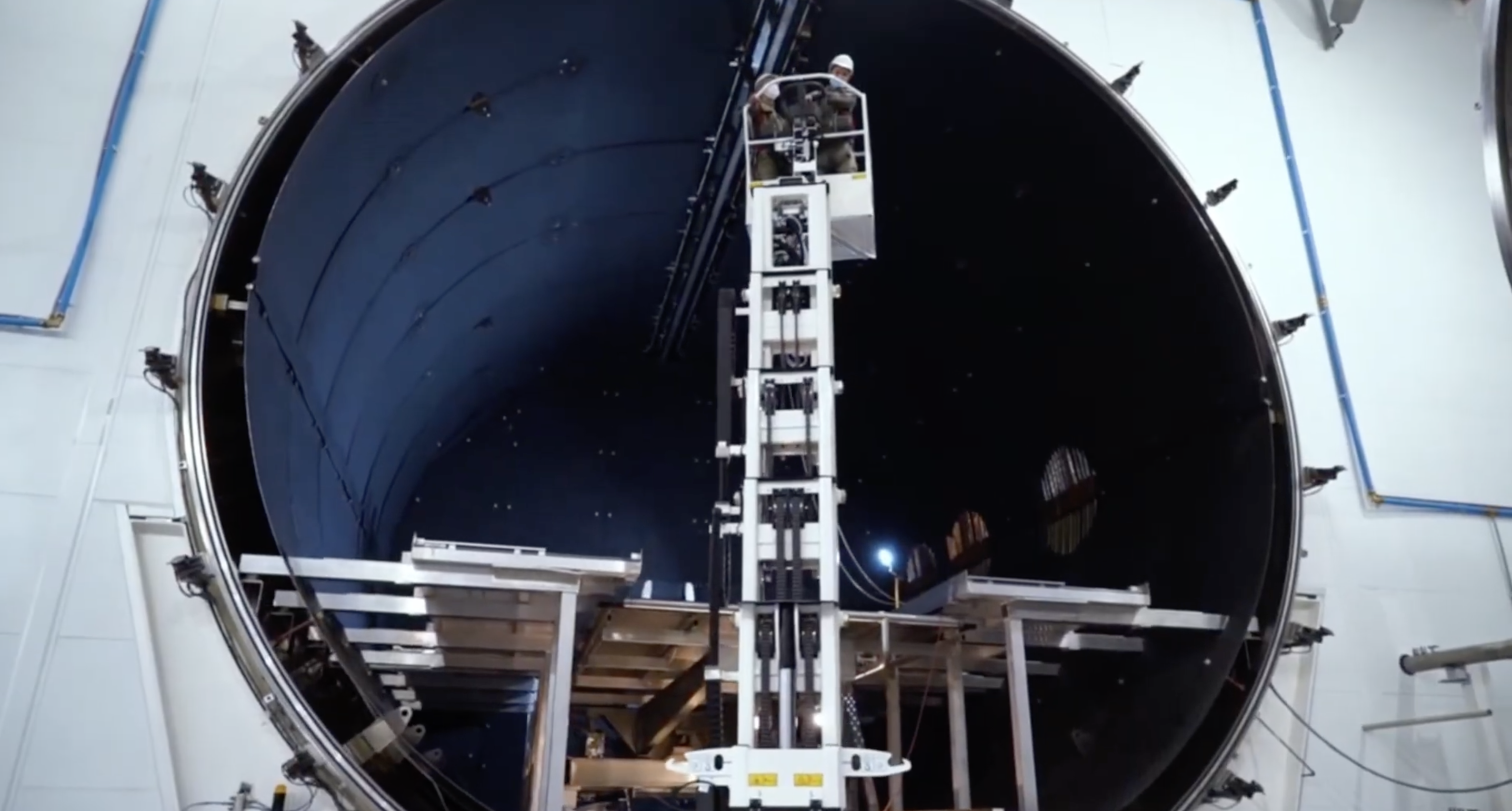
In our special episode, we find out what does this transition actually look like on the ground beyond strategy papers and announcements?
Photo credit: The Astana Times
The economic footprint is no longer theoretical. Over the past five years, space-based monitoring services have generated 977 billion tenge (US$2 billion) in economic impact. The KazSat satellite constellation now fully covers national demand for communications and broadcasting, reducing reliance on foreign systems by more than 120 billion tenge (US$254 million), with KazSat-3R expected to secure that infrastructure going forward.
Space is also quietly becoming part of everyday life. Around 1,000 rural schools are connected to the internet via Starlink, while satellite-enabled systems support emergency response, logistics, and environmental monitoring.
Kazakhstan is also looking further out. Scientists are participating in missions such as DART mission with NASA, while a national space surveillance system: currently 12 telescopes, with plans to expand to 30, is being integrated into global monitoring networks. There are also lunar ambitions, including plans for a near-lunar telescope.
Meanwhile, Baikonur itself is being redefined. Under the sector’s development roadmap through 2029, modernization continues, including the Baiterek project to launch the Soyuz-5 rocket in 2026 and efforts to turn the site into a tourism destination through projects such as QAZCOSMOS.
The other bottleneck: people
Infrastructure alone won’t get Kazakhstan there. A quieter but equally telling shift is happening on the human side. In October last year, the National Space Center completed SANA-1 — Kazakhstan’s first long-duration space simulation, placing an all-female crew in isolated, mission-like conditions. The experiment tracked physiological, cognitive, and emotional adaptation, but it also signaled something broader: a deliberate effort to expand who participates in building the country’s space sector.
That focus carried into Cosmonautics Day this year. The SPACE4WOMEN Kazakhstan event, held at the Ionosphere Institute on April 13, brought together scientists, engineers, and students to discuss not just achievements, but access — who gets to build this industry, and who still doesn’t.
The flight of Kazakhstan’s first female astronaut Danna Karagussova, as part of the crew of Blue Origin’s New Shepard on its 15th human flight in October 2025, was framed not just as a milestone but as a signal. The pipeline needs to be widened.
“Astronomy begins with a simple human act — looking at the sky. Science has no gender; it requires curiosity, persistence, and openness to the unknown,” said astrophysicist Dana Alina.
That next generation is already showing up. A team of Kazakh students, YURT from Nazarbayev Intellectual School, recently won NASA’s Space Settlement Contest with a concept for a 30,000-person orbital station near Jupiter.
While these ambitions may still be some way from becoming reality, they reflect a broader direction of travel. Much like Gagarin’s flight was not just about one man but about humanity’s first step into space, Kazakhstan’s strategy today is aiming for something bigger than incremental progress.
The country is trying to move beyond its inherited role: to become more than just the place rockets take off from. Whether it succeeds is still an open question.
Because becoming a country that designs, builds, and exports space technology at scale remains a work in progress. One that will require not just ambition, but sustained investment, hard choices, and, perhaps most importantly, a clear understanding of how far there is still to go.
