
ASTANA – Kazakhstan is making another effort to reintroduce Turan tigers into the wild, with four Amur tigers expected to arrive from Russia this year as part of a broader effort to rebuild a sustainable population in their historical habitat.
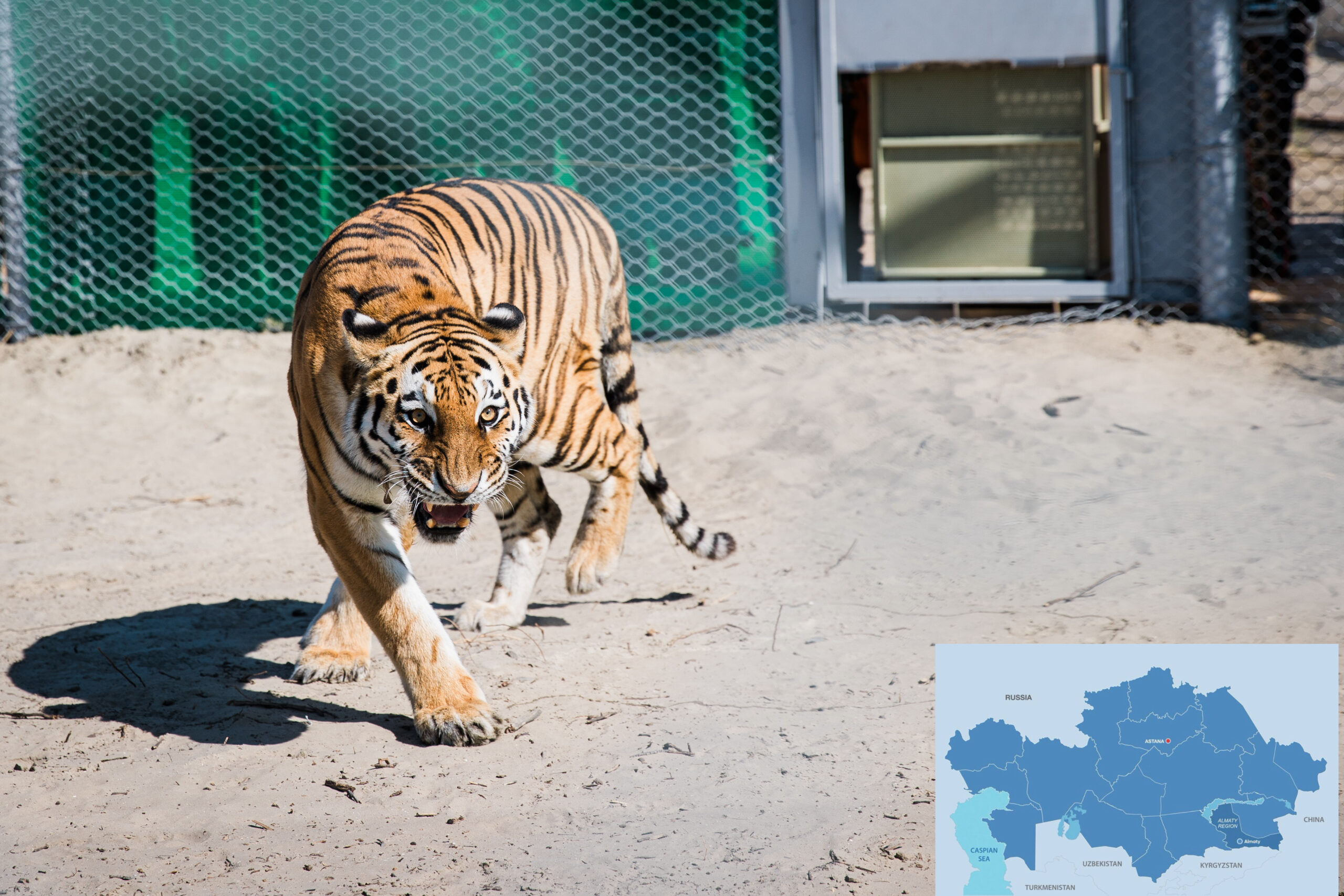
Amur tigers’ offspring are expected to grow into wild tigers, marking the species’ return to Kazakhstan after more than 70 years. Photo credit: wwfcentralasia.org Click to see the map in full size. The map is designed by The Astana Times.
The initiative aims to establish a self-reproducing tiger population in the Ile-Balkhash region in southeastern Kazakhstan over the next several years, restoring ecosystems and securing the long-term survival of the species in Kazakhstan, the Kazakh Forestry and Wildlife Committee told The Astana Times.
“The transport of these tigers is being carried out under a bilateral agreement between Kazakhstan and the Russian Federation. Their arrival is currently being coordinated by the relevant government departments of both countries and forms part of an intergovernmental project,” said the committee in a written comment.
The project builds on a 2017 memorandum signed by the government of Kazakhstan and the World Wide Fund for Nature (WWF) to revive the Turanian tiger population, also known as the Caspian tiger.
How did tigers vanish?
By the start of the 21st century, tigers remained in just 13 countries worldwide, according to the WWF. Their decline was driven largely by targeted extermination, including uncontrolled hunting of ungulates, the tiger’s primary prey, and later, by the destruction of habitats due to large-scale irrigation projects. The global drop in tiger populations led those 13 countries to come together and launch the Global Tiger Initiative.
The last confirmed records of Turan tigers in Central Asia date back to the 1970s, while in Kazakhstan, the species was last recorded as early as 1948.
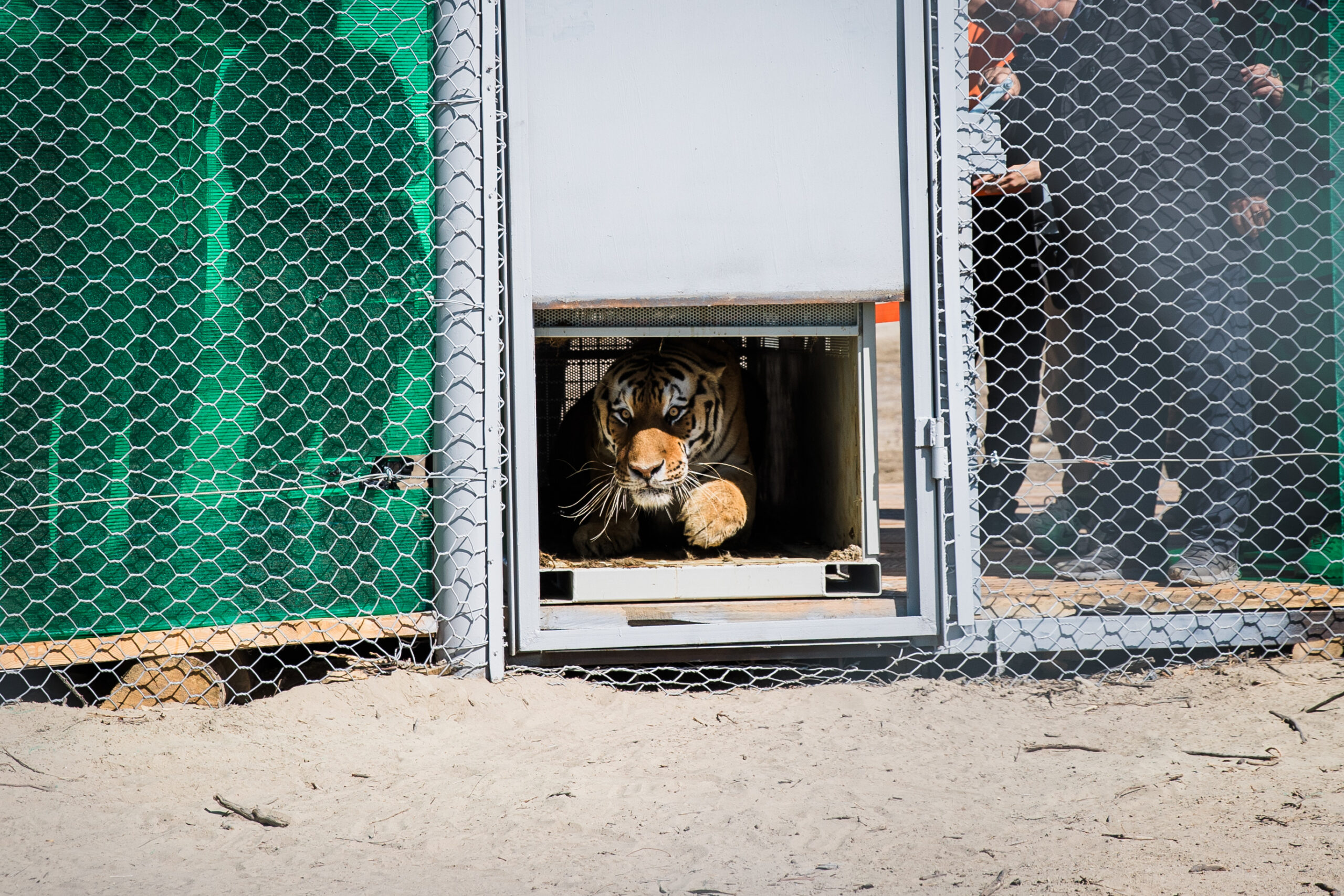
In the early 20th century, Turan tigers ranged from the Caucasus to the Altai and across Central Asia. But habitat destruction, particularly of river ecosystems, along with human pressures such as hunting and deforestation, ultimately drove it to extinction in the region. Photo credit: wwfcentralasia.org
Kazakhstan announced its readiness to return the species to the wild at the first International Tiger Conservation Forum in St. Petersburg in 2010. In 2017, following joint research by scientists from Kazakhstan and Russia, among other countries, a dedicated reintroduction program identified the Ili River delta and the southern Balkhash region as the most suitable site for restoring the extinct Caspian tiger.
In 2018, Kazakhstan established the Ile-Balkhash State Nature Reserve to rebuild the ecosystem, alongside efforts to restore the tiger’s natural prey base. The reserve spans more than 415,000 hectares and covers part of the Ili River delta, tugai and saxaul forests, and wetlands along the southern shore of Lake Balkhash.
Why the Amur tigers?
Officials explain the choice of the Amur tiger is rooted in science. In 2009, genetic research showed that the extinct Turan tiger and the Amur tiger are virtually identical, paving the way for plans to restore the species in Central Asia. Early signs suggest the animals can adapt.
“Two Amur tigers, a male named Kuma and a female named Bogdana, are currently housed at the Ile-Balkhash State Nature Reserve. They were transferred from the Netherlands in September 2024 as part of cooperation with the Landgoed Hoenderdaell and the Stichting Leeuw,” said the committee.
“Under the coordination of reserve specialists, the World Wildlife Fund and the Jolbarys Association, the animals have successfully adapted, displaying stable behavior and good overall condition, which reinforces confidence in the project’s viability,” it added.
Building a habitat from scratch
Reintroducing a top predator, such as a tiger, requires rebuilding the entire food chain. Kazakh authorities said significant groundwork has already been done.
“As part of the program, efforts to create the conditions necessary for tiger reintroduction began with the establishment of the Ile-Balkhash reserve. During this period, 119 kulans have been introduced to the reserve, along with the release of around 200 Bukhara deer into the wild,” said the committee.
Other biotechnical measures include the construction of enclosures to boost ungulate populations, the installation of automated watering systems, and the provision of feed to support the adaptation of relocated animals.
According to the committee, monitoring shows growing populations of key species, including wild boar, one of the tiger’s primary food sources.
“According to surveys and scientific assessments, the current density of key prey species within the reserve is sufficient for the reintroduction of the tiger,” said the officials.
Support from international partners
When asked about the program’s budget and who allocates the financing, the committee said the tiger reintroduction program is being implemented with support from international partners, including the WWF and the United Nations Development Programme. A significant share of funding is provided by WWF, with the remainder coming from the UNDP and Kazakhstan’s state budget through the management of the Ili-Balkhash State Nature Reserve.
Monitoring and safety concerns
Once in Kazakhstan, the tigers will first be placed in specially built enclosures for adaptation. During this stage, experts will monitor behavior, diet., including a concrete portion of meat, and health using 24/7 video surveillance.
“Regular veterinary and biological assessments will be carried out in parallel with the involvement of international experts. This will allow for the timely identification of significant risks and ensure the animals remain in stable, healthy condition,” said the committee.
When released, tigers will continue to be monitored in the field using satellite GPS collars, camera traps, and ground observation. “Constant oversight will be conducted by Kazakh specialists from the Ile-Balkhash State Nature Reserve, the Jolbarys Association and the Institute of Zoology,” said the committee.
Safety concerns
There are also concerns about implementing safeguards to protect populated areas and nearby communities. According to the committee, these GPS collars are equipped with “virtual fence” technology that sends alerts if animals approach buffer zones or populated areas.
“At the same time, the frequency of coordinate transmission is increased, enabling the animal’s movements to be tracked almost in real time. In addition, a backup satellite tracker is fitted to the collar strap, providing an additional communication channel,” said the Kazakh officials.
Authorities have also established rapid-response anti-conflict teams trained to intervene if tigers stray beyond designated areas. The reserve inspectors regularly train, including in tigers’ habitat in Russia’s Khabarovsk region.
“If a signal indicates that an animal has moved beyond its designated range, a response protocol is turned on: patrols are intensified, relevant authorities and local residents are notified, and anti-conflict teams are deployed to the area of potential movement,” said the committee.
“If necessary, established response measures are implemented, including steering the animal away from high-risk areas or in some cases, temporarily removing it and placing it in an enclosure under the supervision of specialists,” it added.
If successful, the project would stand as a rare example of large-scale predator restoration, bringing back a species that once moved through Central Asia’s valleys and forests. Restoring lost biodiversity is possible, but only with sustained commitment, science and a bit of political will.
