
ALMATY – Kazakhstan’s growing strategic role in the development of the Middle Corridor and broader Eurasian connectivity was highlighted during a presentation of an analytical report at the National Press Club in Washington on Feb. 10, reported the Ministry of Foreign Affairs.
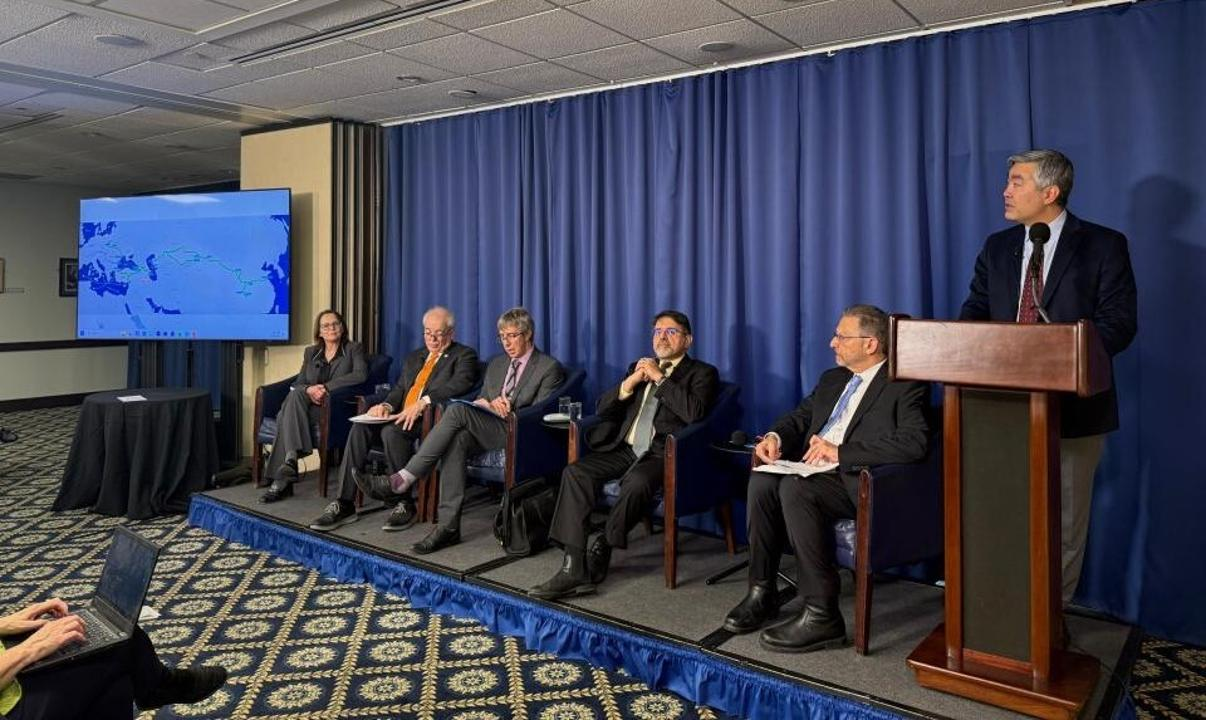
Kazakhstan’s Ambassador to the U.S. Magzhan Ilyassov, emphasized that the expansion of East–West transport and logistics routes supports long-term goals of sustainable economic growth. Photo credit: Ministry of Foreign Affairs.
The report focused on Eurasia’s transit potential, including the Middle Corridor and the Trump Route for International Peace and Prosperity (TRIPP). The event brought together representatives of the United States government along with leading experts from policy and academic circles.
Kazakhstan’s Ambassador to the U.S. Magzhan Ilyassov, emphasized that the expansion of East–West transport and logistics routes supports long-term goals of sustainable economic growth, stronger regional connectivity, and the diversification of global supply chains.
He noted that Kazakhstan continues to enhance its transit and logistics capacity through major investments in the modernization of railways, port infrastructure, and digital systems, as well as by improving trade facilitation and customs procedures.
Speakers at the event described Kazakhstan as one of the U.S.’s key partners in Central Asia, citing its institutional stability, strategic vision, and ability to play a system-forming role in advancing regional connectivity and investment initiatives.
U.S. experts stressed that amid shifting geopolitical dynamics and the reconfiguration of global trade routes, the strategic importance of the Middle Corridor has increased. The route is increasingly viewed as a major overland link between Asia and Europe, offering shorter delivery times and more resilient supply chains.
In this framework, Kazakhstan was identified as the central link in the corridor, ensuring both reliability and long-term development of the route.
Particular attention was also given to Kazakhstan’s role in supporting secure supply chains for critical minerals and energy resources. Experts noted that Kazakhstan and other Central Asian countries hold substantial reserves of materials essential for high-tech industries and are placing greater emphasis on developing domestic processing and manufacturing capacity.
Participants emphasized that Eurasian connectivity is no longer just a matter of transport and trade. It is increasingly seen as a driver of economic diversification, stronger sovereignty, and long-term resilience for countries across the region.
Connectivity linking Central Asia, the South Caucasus, the Black Sea region, and Western markets was described as a key component of an emerging interregional economic framework.
