
ALMATY – The National Bank of Kazakhstan (NBK) has decided to keep its base interest rate at 18%, citing persistent inflationary pressures and elevated uncertainty in both domestic and external conditions, reported the bank’s press service on Jan. 23.
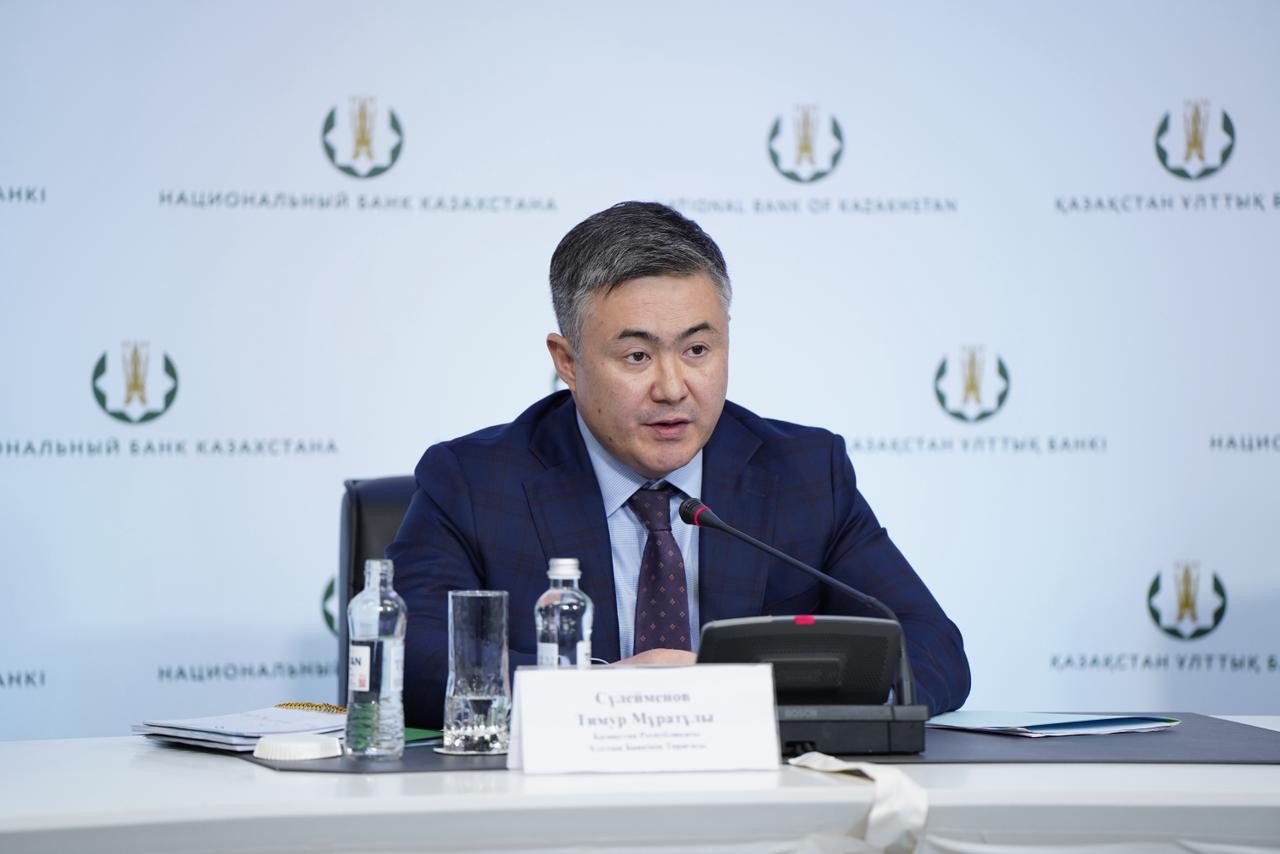
National Bank Governor Timur Suleimenov. Photo credit: NBK.
According to the NBK’s Monetary Policy Committee, inflation reached 12.3% in 2025, fully in line with the central bank’s forecast. The main driver remains food inflation, which stood at 13.5%, reflecting rising production costs and strong export demand, particularly for meat and vegetable oil. Non-food inflation eased slightly to 11.1%, supported by the strengthening tenge, while inflation in paid services slowed to 12% following administrative reductions in regulated utility tariffs.
Monthly inflation accelerated to 0.9% in December 2025, while core inflation remained elevated at 0.8%, indicating sustained price pressures amid strong domestic demand that continues to outpace supply.
Inflation expectations and external risks
Inflation expectations among the population rose to 14.7%, remaining volatile, while professional market participants revised their 2026 inflation outlook upward to 10.8%. The NBK noted that secondary effects from tariff reforms and fuel market liberalization continue to feed into expectations and prices.
Externally, global food prices remain elevated despite recent moderation, with continued growth in grain and sugar prices. Inflation in Russia has slowed under tight monetary conditions, while the European Union continues to record low inflation. In the United States, the Federal Reserve is gradually cutting rates but warns of rising inflation risks linked to trade policy. Meanwhile, escalating geopolitical tensions are increasing uncertainty and adding to global inflationary risks.
Economic growth remains strong
Kazakhstan’s economy grew by 6.5% in 2025, driven by strong performance in transportation, construction, trade, and mining and manufacturing. The NBK emphasized that pro-inflationary risks remain largely domestic, including demand-side pressures, lingering effects of regulated price increases, fuel costs, and uncertainty surrounding large-scale quasi-fiscal stimulus.
Additional risks stem from the implementation of tax reform, including a potential increase in the value-added tax (VAT) rate and expansion of the taxpayer base, which may affect business adaptation in the coming quarters.
Base rate near its peak, says NBK governor
Speaking at a briefing on Jan. 23, NBK Governor Timur Suleimenov said the current base rate is likely close to its practical maximum.
“There is no specific ceiling for the base rate. However, based on our analytical tools and models, we understand the limits of its effectiveness. The current level is probably the most optimal in recent history and is close to the maximum,” he said.
He stressed that the central bank must remain flexible amid external shocks and unforeseen developments.
“The economy can present unexpected challenges, especially given the external environment. We must be prepared for different scenarios,” Suleimenov added, noting that the current rate reflects macroeconomic, market, and fundamental conditions expected over the next year.
The NBK said the balance of risks and inflation dynamics supports a cautious, balanced monetary policy, with a high likelihood that the base rate will be maintained at its current level through the first half of 2026.
The central bank will continue monitoring price dynamics and assessing the effectiveness of joint government measures under the 2026–2028 Macroeconomic Stabilization and Welfare Program, as well as broader anti-inflation initiatives. The next scheduled decision on the base rate will be announced on March 6.
