
ASTANA – Kazakhstan entered 2026 with a renewed focus on political reforms and governance priorities following President Kassym-Jomart Tokayev’s address at the kurultai in Kyzylorda on Jan. 20.
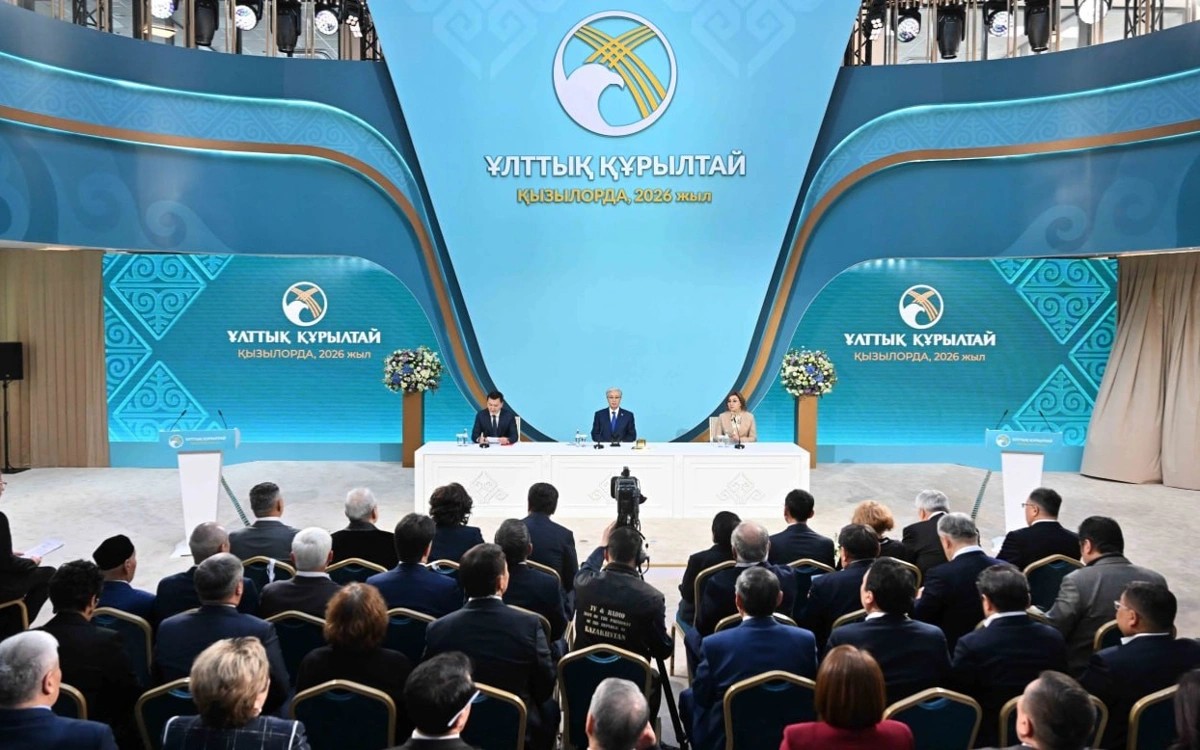
President Kassym-Jomart Tokayev presented several institutional initiatives in his address at the National Kurultai in Kyzylorda on Jan. 20. Photo credit: Akorda
In his January interview, Tokayev described the coming year as decisive, citing a planned constitutional reform referendum and large-scale amendments comparable to adopting a new constitution.

Ljubica Vasić, former deputy foreign minister of Serbia.
Ljubica Vasić, the former deputy foreign minister of Serbia, said Tokayev’s interview went beyond a traditional media format and should be read as a programmatic statement.
“It brings together domestic reforms, social values, security issues and foreign policy into a coherent vision against the backdrop of rapid global change. It summarizes the path already taken, diagnoses existing challenges and outlines the next stage of development,” Vasić said.
She noted that a central theme of the interview was the role of the state as the guarantor of order, justice and institutional stability. “Tokayev noted that building a fair and sustainable society is impossible without a strong state, the rule of law, and equality of all citizens before the law,” she said.
Vasić also spoke about social policy, describing Kazakhstan as positioning itself clearly as a social state committed to healthcare, education, science and culture. At the same time, she said, Tokayev openly acknowledged systemic distortions, particularly in private education and healthcare, where public funding has at times drifted away from public interest.
“Tokayev made it clear that social support must not become a source of parasitism, fraud or inequality and that the state will consistently restore order in the system of benefits and payments, regardless of the sensitivity of certain issues,” Vasić said.
Institutional reforms
At the kurultai, Tokayev presented several institutional initiatives, including a transition to a unicameral parliament, the creation of the post of vice president and the establishment of the Khalyk Kenesi, or People’s Council.
For Riccardo Pelizzo, a professor at Nazarbayev University’s Graduate School of Public Policy, the shift to a single-chamber legislature is designed to improve efficiency.

Riccardo Pelizzo, a professor at Nazarbayev University’s Graduate School of Public Policy. Photo credit: The Nazarbayev University
“My impression is that the reform will make the whole government more efficient. Law-making in bicameral systems can be slow and time-consuming. Removing the second chamber should speed up the process,” he said.
Pelizzo added that a unicameral system does not automatically weaken checks and balances.
“In some bicameral systems, both chambers are controlled by the same political forces, which limits effective oversight. Historically, the second chamber was designed to balance the lower house rather than the executive. A clearer, more streamlined system can also improve accountability to voters,” he said.
Tokayev also proposed creating a vice president position, appointed by the president with parliamentary approval. The vice president would represent Kazakhstan internationally and work with Parliament and domestic and foreign organizations.
Pelizzo welcomed the proposal, saying parliamentary confirmation would strengthen the office’s legitimacy.
“Having a Vice President will allow the President to do more, it will secure greater policy continuity and political stability, as the Vice Presidency can be used to groom or prepare the next President as it has historically been done in several other jurisdictions,” he said.
People’s Council and public participation
The proposed People’s Council would assume key functions of the Assembly of the People of Kazakhstan related to interethnic and interfaith harmony, while also developing policy proposals and promoting state ideology. It would be granted the right of legislative initiative.

Jessica Neafie, assistant professor at Nazarbayev University. Photo credit: The Nazarbayev Universtity
Jessica Neafie, an assistant professor at Nazarbayev University, noted that the initiative could broaden consultation in domestic policymaking, particularly on social cohesion.
“However, its potential value depends on whether it will operate with genuine independence and transparency. Without clear safeguards and separation from the existing political structure, there is a risk that it functions more as a symbolic forum than as a meaningful channel for policy input,” Neafie said.
She highlighted that the council would need legal autonomy, transparent appointment procedures and clearly defined powers to play a real accountability role.
“It should be able to propose legislation, request parliamentary inquiries and require formal responses from the president,” she said, warning that excessive presidential influence could limit its effectiveness.
Digitalization and energy challenges
Neafie also commented on Tokayev’s emphasis on digitalization and artificial intelligence, noting that while the focus reflects global trends, governance challenges cannot be solved by technology alone.
“The growing focus on data centers raises important environmental and energy questions. Digital infrastructure must be planned sustainably, as technological growth is not an end in itself,” she said.
She warned that Kazakhstan’s environmental goals could be undermined if rising electricity demand is met primarily through coal-based power generation.
“Without grid modernization and stronger renewable targets, digital expansion risks increasing emissions,” Neafie said.
She suggested prioritizing wind energy, upgrading infrastructure and requiring data centers to invest in clean power sources to align digital growth with sustainability goals.
Neafie noted that the proposed reforms point to incremental change rather than a fundamental transformation, with their success ultimately depending on implementation and governance practices rather than institutional design alone.
Aviation as a strategic priority
Professor Essam Shehab, the head of the Mechanical and Aerospace Engineering Department at Nazarbayev University, said Tokayev’s address sent a strong signal that aviation is becoming a national priority.

Professor Essam Shehab, head of the Mechanical and Aerospace Engineering Department at Nazarbayev University. Photo credit: The Nazarbayev University
“Kazakhstan has enormous aviation potential due to its geographic position between Europe and Asia and its vast territory. But this potential can only be realized through strategic coherence, professional management, fair fuel pricing and sustained investment in people and technology,” Shehab said.
He noted that modern aviation hubs depend on long-term planning, integrated infrastructure, skilled personnel and efficient logistics systems.
“Cargo aviation is part of a complex global supply chain that includes airports, customs, digital platforms, fuel supply and maintenance services. Without coordination across these elements, it is impossible to compete with established hubs,” Shehab said.
Fuel pricing, he added, is a critical factor for competitiveness.
“Kazakhstan is an oil-producing country with refining capacity, so it should be able to offer competitive jet fuel prices. If fuel costs are higher than in other transit hubs, that immediately undermines our attractiveness for international carriers,” he said.
According to Shehab, rather than competing directly with major hubs such as Dubai or Istanbul, Kazakhstan should focus on niche strengths.
“The most realistic opportunity lies in high-value cargo transit between East Asia and Europe, as well as technical stopovers, cold-weather operations and specialized maintenance services. With the right coordination, Kazakhstan can position itself as a reliability-focused, technically strong alternative,” he said.
