
ASTANA – President Kassym-Jomart Tokayev outlined Kazakhstan’s ongoing political reforms, foreign policy priorities, and digital transformation agenda during the National Kurultai (Congress) in Kyzylorda on Jan. 20, stressing national unity amid global uncertainty.
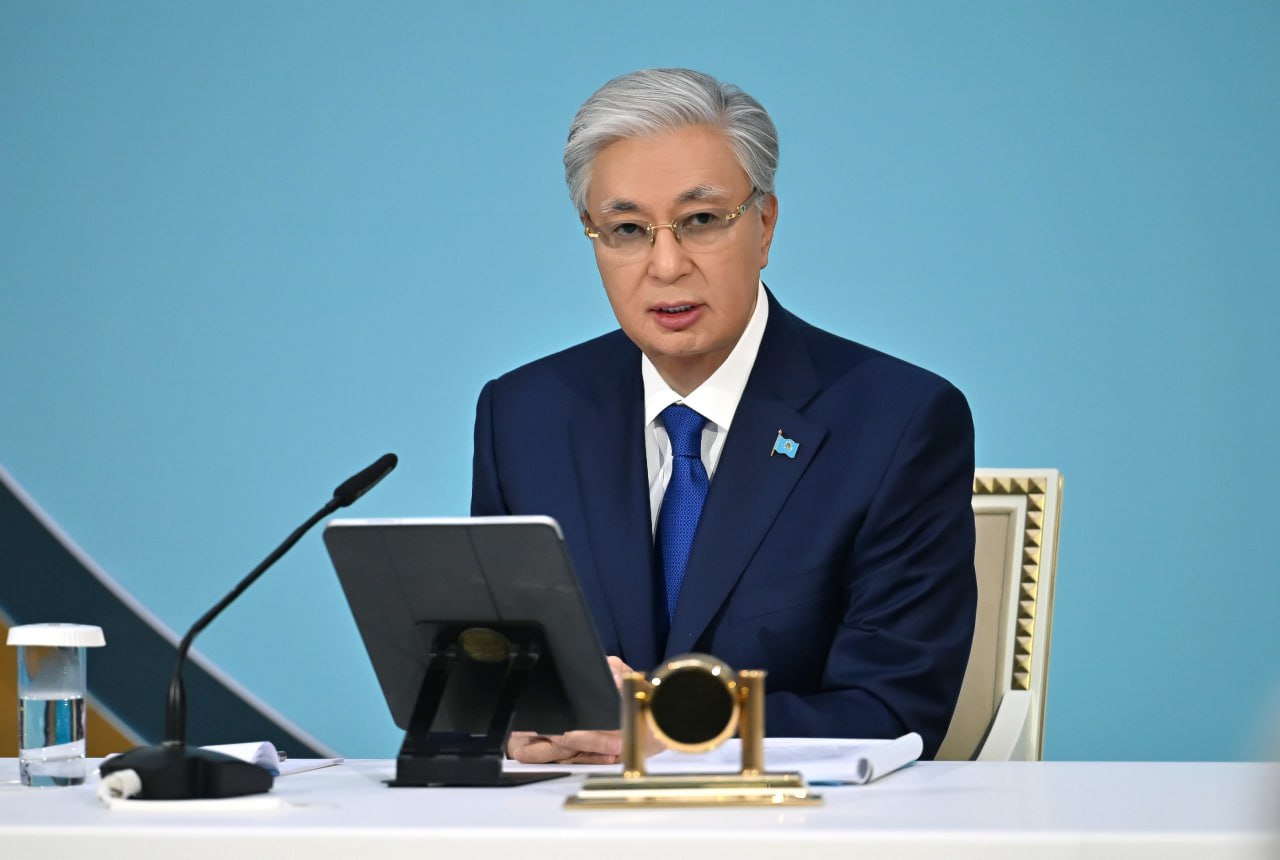
Kassym-Jomart Tokayev proposed establishing the office of vice president during the Jan. 20 National Kurultai in Kyzylorda. Photo credit: Akorda.
Constitutional reform and referendum
Tokayev said the reforms launched in 2022, together with upcoming initiatives to be submitted to a national referendum, mark a transition from the 1995 constitutional model to a fundamentally new system. He emphasized that public support for these changes would lead to a renewal of Kazakhstan’s political system and strengthen long-term stability.
According to Tokayev, the proposed reforms include a move toward a unicameral Parliament, to be named Quryltai; the creation of the Khalyk Kenesi (People’s Council); and the establishment of the position of vice president, reported Akorda.
Khalyk Kenesi (People’s Council)
Tokayev said the People’s Council would assume key functions of the Assembly of the People of Kazakhstan in the areas of interethnic and interfaith harmony, while also focusing on developing proposals to improve domestic policy and promoting and explaining matters related to state ideology. It would be granted the right of legislative initiative. The People’s Council would also be responsible for organizing the Congress of Leaders of World and Traditional Religions.
Presidential succession and vice presidency
Tokayev highlighted the need to regulate presidential succession in the Constitution clearly. He said that if a president’s term is terminated early, presidential elections must be held within two months, ensuring that any head of state comes to power exclusively through elections. He described this principle as fundamental and non-negotiable.
As part of the reforms, Tokayev proposed establishing the office of Vice President, to be appointed by the President with the consent of the Parliament. The Vice President would represent Kazakhstan internationally, work with Parliament, engage with domestic and foreign organizations, and perform other duties assigned by the President. These responsibilities, he noted, should be explicitly reflected in the Constitution.
Tokayev stressed that these amendments would not weaken presidential power, but rather clarify the governance structure and stabilize the state system. Kazakhstan, he said, would continue developing as a presidential republic.
The reforms also envisage the abolition of some administrative structures supporting the current Parliament and the post of State Counselor, alongside reforms to the Presidential Administration to better reflect practical needs.
Economic integration and national interests
Turning to economic policy, Tokayev said Kazakhstan supports economic integration but will firmly defend its national interests, especially amid global tensions. As chair of the Eurasian Economic Union (EAEU) this year, Kazakhstan will prioritize eliminating trade barriers, combating unjustified protectionism, and expanding the use of artificial intelligence to enhance integration efficiency.
He expressed concern over pressure on Kazakhstan’s agricultural processing sector from subsidized imports within the EAEU, calling it a matter of food security and urging the government to act more decisively to protect domestic producers.
Foreign policy in a changing world
Tokayev noted that international relations are undergoing profound changes, marked by declining trust, erosion of international law, and rising global militarization. In this context, he said Kazakhstan’s foreign policy must remain balanced and focused on safeguarding national interests.
He underlined that diplomatic decisions carry long-term consequences and must be made with professionalism and caution. Diplomacy, he said, should serve as a tool for compromise rather than confrontation.
Digitalization and artificial intelligence
President Tokayev emphasized that digitalization and artificial intelligence are reshaping global realities, diminishing the importance of population size and rewarding countries that adapt quickly and strategically. He said Kazakhstan has chosen a path of accelerated digitalization and AI adoption across all sectors.
At the same time, Tokayev warned that technology alone cannot resolve poor governance. According to him, effective digital transformation requires streamlined management processes, improved organizational culture, and modern management practices in the public sector.
He also highlighted the need for a strong infrastructure base for the future digital and energy-intensive economy, including the early designation of zones for high-capacity data centers with reliable power, cooling, and security systems.
