
ASTANA — Kazakhstan is projected to maintain economic growth in 2026, but at a slower and more balanced pace amid inflationary pressure and tighter financial conditions. According to experts, the country is entering a phase where efficiency and investment quality will matter more than rapid expansion.

Photo credit: Shutterstock
“I am sure that Kazakhstan will gradually move away from raw material dependence, even if not next year. The share of manufacturing and domestic demand is increasing, while the state is strengthening the role of private capital in investment projects,” said financial analyst Rassul Rysmambetov.
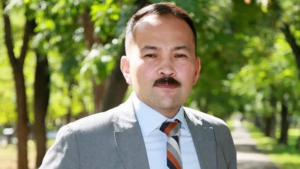
Rassul Rysmambetov, a financial analyst. Photo credit: Kazinform
He expects Kazakhstan’s economy to grow by 4-4.5% in 2026, despite external risks and commodity market volatility. He said infrastructure projects, digitalization of the public sector, and deeper industrial processing will remain the main growth drivers.
Rysmambetov also noted that growth will remain uneven due to continued reliance on oil exports and exposure to logistical risks, including Caspian routes and the Caspian Pipeline Consortium (CPC). He added that new regional projects, including transport corridors, energy initiatives, and agro-industrial clusters, are expected to begin delivering tangible economic benefits as early as 2026, particularly in central and northern regions such as Kostanai.
“I expect the country to enter a phase of moderate but sustainable growth, where the main driver of development will be efficiency rather than subsidies. It is also important that, in long-term planning, the focus moves away from relying solely on the indicator of GDP volume,” said Rysmambetov.
National Bank outlook and structural constraints
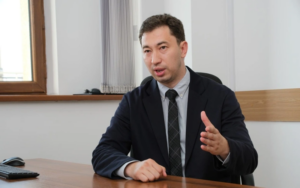
Economist Bauyrzhan Shurmanov. Photo credit: Kazinform
Economist Bauyrzhan Shurmanov agrees with the assessment presented by the National Bank of Kazakhstan (NBK) in its updated Monetary Policy Report, which, he said, outlines the key constraints facing the economy ahead of 2026.
“The economy is shifting from this year’s high growth rates to a more moderate trajectory. This is inevitable given overheated demand, high inflation, and tighter financial conditions. A baseline growth forecast of 3.5-4.5% looks realistic,” said Shurmanov.
According to him, domestic consumption is expected to slow, while industry, extractive sectors, and infrastructure projects are likely to remain relatively stable, leading to uneven growth across the economy.
Inflation and interest rate trajectory
Rysmambetov forecasts that inflation will slow slightly to 10-11% in 2026, supported by tariff adjustments, lower food price volatility, and stronger domestic supply. He expects the NBK to begin gradually easing monetary policy in the second quarter of 2026.
“I expect the base rate to decline from the current 18% to around 16-17%. This could revive investment and credit demand without putting pressure on the foreign exchange market,” he said.
However, he also noted that inflation expectations remain fragile. Without structural reforms in public procurement and tariff regulation, inflation risks could quickly intensify, limiting the long-term impact of rate cuts.
Shurmanov, by contrast, sees a more complex inflation path. He cited VAT increases, tariff changes, and fuel market liberalization as persistent sources of price pressure. He said that inflation forecasts in the 9.5-12.5% range reflect these risks.
“In such conditions, a near-term rate cut is unlikely. (…) If inflation begins to slow sustainably only by midyear, room for easing may appear no earlier than the second half of the year, and even then only gradually,” said Shurmanov.
Tenge outlook: stability with volatility risks
Rysmambetov expects the tenge to trade broadly within its 2025 range, supported by foreign exchange reserves and a current account surplus.
“I do not expect a sharp weakening. Gold and foreign exchange reserves and the current account surplus ensure relative stability. At the same time, strengthening of the tenge is possible only with growth in real exports and a reduction in carry trade, which currently supports the exchange rate artificially,” he said.
However, Shurmanov highlighted the risk of a widening current account deficit, which could gradually weaken the national currency. While high interest rates continue to attract capital inflows, such flows remain sensitive to shifts in global conditions.
He expects heightened volatility and a gradual real depreciation of the tenge, characterizing this as a “normal economic response given the current mix of factors.”
Sectors expected to drive growth
Both experts agree that Kazakhstan is entering a stage where growth will be driven less by subsidies and more by productivity and private initiative.
Rysmambetov identified energy, transport and logistics corridors, agriculture, and the digital sector as key growth areas in 2026. Overland routes through the Caspian Sea and China are expected to reshape trade flows and attract investment.
“Agriculture and digital transformation of the public sector can become major magnets for private investment. In 2026, Kazakhstan will move from administrative growth to entrepreneurial growth, where economic momentum comes from business and regions rather than state programs,” he said, noting that this shift from a state-driven economy to an economy based on trust and data will become the key condition for sustainable growth.
Shurmanov expects growth to be supported primarily by the extractive sector, infrastructure construction, and selected segments of non-resource manufacturing and information and communications technology. He added that consumer-driven sectors are likely to expand more slowly amid declining real incomes and tighter credit conditions.
“In this sense, 2026 will be a transitional year. The economy will be balancing between the need to curb inflation and the task of sustaining investment activity,” said Shurmanov.
The article was originally published on Kazinform.
