
BAKU — Imagine needing 100 supercomputers worth $10 million each just to make your movie. That was Pixar in the 1980s, a tiny team with a gigantic dream. At this year’s INMerge Innovation Summit in Baku, Ed Catmull Pixar’s co-founder shared how they turned the impossible into “Toy Story,” the first full-length computer-animated film.
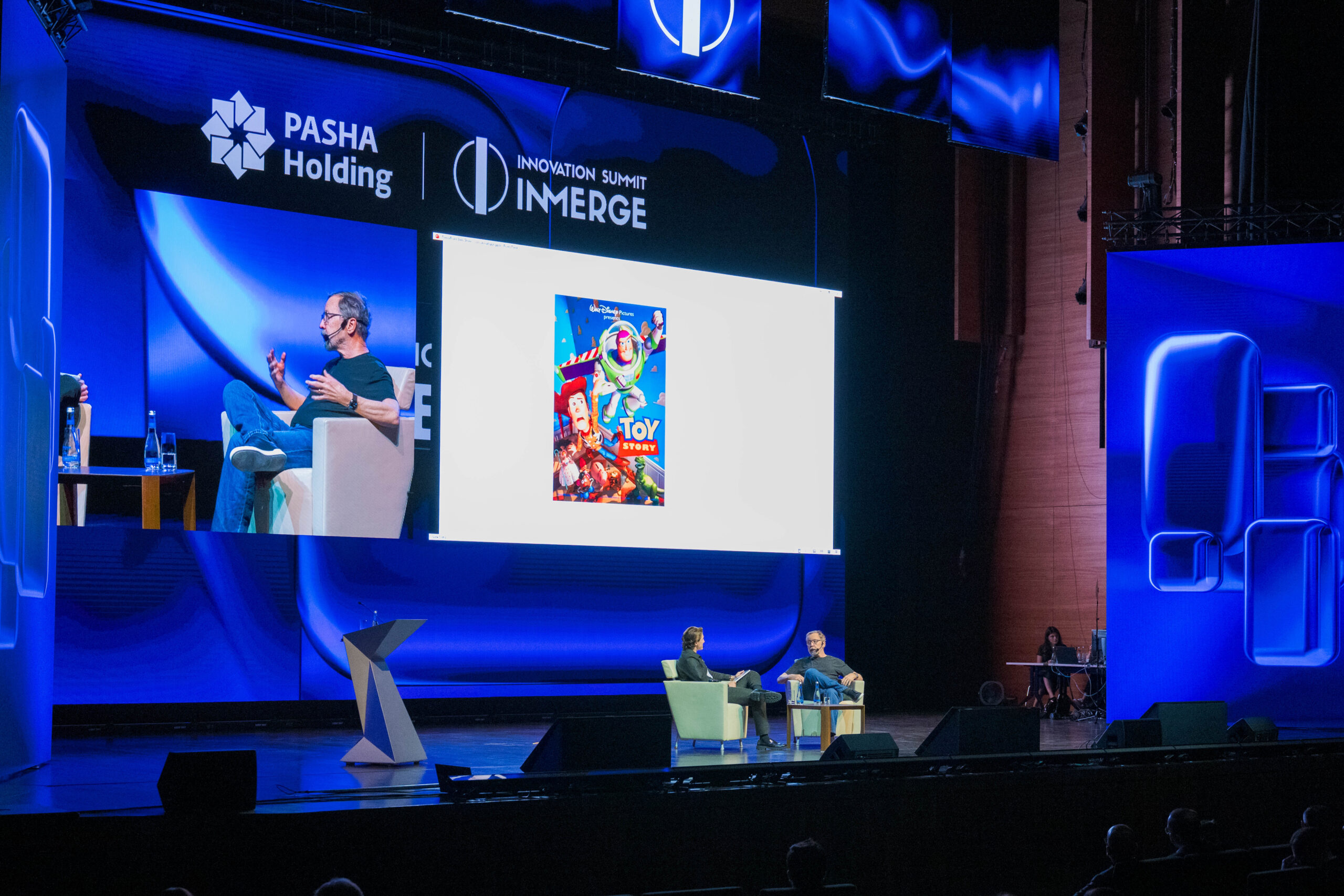
Ed Catmull at INMerge 2025 on Sept. 29 in Baku. Photo credit: INMerge 2025/ Bahman Mirzoyev
Catmull’s story starts long before Pixar. During the one-on-one session Catmull recalled his early years in graduate school, where his first mentors, Alan Kay and Ivan Sutherland, both future Turing Award laureates, taught him to approach change differently. They believed that technological progress was moving so quickly that researchers must design for the future, even if the hardware to realize their ideas did not yet exist.
“Sometimes you emulate the future. You may get it wrong, but that’s how you learn faster,” Catmull said.
Even as a student, Catmull was surrounded by future innovators like John Warnock, co-founder of Adobe, and Jim Clark, founder of Netscape. That environment inspired him to create spaces where the best people could do their best work, a principle he carried into Lucasfilm and Pixar.
Catmull’s journey began with a love for art, though he initially doubted he could become a great animator. It was only in graduate school, when he encountered a class on computer graphics, that he realized the potential of combining creativity with technology.
“When I made my first hand-drawn animation using a computer, I thought this could go a long way,” he said.
When Catmull joined Lucasfilm, the technology required for fully computer-animated films did not yet exist. At the time, rendering a single frame would have required 100 Cray-1 supercomputers, each costing $10 million.
“So it wasn’t economically practical. But we calculated that within 14 to 15 years, it would become possible,” Catmull said. Remarkably, 14 years later, “Toy Story” premiered as the first fully computer-animated feature film.
Pixar’s success wasn’t only about technology. Culture drove innovation. Catmull carefully built an environment where collaboration mattered more than hierarchy, and curiosity outweighed ego. Everyone was a peer, everyone could experiment.
“We created an animation studio starting with one artist… As we added artists, it was to make sure they came in as peers. That was a driving force.”
This lesson goes beyond animation. AI startups, renewable energy innovators, media platforms — all thrive by building tomorrow today, experimenting even before the world is ready. Small steps, bold experiments, and a culture that supports them can change industries.
“The future doesn’t arrive neatly packaged on our doorstep. It needs boldness, trial and error, and a little bit of imagination.”
Catmull’s message at InMerge was simple but powerful: don’t wait for perfect tools or perfect timing. Start now. Learn fast. Embrace uncertainty.
INMerge 2025, organized by PASHA Holding, which took place on Sept 29-30, was a true showdown of inspiration for The Astana Times team. In her column from Baku, Aida Haidar reflects on what Netflix co-founder Marc Randolph made her realize about innovation, risk, and the value of failure. You can read her piece here.
