
ALMATY – Kazakhstan’s economic growth prospects were discussed at an Aug. 19 meeting of the economic growth headquarters chaired by Vice Prime Minister and Minister of National Economy Serik Zhumangarin.
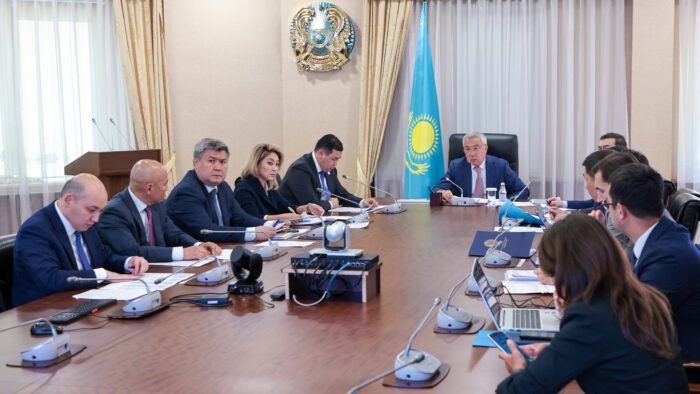
Photo credit: Prime Minister press service
Officials discussed GDP growth over the first eight months of 2025 and reviewed progress in key sectors, reported the Prime Minister’s press service.
Agriculture and transport strengthen their contribution to GDP
Agriculture, which accounts for approximately 4% of GDP, recorded a 3.7% growth in gross output over the first seven months, reaching 2.4 trillion tenge (approximately US$4.44 billion). Crop production increased by 5%, while livestock production rose by 3.4%. The sector’s overall contribution to GDP is projected at 3% by the end of August.
The transport and logistics sector demonstrated one of the highest growth rates, expanding by 22.5% in this year’s first seven months. This was largely driven by increased demand from the mining, oil, gas, agriculture, construction, and trade sectors. By the end of the year, the sector’s GDP share is expected to reach 6.5%, up from 5.6% in 2024.
Growth will be supported by completing 7,000 km of roadworks, finishing the second track on Dostyk–Mointy, and completing the Almaty bypass railway line. Additional boosts are expected from increased domestic grain and fuel transportation ahead of the heating season.
Trade remains a key growth driver
Trade contributed 19% to GDP in 2024 and continues to grow, with an 8.6% increase over seven months, totaling 37.7 trillion tenge (US$69.8 billion). Wholesale trade rose 9.5% to 25.2 trillion tenge (US$46.7 billion), while retail trade climbed 6.6% to 12.3 trillion tenge (US$22.8 billion).
Five regions – Almaty, Astana, Shymkent, Atyrau and Karaganda – accounted for 71% of total trade turnover. Notably, the Turkistan Region saw a 64.4% increase, while the Akmola Region grew 44.7%, and Shymkent recorded a 20.5% rise.
Mining and manufacturing drive industrial output
Oil production reached 58.5 million tons between January and July, up 11.9% year-over-year, with output projected to reach 66.7 million tons by the end of August.
The manufacturing sector, which accounts for 12.4% of GDP, grew by 6.1% in the first seven months. Key segments include metallurgy (40.1% share), machinery (18.9%), food production (13.4%), oil refining (5%), construction materials (5.5%), and chemicals (4.6%).
Machine building is expected to maintain solid growth, with over 160,000 vehicles projected for production in 2025. In the first seven months, 75,406 vehicles, 67 locomotives and 1,984 wagons were manufactured.
The metallurgical sector recorded a 1.3% growth rate for the period, a comparatively modest result following a decade of robust expansion that averaged 6.9%. Deputy Chairman of the Committee for Industry, Shyngys Suyunbaev, stated that the sector still has the capacity to achieve 5% growth by the end of the year with the implementation of a package of procedural measures.
Zhumangarin instructed the Ministry of Industry and its committees to prepare a detailed analysis of the proposed measures and their expected impact on sectoral growth, with the goal of identifying actions that would deliver a meaningful increase in output.
Construction continues with steady growth
Construction contributes approximately 6% to the country’s GDP. From January to July, 9.4 million sq. m of housing were commissioned, up 5.2% from last year. The plan has been fulfilled to the extent of 48.9%, with instructions issued to accelerate regional project completions.
At the conclusion of the meeting, Zhumangarin instructed ministries and regional administrations to maintain growth momentum and ensure the timely fulfillment of plans across all key sectors.
