
ASTANA — New import tariffs from the United States took effect Aug. 7, imposing a 25% duty on Kazakhstan’s exports. Officials say the measures affect only a small share of goods, but exporters are watching for potential shifts in trade flows and pricing.
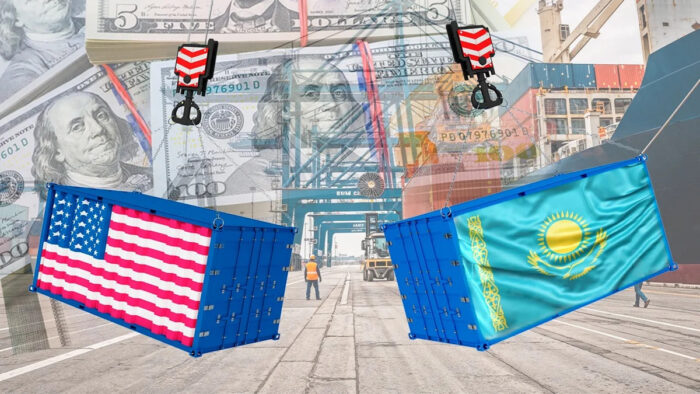
New import tariffs from the United States took effect Aug. 7, imposing a 25% duty on Kazakhstan’s exports. Photo credit: Kazinform
U.S. President Donald Trump signed the order on July 31, introducing higher tariffs on imports from several countries, including Kazakhstan. According to the Kazakh Ministry of Trade and Integration, the new duties will cover 4.8% of Kazakhstan’s exports to the U.S., leaving 95.2% of goods unaffected.
Kazakhstan-U.S. trade overview
According to the Bureau of National Statistics, in 2024, bilateral trade with the U.S. reached $4.2 billion, up 4% from 2023. Kazakhstan’s exports to the U.S. increased by 30.6% to $2 billion, while imports from the U.S. totaled $2.2 billion.
Oil remains the country’s primary export to the U.S., accounting for approximately 56% of the total in 2024. Uranium followed with a 16% share, silver at 12%, and ferroalloys at 9.5%. According to the ministry, these categories are excluded from the new tariffs and make up 92% of Kazakhstan’s shipments to the U.S.
The tariffs target specific goods worth approximately $100 million in exports last year, including phosphorus ($15.9 million), ferrosilicon ($12.7 million), lenses ($4.1 million), wheat gluten ($4 million), and ammonium nitrate ($2.4 million).
Kazakh Minister of Trade and Integration Arman Shakkaliyev noted that these items represent roughly 4-8% of total U.S.-bound exports.
First-half 2025 performance
In the first six months of 2025, bilateral trade reached $1.6 billion, down 22% from $2 billion in the same period last year. Kazakhstan’s exports to the U.S. decreased 36.3% to $566.5 million, primarily due to declines in crude oil shipments (down 61.7% to $221.1 million), ferroalloys (down 30.1% to $56.7 million), and silver (down 7.6% to $82.6 million). Wheat gluten exports, however, reached 6,700 tons worth $8.12 million.
According to the ministry, the export structure remains heavily resource-based, with oil, uranium, silver, and ferroalloys comprising more than 89% of U.S.-bound shipments in the first half of 2025.
Expert views on tariff impact
Experts note that Kazakhstan typically runs a trade surplus due to higher export volumes compared to imports.
“In fact, we see a situation where Kazakhstan’s exports are lower in value than its imports from the U.S. The question is whether this balance will change once the 25% tariffs take effect,” said Lidiya Parkhomchik, an expert at the Institute of World Economics and Politics.
Parkhomchik noted that commodity exports are price-sensitive and tied to global market conditions. Oil shipments, for example, can vary in value depending on international prices, while uranium deliveries to the U.S. have shown a clear upward trend.
According to her, uranium ore shipments to the U.S. had nearly doubled in volume, resulting in a approximately two-fold increase in Kazakhstan’s export revenue from the commodity. In contrast, oil exports showed the opposite trend, with both revenue and tonnage dropping by half compared to the same period in the previous year.
Parkhomchik added that while Kazakhstan may recover oil shipment volumes later this year, lower average oil prices in early 2025 could limit total revenue. She noted that imports from the U.S. have remained stable and are likely to stay that way through year-end.
“It is clear that Astana must continue defending its national interests in promoting exports abroad. The U.S. is no exception. But we should also recognize that this sharp tariff shift is part of a global trend, not one tied to Central Asia,” she said.
Economist Arman Beisembayev agreed that the impact on Kazakhstan’s exports will be limited.
“We are a resource-based country. With our neighbors, we primarily trade raw materials for export, including oil, wheat, sugar beet, and so on. Mostly without processing: whatever is grown is harvested and shipped. The situation with the United States is similar – we send there raw materials that are on the list of exceptions,” said Beisembayev.
Tariffs are not equivalent to a ban
“Mutual trade is not going anywhere. Our goods will simply be 25% more expensive in the U.S. Who will pay for that? The average American consumer who buys these products,” said Beisembayev.
He added that increased tariffs generally reduce a product’s competitiveness, raising the question of whether U.S. buyers will maintain demand for goods that become more expensive.
Despite the exclusion of most Kazakh exports from the new duties, the government is continuing talks with U.S. partners. Analysts say the U.S. trade deficit with Kazakhstan could still widen by year-end due to changing market conditions and the tariff policy.
The article was originally published in Kazinform.
