
Universities are racing to embrace artificial intelligence. But who is helping students decide when its answers deserve to be trusted? Global Media and Information Literacy Week is a timely moment to recognize the academic library’s place in that task. Yet amid discussions of innovation, automation and future skills, the library is often overlooked. Many still see it as a place that buys, stores and lends books. In that view, Google reduced its importance and AI may finish the job.
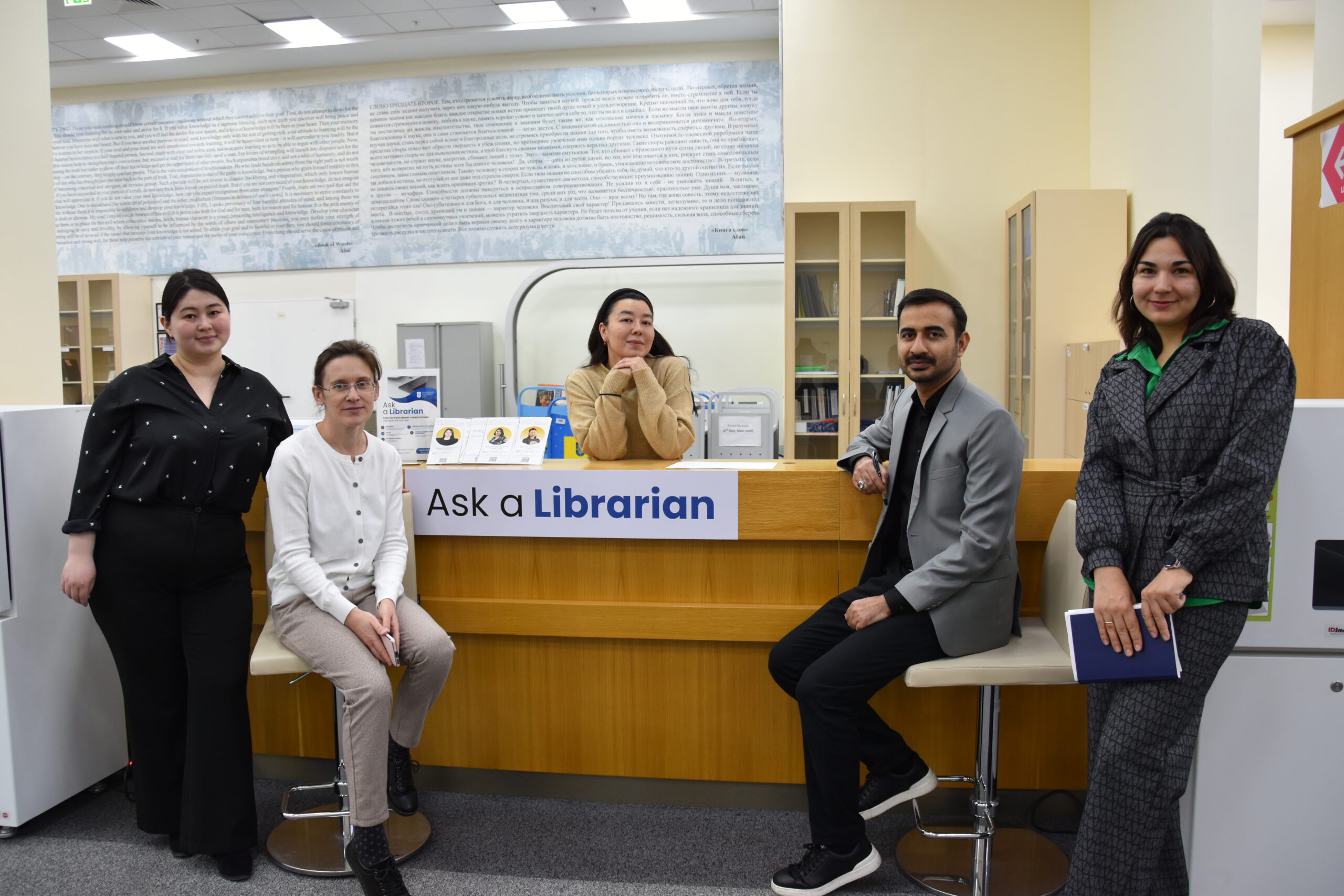
L-R: Diana Baidollinova, a librarian at the Teaching and Learning Support Office (TLSO); Darya Zvonareva, the head of TLSO; Aigerim Akparova, TLSO Librarian; Saqib Raza, PhD student NU; Venera Niyazbayeva, TLSO Librarian. Photo credit NU Library.
The opposite is closer to the truth. AI has not made academic libraries less relevant. It has made their deeper purpose impossible to ignore. The central problem facing students today is no longer access to information. Information is everywhere. Answers appear within seconds. Generative AI can summarize articles, suggest references, produce arguments and imitate academic language with remarkable confidence. But confidence is not credibility. AI can invent citations. Search engines rank rather than judge. Predatory journals can look professional. Weak evidence travels quickly. A polished paragraph can hide a poor source, and an impressive answer can conceal almost no understanding at all.
This changes the meaning of literacy. Knowing how to find information is no longer enough. Students must know how to question it. They must understand where evidence comes from, why one source deserves more trust than another, how scholarly knowledge is produced, and when an AI-generated answer should be challenged rather than accepted. This is where the modern academic library should be understood differently. A serious university library is not a warehouse of books. It is part of the university’s intellectual infrastructure.
Nazarbayev University Library offers a useful example. Yes, it provides books, electronic journals, databases, study spaces and extensive digital access. It is technologically well equipped and has introduced systems that make academic resources easier to discover and use. But judging the library only by its collection would miss its most important work. NU Library supports students in literature searching, source evaluation, referencing, citation management and responsible use of information. It helps researchers navigate databases, systematic review resources, publication strategies, research visibility, bibliometrics, open access and journal selection. It also provides guidance that can help scholars identify questionable publishing practices and avoid predatory outlets.
These are not administrative services. They are academic capabilities. The distinction matters because universities often speak about developing critical thinkers while underinvesting in the very institutions that teach students how knowledge should be located, tested and used. The rise of AI makes this contradiction harder to defend. A student may now produce a literature review faster than ever before. But can that student explain why the selected studies are credible? Can they distinguish a peer-reviewed source from a weak one? Can they recognize a fabricated reference? Can they identify bias in an AI-generated synthesis? Can they trace a claim back to the original evidence? If not, technological fluency has been mistaken for intellectual competence.
Modern libraries are increasingly working at exactly this boundary. At Nazarbayev University, library initiatives have extended into information literacy, research support and emerging AI-related practices. Workshops and training expose students and researchers to tools for literature discovery, reference management, research evaluation and responsible academic work. Professional development initiatives also strengthen the capacity of librarians themselves to respond to changing research and teaching environments.
This is the future-facing role that deserves far more attention. Academic librarians should not be treated as custodians standing at the edge of teaching and research. They are increasingly partners in both. They sit at the intersection of information, technology, scholarship and academic integrity. Few university units are better placed to teach students how to navigate a world in which information is abundant but reliability is uneven.
This should also change how university leaders think about AI literacy. AI literacy cannot mean teaching students which tools to use and which prompts them to write. That is too shallow. Real AI literacy requires information literacy underneath it. Students must know how to verify, compare, attribute, question and sometimes reject what a system gives them. Without those habits, universities may produce students who are efficient users of AI but weak judges of knowledge. That is not progress.
Universities should reconsider what intellectual preparedness means in an age when machines can generate answers faster than humans can verify them. That is why academic libraries matter. They are not relics of an earlier information age. They are among the institutions best positioned to help universities navigate the next one. And as AI makes information easier to produce, the universities that thrive will be those that invest just as seriously in the human capacity to question, verify and think.
In an age overflowing with answers, the academic library may prove most valuable for teaching us when not to accept one.
Note: The UN General Assembly commemorates the Global Media and Information Literacy Week, observed from Oct. 24-31, to raise awareness and celebrate the progress achieved towards Media and Information Literacy for all since 2021.
The author is Saqib Raza, a PhD scholar in education and an MSc graduate in Educational Leadership in Higher Education from Nazarbayev University Graduate School of Education, Kazakhstan.
Disclaimer: The views and opinions expressed in this article are those of the author and do not necessarily reflect the position of The Astana Times.
