
ASTANA – Kazakhstan and Belgium reaffirmed their commitment to strengthening bilateral relations, focusing on the Trans-Caspian International Transport Route, artificial intelligence, critical minerals and cooperation on international topics, according to a joint statement adopted by President Kassym-Jomart Tokayev and King Philippe of the Belgians on Oct. 12.
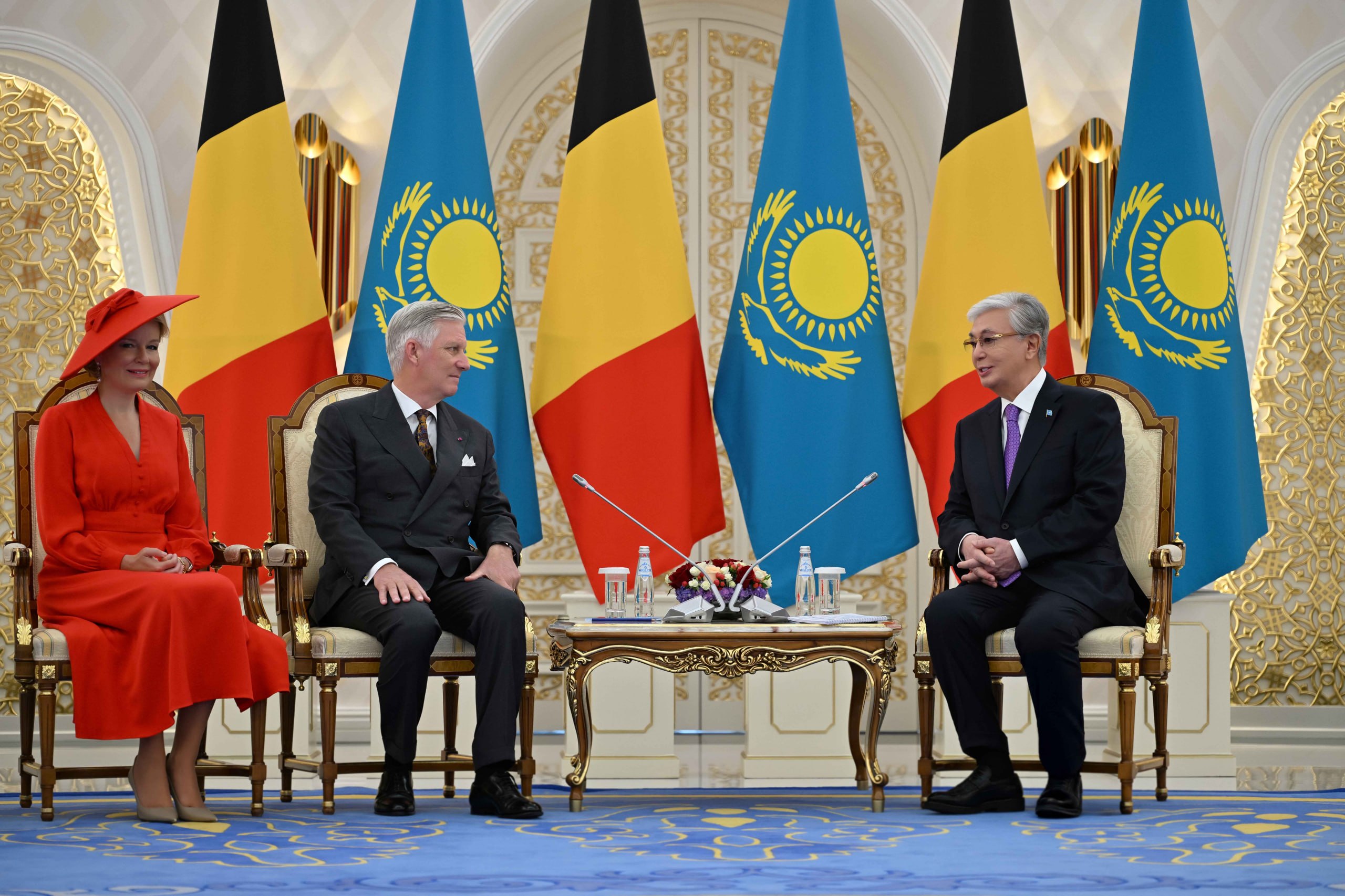
Kazakhstan’s President Kassym-Jomart Tokayev with King Philippe and Queen Mathilde of the Belgians during their state visit to Astana on Oct. 12. Photo credit: Akorda
The statement followed talks during the Belgian royal couple’s state visit to Kazakhstan on Oct. 11-14, which both officials described as an important milestone in bilateral relations.
Middle Corridor and digital technologies
The two countries underscored the growing role of the Trans-Caspian International Transport Route, or Middle Corridor, as a reliable and sustainable transport link between Asia and Europe.
They also reaffirmed the importance of developing transport and logistics cooperation and enhancing connectivity between the two regions.
Digitalization, artificial intelligence and innovation were identified as increasingly important for sustainable economic development and competitiveness. The two leaders expressed interest in developing cooperation in artificial intelligence, big data, cloud technologies, supercomputing infrastructure and data centers.
During the press briefing, Tokayev highlighted Kazakhstan’s interest in expanding cooperation across emerging industries, including digitalization and space technologies.
King Philippe, in turn, underlined Kazakhstan’s technological development, noting that the country was “at the forefront of digitalization” and had developed unique solutions, notably in artificial intelligence.
“We are keen to visit the Alem.AI center and discuss synergies between our countries,” he said.
Critical minerals and economic cooperation
The joint statement reaffirmed the importance of cooperation in critical minerals, petrochemicals, industry and mechanical engineering, and renewable energy.
The leaders welcomed the holding of a roundtable on critical minerals during the state visit, underscoring the strategic importance of cooperation in this field.
They also highlighted the potential to expand agricultural trade, develop the food industry and introduce modern agricultural technologies.
Tokayev noted that Belgium had invested more than $15 billion in Kazakhstan’s economy since 2005, describing economic cooperation as a cornerstone of bilateral relations.
The leaders welcomed the Kazakhstan-Belgium Business Council’s activities and the fourth meeting during the visit as an important mechanism for strengthening ties between the two countries’ business communities.
The statement also reaffirmed their commitment to the Enhanced Partnership and Cooperation Agreement between Kazakhstan and the European Union and its member states, signed on Dec. 21, 2015.
Education, healthcare and cultural ties
The two officials welcomed the Kazakhstan-Belgium Rectors’ Forum and expressed support for joint educational programs, academic mobility, scientific research and partnerships between universities and research centers.
They also reaffirmed the importance of strengthening healthcare cooperation, including enhancing the role of primary healthcare within the World Health Organization Global Coalition for Primary Health Care.
The leaders referred to the principles of the 1978 Alma-Ata Declaration on Primary Health Care and the 2018 Astana Declaration, as well as initiatives to be discussed following the conference Towards the 50th Anniversary of the Alma-Ata Declaration: Building Strong Primary Health Care for Future Generations, scheduled for Oct. 14 in Almaty.
The discussions also featured cultural cooperation. Tokayev welcomed the presentation of works by Belgian artist James Ensor at Kazakhstan’s National Museum and cooperation between the Almaty Museum of Arts and KANAL-Center Pompidou.
Tokayev and King Philippe further welcomed the entry into force of the protocol amending the agreement between Kazakhstan and the Benelux countries on visa exemption for holders of service passports.
They also expressed their intention to conclude negotiations and sign a bilateral agreement on remunerated employment for family members of diplomatic missions as a deliverable marking 35 years of diplomatic relations between Kazakhstan and Belgium in 2027.
Commitment to international law and dialogue
On international and regional matters, the leaders reaffirmed their commitment to multilateralism, international law and the United Nations’ central role in maintaining international peace and security, promoting sustainable development and addressing global challenges.
They agreed to intensify bilateral political dialogue on international affairs and economic development within the United Nations, the Organization for Security and Cooperation in Europe (OSCE), and multilateral platforms in the Kazakhstan-EU and Central Asia-EU formats.
The statement also highlighted the importance of strengthening the Convention on the Prohibition of the Development, Production and Stockpiling of Bacteriological (Biological) and Toxin Weapons and on Their Destruction, adopted on April 10, 1972.
The leaders expressed satisfaction with the outcomes of their talks and reaffirmed their determination to give new impetus to the Kazakhstan-Belgium partnership.
Both officials expressed confidence that King Philippe’s first state visit to Kazakhstan would lay the foundation for the further qualitative development of bilateral relations.
