
ASTANA — Kazakhstan should think like a small, open economy and look to California’s transformation beyond oil, rather than relying on higher commodity prices and government spending to sustain economic growth, former World Bank chief economist Indermit Gill told The Astana Times on Oct. 29.
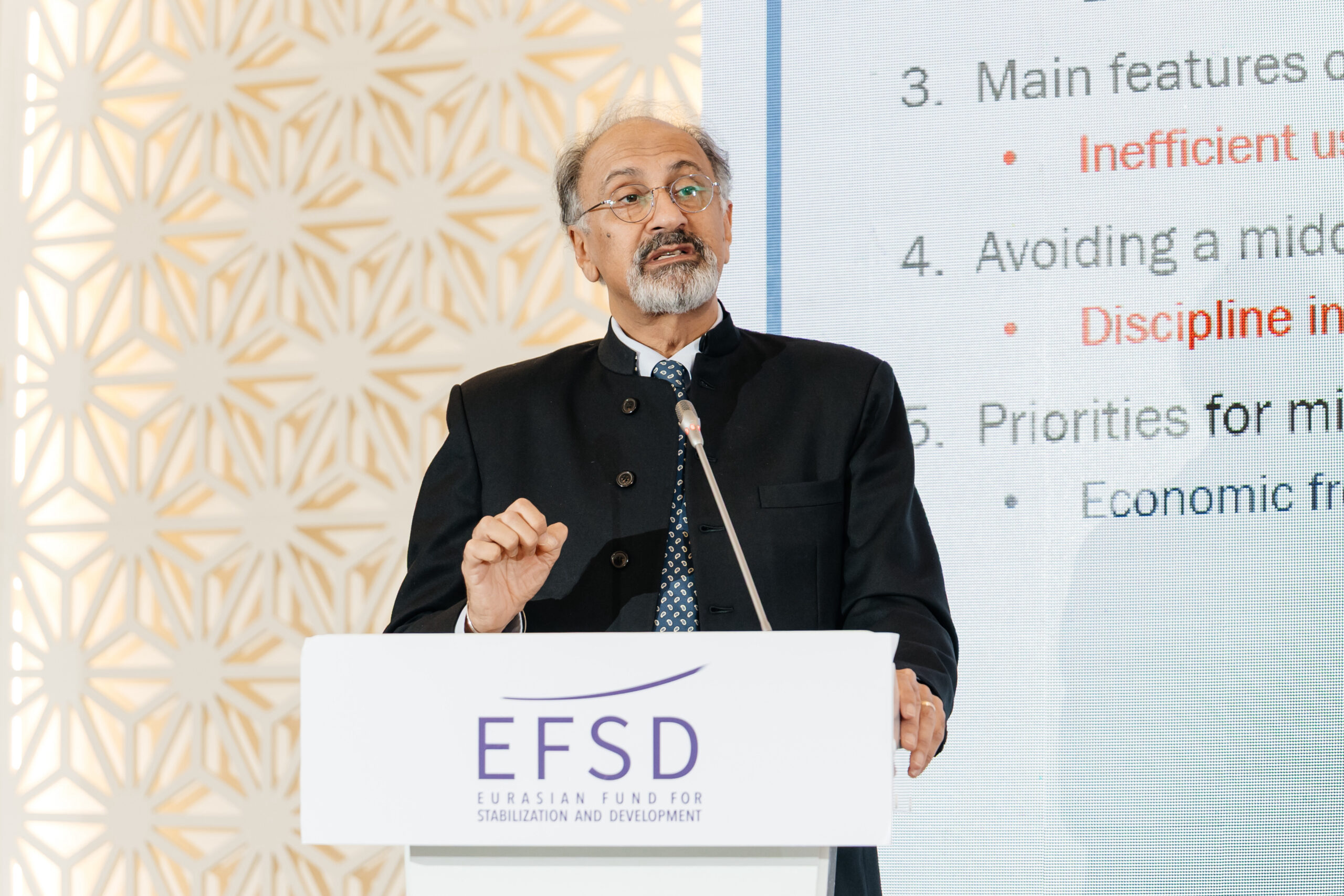
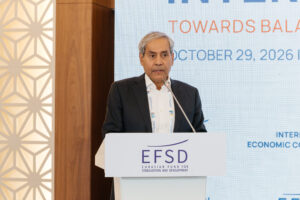
Economist Indermit Gill speaks at the EFSD International Economic Conference. Photo credit: EFSD
Gill, who, alongside economist Homi Kharas, coined the widely used term “middle-income trap” in a landmark 2007 World Bank report, pointed to California’s evolution from an oil-producing economy into a major center of technology, entertainment and agriculture as an example of the transformation Kazakhstan could pursue.
Indermit Gill and The Astana Times reporter Nagima Abuova on the sidelines of the EFSD International Economic Conference in Astana on Oct. 29. Photo credit: EFSD
The comparison offers a different way to view Kazakhstan’s resource wealth. Oil and gas revenues have helped finance the country’s development, but the more consequential question is whether that wealth can generate industries that can sustain prosperity independently of commodity prices.
“I think Kazakhstan has done a good job in terms of converting resources that are underground into converting, into resources that are above ground. Astana, for example, it’s a great achievement. But you have to reinvent yourself,” Gill told The Astana Times.
“The most successful case of a resource-rich economy becoming diversified is California. California used to depend a lot on oil. But now you hear about services like entertainment services. You hear about Silicon Valley. You hear about agriculture. That’s the kind of thing that I’m thinking about for Kazakhstan,” he said.
His comments came on the sidelines of an international economic conference organized by the Eurasian Fund for Stabilization and Development (EFSD) in Astana, where economists and policymakers discussed the foundations of sustainable growth and structural transformation.
The productivity gap
According to Gill, the distinction between temporary economic expansion and lasting transformation comes down to productivity: how effectively an economy converts capital, labor and energy into goods and services.
He pointed to Kazakhstan’s experience of rising per capita income followed by periods of decline, illustrating how growth supported by favorable external conditions can prove difficult to sustain without changes in the underlying economy.
“It has grown, then it’s come down again. And the reason why it’s come down is because that structural transformation didn’t take place, so you didn’t have a new structure which could sustain a high income. That comes from having a more productive economy,” said Gill.
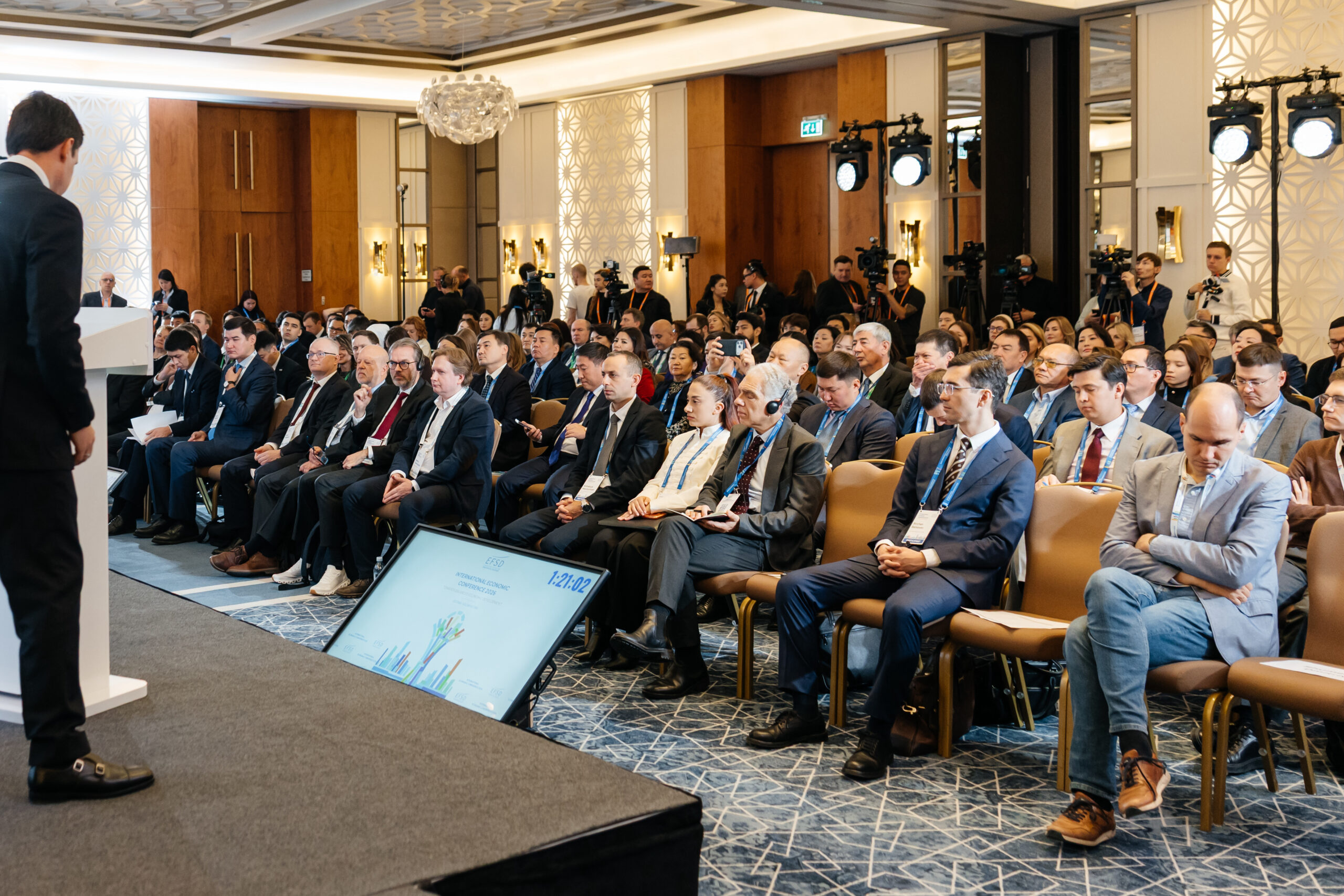
Participants attend the EFSD International Economic Conference in Astana. Photo credit: EFSD
During the plenary session, Gill presented data showing that middle-income economies produce roughly one-fifth as much output per worker as the United States, despite possessing capital equivalent to approximately 70% of that in high-income economies. The disparity suggests considerable potential to increase output by improving how existing resources are used.
Gill said Kazakhstan has become more efficient, but much of its income growth has been driven by higher commodity prices, including oil, gas and agricultural products.
“I think Kazakhstan has become more efficient, but I think that more of the gain has actually come from a higher price of the output. (…) I would worry that a big part of this is actually coming from an external shock, and I would worry that it is coming from an expansion of government spending, rather than greater productivity among enterprises,” said Gill.
EFSD Chief Economist Sergei Ulatov echoed this concern, emphasizing that investment alone does not guarantee sustainable growth. He said projects that fail to improve productivity could leave future generations with financial obligations rather than stronger economic capacity.
“As Indermit Gill emphasized, investment alone is not the answer to sustainable growth. If investments are inefficient and unproductive, they are likely to become a burden on future generations. That is why, when we implement projects, the quality of investment and the quality of individual projects are extremely important,” Ulatov told journalists.
He noted that public investment can stimulate economic activity immediately, while its contribution to long-term growth may only become clear years later. The key question is whether projects expand productive capacity or merely increase spending and demand.
From connectivity to innovation
Gill also emphasized that Kazakhstan should regard itself as a small economy despite its relative size within Central Asia. Compared with the world’s largest markets, most economies depend on international integration to access technologies, capital and expertise unavailable domestically.
Openness becomes more important as economies develop. Gill explained that low-income countries can make substantial progress through investment, while middle-income economies must use resources more efficiently and adopt existing technologies. Upper-middle-income economies such as Kazakhstan must eventually develop their own innovation capabilities.
This progression is particularly relevant to Central Asia’s expanding transport corridors. As Kazakhstan strengthens connections between major markets, infrastructure development must be accompanied by greater openness to foreign investment, technologies and skilled workers.
Gill linked this to “technology infusion,” the process of importing and spreading existing technologies throughout an economy. He cited China’s experience of incorporating foreign technologies, products and business practices into domestic production.
“The success of countries like China has been that they have actually been very open to external influence in terms of new ideas, new forms of entrepreneurial organization, new products. If you go to China, for example, you find trains that look Japanese, you have cars that look like Tesla. So, basically, they just infuse these technologies into the economy and as a result, they become better and better,” said Gill.
When growth becomes the goal
For Ulatov, one obstacle to structural transformation is governments’ emphasis on headline GDP growth, which can encourage short-term investment decisions over productivity improvements.
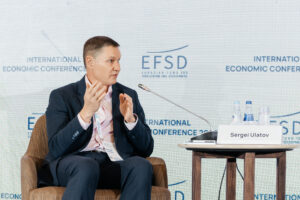
Sergei Ulatov speaks during a panel discussion at the conference. Photo credit: EFSD
“If economic growth becomes the only political KPI, that is a very bad idea. If you target it, you are most likely to take the easy route. And the easy route, if you have the resources, is simply to increase domestic demand through investment,” he said.
Ulatov said Central Asian economies still require substantial investment in roads, electricity systems and water infrastructure. However, he distinguished such public needs from financing large state-owned enterprises whose commercial viability and long-term economic contribution remain uncertain. The concern extends to competition, particularly when governments select enterprises for continued financial support rather than allowing more productive businesses to expand.
“We discussed today the concept of ‘too big to fail.’ Very often, governments choose their own winners – what economists call ‘picking winners’ – and then continue supporting those companies. The question is whether this distorts competition and pushes small and medium-sized enterprises out of the market. These are the companies that should be growing. They could become the source of your future economic growth. Governments need to think carefully about this.” he said.
The foundations of sustainable growth
Brian Pinto, a former World Bank senior adviser specializing in sovereign debt and economic policy, expanded on the relationship between competition, fiscal discipline and long-term economic performance.
Brian Pinto, former senior adviser at the World Bank, speaks at the EFSD International Economic Conference in Astana on Oct. 29. Photo credit: EFSD
“If the private sector or the bond markets are concerned about the sustainability of debt, real interest rates and risk premia are going to rise, and this is going to affect the investment climate for the private sector,” said Pinto.
“At the same time, if you don’t have strong microeconomic foundations for growth, you’re eventually going to have problems raising enough tax revenue, creating concerns about budget risks, higher inflation, uncertainty and potentially higher taxes down the road. And this, in turn, is going to stifle private investment,” he said.
He outlined three measures he called the “microeconomic policy trio”: hard budget constraints, competition and pragmatic management of exchange rates and interest rates.
Hard budget constraints require governments, banks and enterprises to operate within financial limits rather than repeatedly supporting loss-making businesses. Effective bankruptcy procedures let capital and labor shift to more productive activities, while competition pushes companies to improve efficiency.
Pinto said the relatively favorable macroeconomic conditions in EFSD member economies provide an opportunity to implement reforms before economic pressures intensify.
“So the big lesson, of course, for the EFSD countries, they have a very good situation right now. The macroeconomic situation is relatively good. But in order to enhance structural transformation, now is the time for them to think from a position of strength of implementing the micro-policy trio,” said Pinto.
