
ASTANA – Strategic investment in the Trans-Caspian International Transport Route could more than triple trade along the route, cut travel times in half and create two million additional jobs by 2040, according to a new report published by the World Bank on Sept. 28.
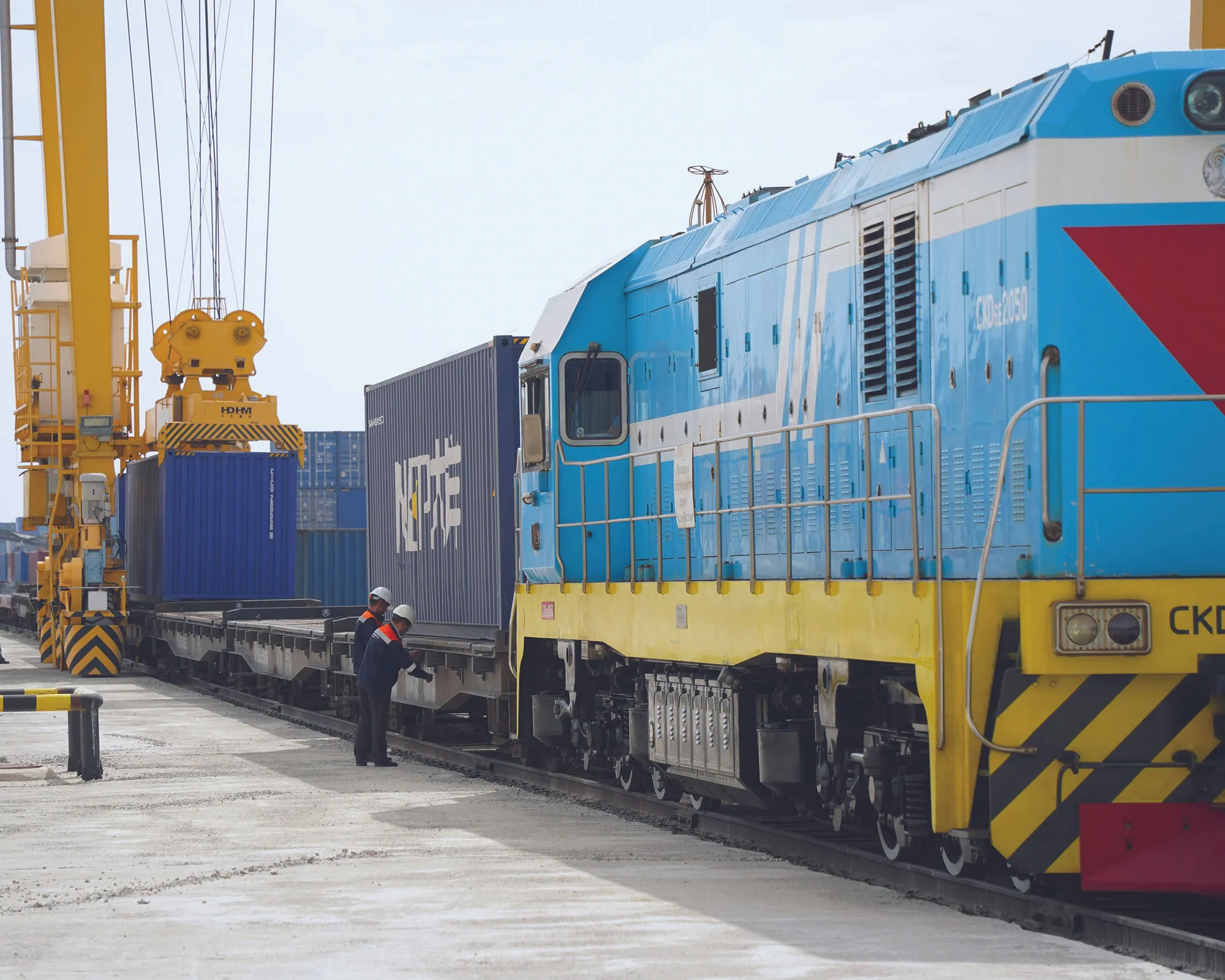
Photo credit: OECD
The route, also known as the Middle Corridor and referred to by the World Bank as the Trans-Caspian Transport Corridor, is emerging as an increasingly important trade link between Asia and Europe through Central Asia, the South Caucasus and Türkiye.
The route combines rail, road and shipping across the Caspian and Black seas, connecting countries along the corridor with one another and with wider global markets. Its position also gives it a broader role as an overland link between East Asia and Europe.
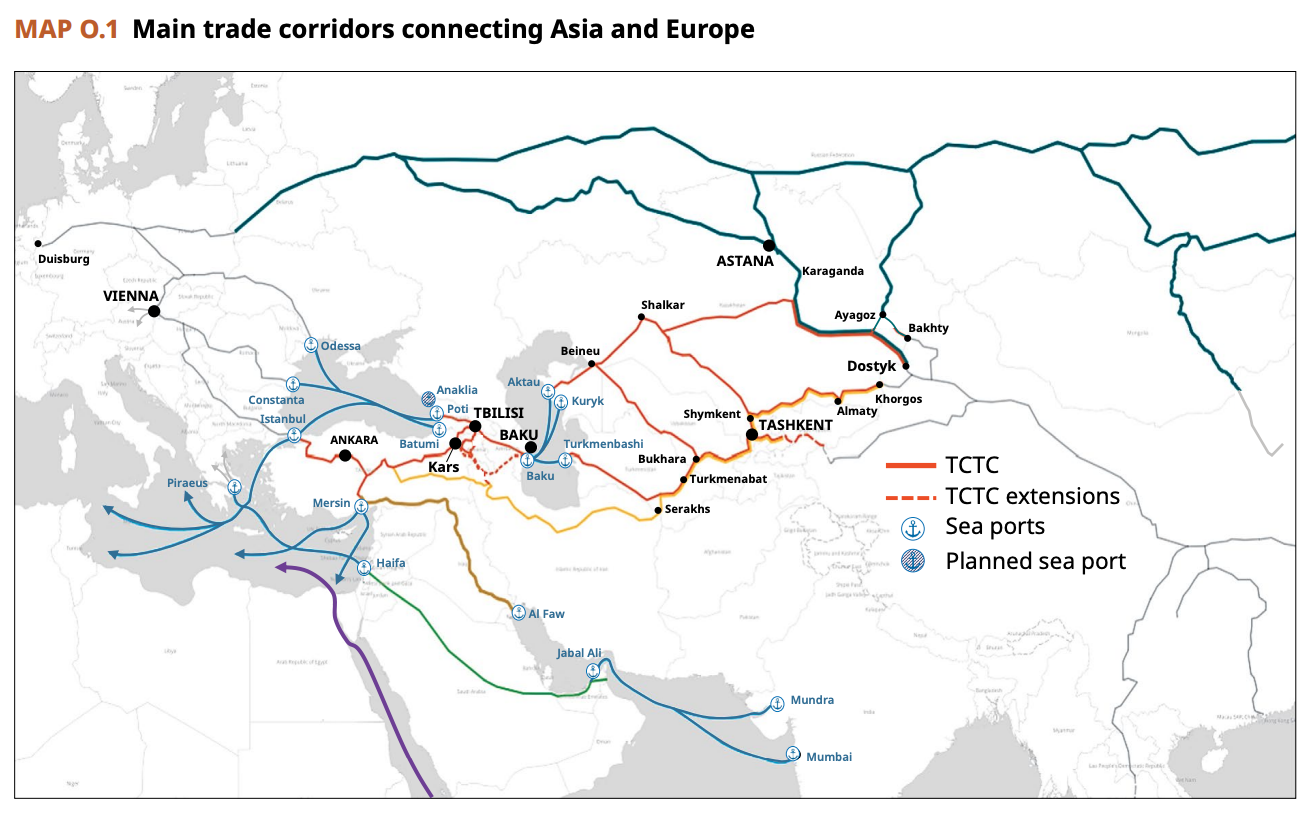
Main corridors connecting Asia and Europe. Photo credit: World Bank
The report identifies nine countries along the route: Armenia, Azerbaijan, Georgia, Kazakhstan, the Kyrgyz Republic, Tajikistan, Türkiye, Turkmenistan and Uzbekistan, with a combined population of nearly 200 million people. Armenia is included even though it is not yet directly connected to the corridor, as physical links are expected to be developed in the 2030s, within the report’s 2023-2040 timeframe.
Key findings
The report projects that stronger transport links could raise GDP across the nine countries along the corridor by 3.3%. This is equal to $58 billion at current levels of economic activity, as well as boost employment by 2.9%.
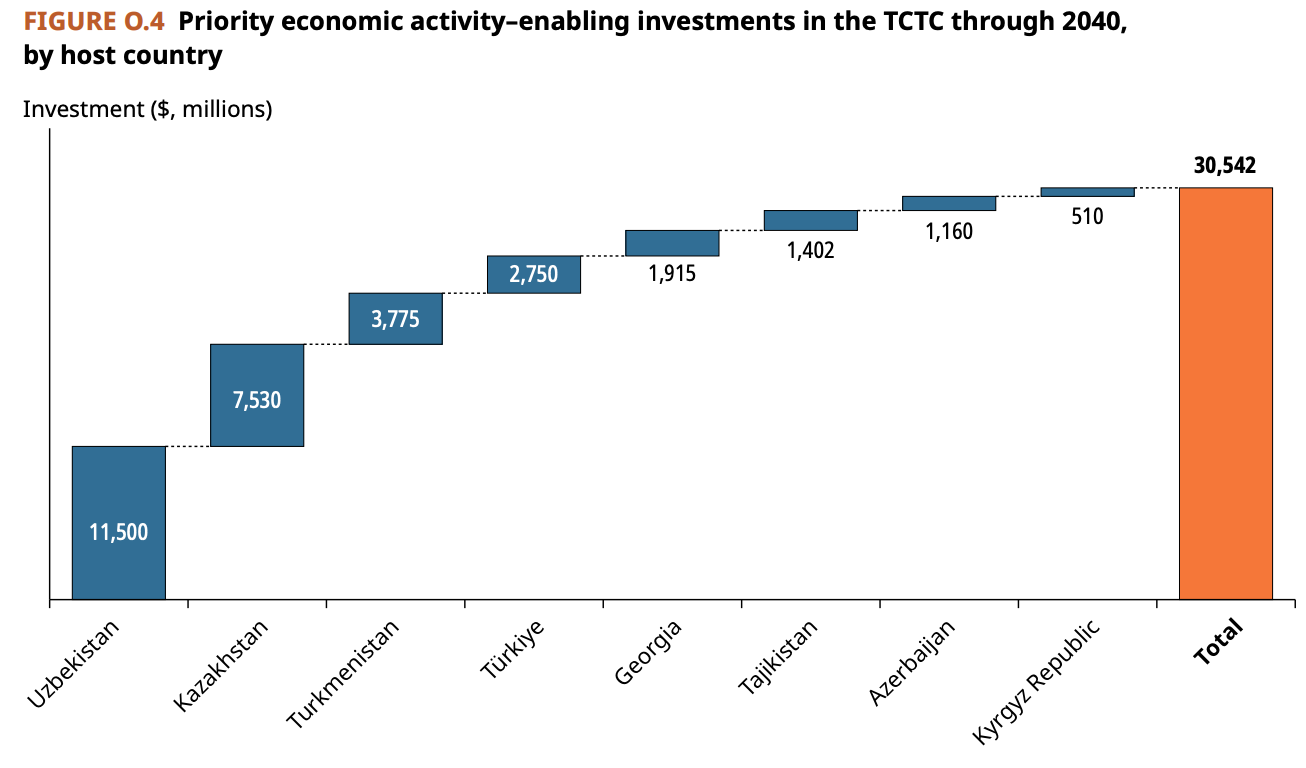
Enabling investments by countries. Photo credit World Bank
It identifies 16 priority infrastructure projects worth a combined $25.1 billion. Three-quarters are already underway or expected to begin soon, suggesting that a lack of infrastructure may no longer be the corridor’s biggest long-term constraint.
Kazakhstan accounts for several of the 16 priority projects identified in the report. They include the $1.4 billion Moiynty-Kyrgyz railway line, the $1.2 billion Bakhty-Ayagoz railway and border crossing, the $550 million Darbaza-Maktaaral railway, a $315 million Almaty bypass line, a $310 million expansion of Aktau Port and a $212 million upgrade of the Altynkol-Zhetigen railway. Together, the projects are intended to expand rail capacity, ease bottlenecks around major hubs and strengthen Kazakhstan’s connections to both the Caspian Sea and markets to the east and south.
An additional $30 billion will be required for what the report describes as “enabling” investments. This includes better road and rail connections to local economies, logistics hubs and inland terminals that can speed up cargo movement. Investment is also needed in locomotives, railcars, cargo-handling equipment and digital systems to keep goods moving efficiently across the network.
With major projects already moving forward, the harder challenge will increasingly be how efficiently the route is managed and how well countries coordinate operations across borders.
“Total trans-Caspian volumes are expected to increase by about 3.6 times, from 8.8 million tons in 2023 to 32.1 million tons by 2040. The Eastern gateway, consisting of the main entry and exit points along the corridor’s eastern flank, is projected to grow at a similar pace, increasing from 28.5 million tons to 105.7 million tons, and the Western gateway is expected to expand from 12.1 million tons to around 35.0 million tons over the same period,” said the report.
Beyond infrastructure
The report examines how stronger trade corridors can cut logistics costs, draw investment, improve productivity and create jobs. It assesses the economic potential of the Trans-Caspian route, identifies the main constraints limiting its performance and sets out recommendations for turning it into a stronger driver of regional growth.
The report indicates that if governments combine infrastructure spending with reforms to customs, logistics and other trade procedures, freight volumes could quadruple and travel times could fall by as much as two-thirds. Those gains would come from easing transport bottlenecks, making supply chains more reliable and expanding market access in the nine countries positioned along the route.
The stakes have grown as disruptions to global supply chains, geopolitical tensions and climate-related risks increase pressure on existing trade routes. Growing obstacles to trade across Eurasia have pushed the Middle Corridor higher on the policy agenda and accelerated investment by countries along the route, often with support from international financial institutions.
Many of the countries along the route are also major producers of energy, critical minerals, raw materials and food products.
A stronger route could therefore do more than carry transit cargo. The report notes it could help countries reduce their exposure to external disruptions while turning growing freight flows into domestic investment, business growth and jobs. Rising regional trade, particularly among developing economies, gives governments another reason to accelerate development of the Trans-Caspian route.
“The Trans-Caspian Transport Corridor can become a powerful driver for faster growth, economic diversification, poverty reduction, and expanded private investment for the countries along the corridor,” said World Bank Vice President for Europe and Central Asia Antonella Bassani.
From bulk cargo to containers
Immediate actions highlighted by experts cover expansion and modernization of railways, roads, ports, border crossings and inland logistics hubs along the route. The report emphasizes that is especially important because bulk commodities such as grain, fertilizer, construction materials and fuel account for 92% of freight currently crossing the Caspian Sea. For these goods, available capacity and low transport costs are critical.
The report stresses that the Middle Corridor’s biggest strategic challenge is to become a genuinely attractive route for container cargo, not just bulk goods.
“The most pressing, yet by its nature long-term, priority for the TCTC is to become a competitive, resilient option for containerized trade; this will require transformational changes to boost corridor performance,” reads the report.
Most of the investment is needed before 2030 to ease existing bottlenecks, the report says. Further upgrades will likely be required in the 2030s as new capacity constraints emerge.
Priority actions
The operational challenge is considerable. According to the report, depending on the route, a shipment traveling from origin to destination may cross four or five borders, change railway gauge twice, move between rail and ships up to four times and enter or leave customs transit systems up to 10 times.
Experts note the corridor also remains difficult to manage because responsibility is spread across a wide range of actors, including rail operators, shipping companies, ports, customs agencies and national and regional institutions. Differences in income levels, market integration and decision-making structures add another layer of complexity.
“Making this system work efficiently is among the most daunting development challenges in global logistics,” reads the report.
The World Bank proposes four broad steps to improve how the corridor is governed and operated.
One proposal is to replace fragmented paperwork systems with a shared digital platform where transport and trade data can be submitted once and used across the route. It also recommends closer integration between rail and Caspian shipping, potentially through a joint rail-and-shipping operator that could manage container traffic across both modes.
Another priority is stronger coordination among corridor countries so they can track delays, identify bottlenecks and respond to problems together. The report also says state-owned railways, ports and shipping companies need stronger governance and more commercial operating models to improve efficiency and financial performance.
“Realizing the corridor’s full potential will depend on practical improvements that make freight movement faster, more predictable, and easier to manage across borders,” said World Bank Regional Director of Infrastructure, Europe and Central Asia Charles Cormier.
He said better connected railways, ports, logistics hubs and digital systems, combined with stronger coordination among countries and operators, could make the corridor more competitive and strengthen its role in regional development.
Stakes of investing in the corridor are substantial as well as the benefits. The report describes the route for Central Asian countries as a “lifeline connection to global markets for all freight, as well as an enabler, in conjunction with complementary policies beyond transportation and logistics alone, of long-term economic diversification.”
Besides creating opportunities in transport, logistics services, the route also offers new channels for economic diversification, including via enabling new sectors, such as agro-processing, mining and extractives and minerals processing, light manufacturing, and digital logistics.
In that sense, the World Bank positions the Middle Corridor’s next phase as depending not simply on building more infrastructure, but on turning national railways, ports, border crossings and shipping services into a corridor that functions as a single, reliable trade system.
The World Bank’s earlier report on the Middle Corridor focused on Kazakhstan, Azerbaijan, and Georgia to identify priority measures that can transform this multimodal rail and maritime corridor into a vital and dependable trade route.
The findings come against the backdrop of more than three decades of cooperation between Kazakhstan and the World Bank Group. Over 33 years, the bank has supported more than 50 projects in the country worth over $8 billion, including in transport, education, environmental protection, green technologies and digitalization, according to the Kazakh government.
