
ASTANA — The United States should establish permanent normal trade relations with Kazakhstan and offer greater economic opportunities rather than pressure the country to choose between Washington, Moscow and Beijing, Congressman Jimmy Panetta said during a Hudson Institute discussion on Sept. 2, as Washington weighs how to deepen its economic and strategic engagement with Central Asia.
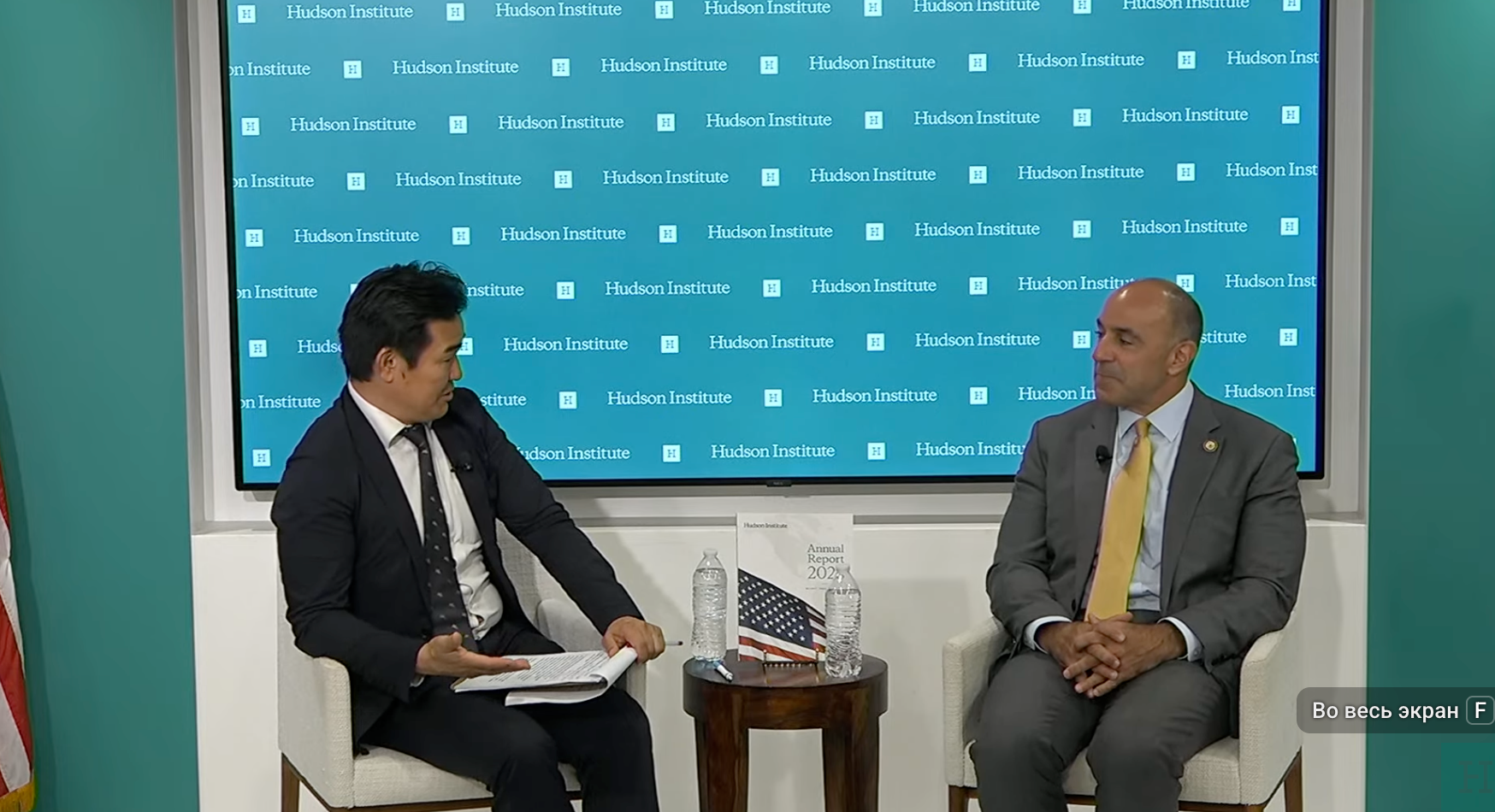
ongressman Panetta and Ken Moriyasu, senior fellow at the Hudson Institute, on Sept. 2, as Washington weighs how to deepen its economic and strategic engagement with Central Asia.
Panetta, a California Democrat and a member of the House Ways and Means Committee, said repealing the Jackson-Vanik amendment would send an important signal of Washington’s commitment as it seeks new critical-mineral suppliers and greater influence in Central Asia.
He noted that closer engagement would serve U.S. interests at a time when securing diversified critical-mineral supply chains has become a growing priority in Washington. His remarks followed a House Ways and Means Committee hearing in which lawmakers considered legislation granting Kazakhstan permanent normal trade relations.
Jackson-Vanik is holding back U.S.-Kazakhstan ties
Panetta’s assessment iss straightforward: when the US retreats from a strategically important space, competitors move quickly to fill the gap.
At the center of that conversation was the decades-old Jackson-Vanik amendment, which Panetta described bluntly as a “Cold War relic.” The Jackson-Vanik amendment, adopted in 1974 to pressure the Soviet Union over restrictions on emigration, links normal U.S. trade relations to freedom of movement. Kazakhstan has met its requirements for decades but remains formally covered by the law.
Panetta framed the continued application of Jackson-Vanik as a contradiction in U.S. policy: Washington is seeking closer economic ties with Kazakhstan while retaining a trade mechanism created during the Cold War.
Panetta called the repeal a “huge step to take to demonstrate symbolically our commitment at a very low cost to the future of not just Kazakh-U.S. relations,” while also noting that it would benefit the U.S. by helping diversify supplies of rare-earth and other critical minerals.
Kazakhstan’s reforms
Yet the significance of Jackson-Vanik in this debate goes beyond economics, because the case being made in Washington is also about how the U.S. assesses Kazakhstan politically and whether it recognizes the context in which the country is pursuing domestic change. Panetta pointed specifically to reforms under President Kassym-Jomart Tokayev. He cited Kazakhstan’s single seven-year presidential term as evidence of political reform, while acknowledging that “more can be done.”
“These are big steps that President Tokayev is taking in the face of a very tough history of this country in order to show that it is willing to make the types of changes that are needed to enhance its democracy and uphold its democratic values. I think it is a major reform not just for Kazakhstan, but for the region, because I guarantee you, Kazakhstan’s biggest neighbors, China and Russia, didn’t like to hear that,” Panetta said.
Panetta described Kazakhstan as a country with exceptionally deep ties to both Russia and China and said that expecting Astana to sever those relationships would be strategically unrealistic.
During the discussion, the possibility was also raised that Kazakhstan’s participation in both U.S.-backed Pax Silica and a Chinese AI initiative could create pressure for Astana to choose one technological ecosystem over the other. Panetta rejected that approach.
“I do not think that is the right strategy to have, and we have to continue to give them the options to choose America,” he said.
The U.S. should compete, not pressure
American engagement should be strong enough that countries choose the U.S. because doing so serves their interests, rather than because Washington has successfully compelled them to choose, he added.
For Kazakhstan, the argument is particularly relevant because the discussion does not present its balanced foreign policy as an obstacle to closer U.S. engagement, but rather as a reality Washington needs to understand and, potentially, use to its advantage.
As Ken Moriyasu, a senior fellow at the Hudson Institute, noted, Kazakhstan’s multi-vector approach may actually benefit the U.S., because Kazakhstan’s geography and economic position make close ties with China and Russia unavoidable, while its relationship with Washington provides another channel for influence. Panetta agreed, emphasizing that Kazakhstan’s position makes such a strategy understandable and that the U.S. should seek to become part of that balancing act rather than demand it abandon it.
This approach also rests on a practical calculation. The discussion repeatedly returned to Kazakhstan’s potential importance for U.S. critical-mineral supply chains, and therefore to the broader question of whether Washington is prepared to translate its renewed strategic interest in Central Asia into the kind of sustained economic engagement that could compete with the relationships China and Russia have already built.
Panetta noted that Washington is only beginning to move in that direction, pointing to the bipartisan support for Jackson-Vanik repeal and the lengthy effort required to bring the issue before the Ways and Means Committee.
“Passing legislation in Congress, one, it is a marathon. Two, it takes a lot of luck. Three, it takes a lot of timing,” he said, adding that the process is beginning to move in the right direction.
Trump visit could send a strong signal
When asked about a possible visit by President Donald Trump, Panetta declined to say whether one was likely but said a presidential trip would signal that Washington intended to remain engaged in a region where China and Russia maintain a strong diplomatic presence.
As leaders gathered in Bishkek recently for the Shanghai Cooperation Organisation summit, including Xi Jinping, Vladimir Putin, Narendra Modi, Recep Tayyip Erdoğan and Pakistan’s leadership, Panetta pointed to the gathering as evidence of how quickly geopolitical space can be occupied when Washington is absent.
Panetta’s argument was that Washington does not need Kazakhstan to abandon its relationships with Moscow and Beijing; it needs to ensure that the U.S. is sufficiently useful, credible and economically attractive to become another indispensable partner.
