
ASTANA – Kazakhstan launched a new housing initiative on April 29 aimed at improving access to safe, affordable housing for vulnerable groups and advancing broader housing policy reforms.

Photo credit: egov.kz
The three-year project, called Shanyraq: Partnerships for Stronger Communities and the Right to Accessible Housing for All, is supported by the European Union and implemented by the Eurasia Foundation of Central Asia (EFCA) in partnership with the iTeachMe Foundation and the Nomad Rights Foundation. It is expected to directly benefit at least 400 people while strengthening civil society organizations, advancing housing rights advocacy and improving citizens’ legal and financial literacy.
“Safe, adequate and affordable housing is not a privilege – it is a basic right. Through the Shanyraq project, we are bringing partners together to help make that right a reality for everyone in Kazakhstan,” said Juana Mera Cabello, the deputy head of cooperation at the Delegation of the European Union to Kazakhstan.
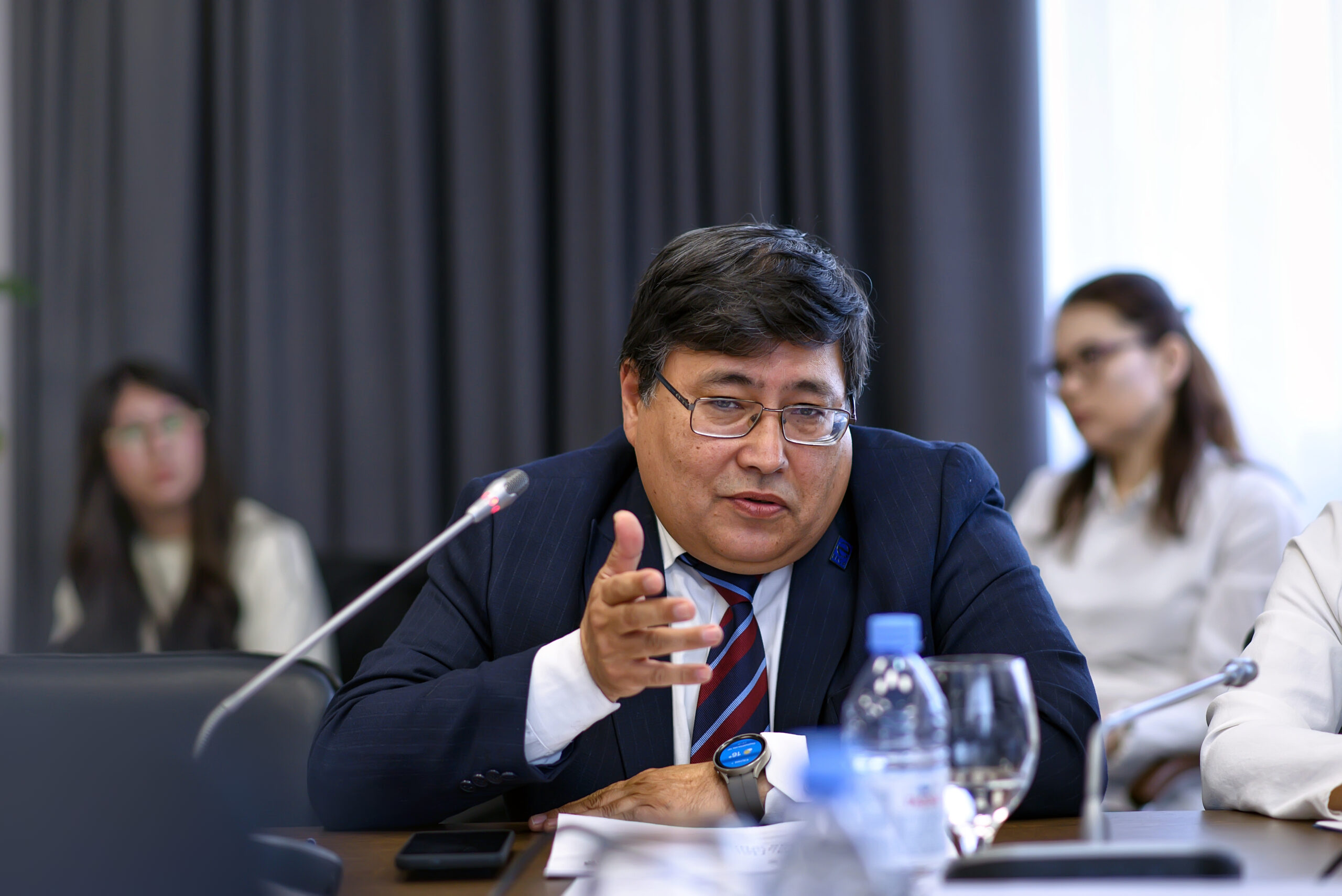
Rinad Temirbekov, director of the Eurasia Foundation of Central Asia (EFCA), noted that the project aims to increase the effectiveness of existing housing support programs for socially vulnerable groups. Photo credit: EFCA
Rinad Temirbekov, the EFCA director, said the project is built on a partnership between civil society organizations and government agencies, with the goal of increasing the effectiveness of existing housing support programs for socially vulnerable groups.
He identified four categories of systemic barriers the project seeks to address: legal and institutional, economic, physical and informational.
“Legal and institutional barriers include restrictions on eligibility for housing waiting lists, inadequate criteria for determining need and limited mechanisms to account for diverse life circumstances,” Temirbekov said.
Economic barriers stem from the gap between household incomes and market housing prices, as well as shortcomings in government subsidy programs that do not fully reflect the actual costs of building adequate housing.
Temirbekov noted that physical barriers include a shortage of accessible and adaptable housing units and underdeveloped infrastructure for people with disabilities, whose needs vary significantly across categories.
Informational barriers reflect a lack of public awareness about available government programs, difficulty accessing advisory support and the absence of a single digital platform to simplify access to housing services.
“The variety of programs is really present. However, it is difficult for a person to understand the nuances of different programs,” Temirbekov said.
Project beneficiaries include people with disabilities, families raising children with disabilities, large families, orphanage graduates and single parents.
Temirbekov said expected outcomes include inspections of housing units for accessibility compliance, improved access to adequate housing, stronger capacity of civil society organizations and policy recommendations for housing reform.
Research and advocacy
Alisher Kozhagulov, a lawyer and representative of the Nomad Rights Foundation, said the project includes a significant research component, with ten nongovernmental organizations conducting studies nationwide. Research will be conducted both online and in person, using focus groups, interviews, observations and assessments of how people navigate, or are unable to navigate, housing waiting lists.
“The main goal is to create a toolkit for working with this data for NGOs and anyone to assess the availability and quality of housing,” Kozhagulov told The Astana Times.
He noted that the project’s broader ambition is to reframe housing in Kazakhstan, shifting it from a commodity to a recognized social good and human right.
“We are not saying the state should give everyone housing for free. We are saying that housing should be accessible to anyone, and that it should be adequate in terms of safety, convenience and comfort, not just four walls and a roof,” he said.
Kozhagulov highlighted that the research will examine specific technical issues, including how housing is allocated through waiting lists, what types of units are assigned and to whom, and whether the distribution process is fair and transparent.
He also flagged a legislative gap that allows housing to be provided, with consent, below the legally required minimum of 15 to 18 square meters per person.
“This creates room for manipulation, as people who have waited in line for decades may feel compelled to accept substandard housing. We want to close that gap,” said Alisher Kozhagulov.
