
ALMATY – Kazakhstan’s transport and logistics sector reached 12.2 trillion tenge (US$26.5 billion) in output in 2025, as the government ramps up efforts to expand the country’s transit potential, Prime Minister Olzhas Bektenov said at an April 13 government meeting.
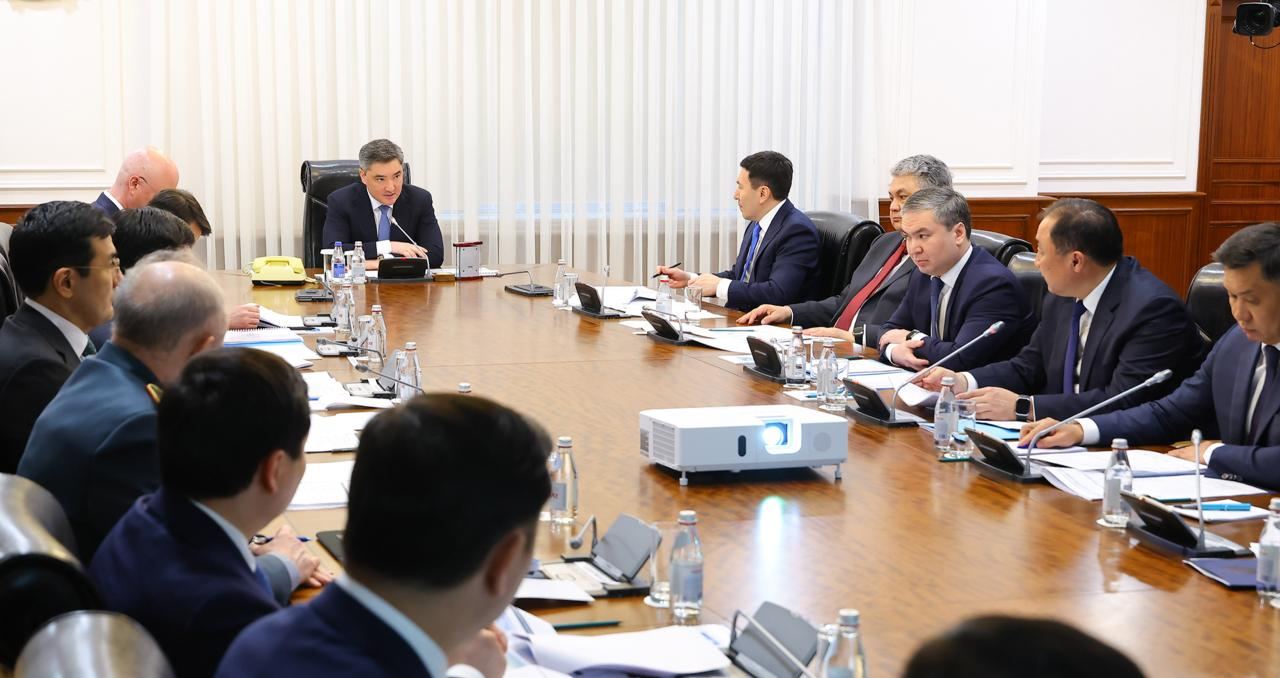
Prime Minister Olzhas Bektenov held a meeting to review the development of transit and transport sectors. Photo credit: Prime Minister’s press service.
According to him, road transport remains a key pillar, with 353 million tons of cargo transported domestically last year. Major infrastructure upgrades included the completion of four large highway projects, such as Kalbatau–Maikapchagay, Taldykorgan–Ust-Kamenogorsk, Atyrau–Astrakhan, and Karagandy–Almaty, covering a total of 2,000 kilometers.
Ongoing work focuses on developing transit corridors, including Aktobe–Kyzylorda, Beineu–Saksaulsky, Center–West, Karagandy–Zhezkazgan, and the Saryagash bypass. Annual road construction and repair now covers 13,000 kilometers.
Modernization of border checkpoints is also underway, with 37 facilities under construction and completion expected by 2027.
Rail transit and Trans-Caspian corridor development
Rail transport continues to play an increasingly important role in transit flows. In 2025, transit volumes reached 33 million tons, a 20% year-on-year increase, while the share of transit in total rail transportation rose to 10%.
In the first quarter of 2026, transit volumes increased by a further 14%, reaching 9 million tons, with container traffic up by 6%.
Particular attention was given to the development of the Trans-Caspian International Transport Route. Efforts are focused on reducing delivery times, introducing unified tariffs along the Altynkol–Poti/Batumi route, and integrating digital systems with partners in Azerbaijan and Georgia.
Large-scale railway infrastructure projects totaling 3,900 kilometers are also underway, including new lines such as Moiynty–Kyzylzhar and Bakhty–Ayagoz, as well as the modernization of key segments.
Bektenov highlighted delays in the Bakhty–Ayagoz project due to insufficient equipment and workforce, instructing authorities to address the issue. He also emphasized the importance of expanding the capacity of cross-border junctions to 100 million tons annually.
Ports and maritime logistics
According to Bektenov, the government is also advancing maritime infrastructure, particularly through the development of the Ports of Aktau and Kuryk.
Plans include dredging 1.3 million cubic meters at Aktau port this year. Bektenov criticized delays in procuring six container vessels for the Aktau–Baku route and instructed officials to expedite the process.
Aviation growth and new routes
According to Bektenov, Kazakhstan’s civil aviation sector also performed strongly. In 2025, airlines transported 20.8 million passengers, while airports handled 31.8 million travelers, including 12 million in Almaty and 9.2 million in Astana.
By 2028, the country plans to implement 11 major aviation infrastructure projects, including four new airports, two runways, and upgrades in five cities.
This year, Kazakhstan aims to expand its international flight network to 135 routes across 30 countries, up from 115 routes in 2024.
Government measures have also reduced domestic aviation fuel prices to $800 per ton, making them more competitive regionally. As a result, several foreign airlines, including Centrum Air, Shiraq Avia, Martinair, One Air, Atlas Air and MNG Airlines, have entered the Kazakh market.
Digitalization and logistics efficiency
According to officials, digital transformation remains a central priority. Kazakhstan conducts transport operations with 42 countries, while the number of foreign transport permits has tripled since 2022.
The introduction of the CarGoRuqsat system has enabled electronic issuance of permits, with 70% already digitized. Kazakhstan has also launched pilot projects for e-Permit systems with member states of the Organization of Turkic States and e-CMR for international freight transport.
Bektenov instructed authorities to continue expanding digital permit systems in cooperation with international partners.
Throughout the meeting, Bektenov stressed the need to improve implementation speed across key projects, from railway construction to airport modernization and border infrastructure.
The government, he said, must ensure that all initiatives are delivered on time to fully unlock Kazakhstan’s potential as a major Eurasian transit hub.
