
ASTANA – The Diriyah Biennale Foundation (DBF) will host the Islamic Arts Biennale’s third edition from Nov. 1, 2027 through March 1, 2028, at the Western Hajj Terminal of King Abdulaziz International Airport in Jeddah, Saudi Arabia. The exhibition seeks to bring together historical works with contemporary ones exploring the arts of Islamic civilizations, past and present.
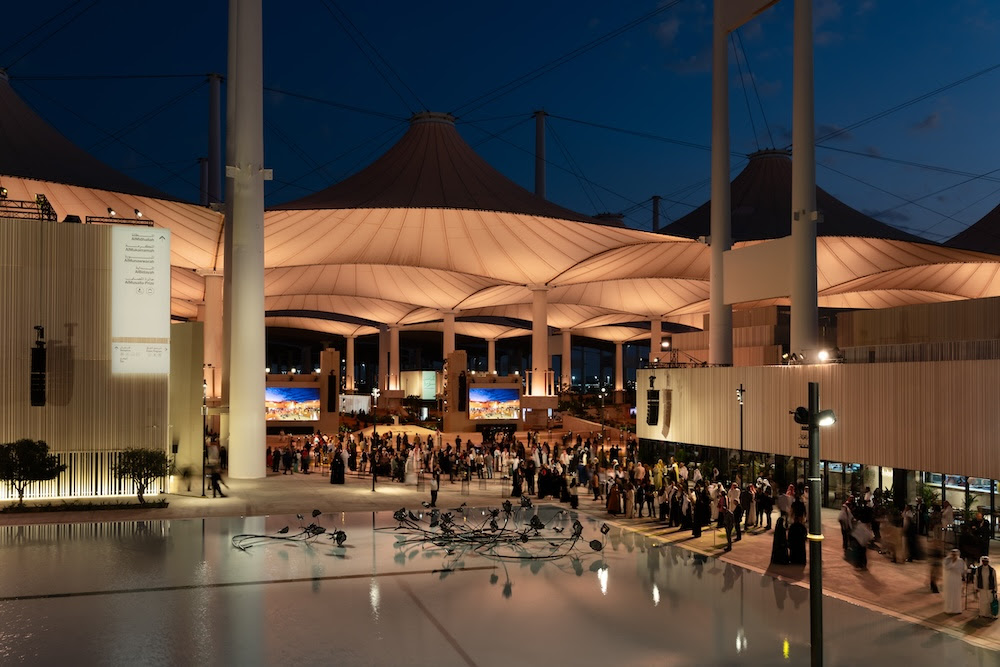
The 2025 Islamic Arts Biennale at the Western Hajj Terminal of King Abdulaziz International Airport. Photo credit: Diriyah Biennale Foundation.
The foundation has launched a call for proposals and a committee evaluation led by a multi-disciplinary team with expertise in archaeology, architecture, art history, contemporary art, and cartography.
Jordanian artist Raya Kassisieh and AT editor in chief Zhanna Shayakhmetova pose near the “Heavy Petals” sculptural installation at the Islamic Arts Biennale in 2025. Photo credit: Diriyah Biennale Foundation.
The organization also shared plans to develop a year-round exchange program for artists and institutions.
According to Diriyah Biennale Foundation CEO Aya Al-Bakree, the exhibition presents “a new model for institutional collaboration and the writing of histories of art.”
“Creating new connections, conversations, and encounters through the arts is at the core of the Diriyah Biennale Foundation’s work, and with the Islamic Arts Biennale we show that these encounters can happen over vast stretches of historical time as well as across places,” said Aya Al-Bakree.
Author and historian Abdul Rahman Azzam, one of the curatorial team member, during a media tour to the exhibition halls. Photo credit: Diriyah Biennale Foundation.
The inaugural and second editions presented more than 500 historical objects from more than 40 institutions across more than 20 countries.
One of the highlights of the biennale was the first-ever display of the Kiswah of the Holy Kaaba outside Makkah in 2025. The AlMusalla Prize international architectural competition has also been launched officially to recognize new architectural solutions for the spaces of worship being modular, empowering and open.
It should be noted that Kazakh and Uzbek creative industry representatives took part in the second biennale last year. Uzbekistan showcased 17 historical items, including the Kattalangar Quran of the eighth century, one of the most important manuscripts of the Islamic world, a collection of hadiths “Imam al-Bukhari’s Al-Jami ‘as-Sahih” of the 17th century, ceramic jugs and bowls from Samarkand and Afrasiab of the 10th-12th centuries, national clothes and shoes.
