
ALMATY – The spirit of a city is preserved in those buildings that have witnessed thousands of personal stories and every stage of its growth and transformation. Today, as the skyline is reshaped by glass towers and constant redevelopment, it is these long-standing architectural landmarks, now part of the city’s cultural heritage, that continue to reflect its rhythm of life, deepening locals’ affection and drawing visitors from around the world.
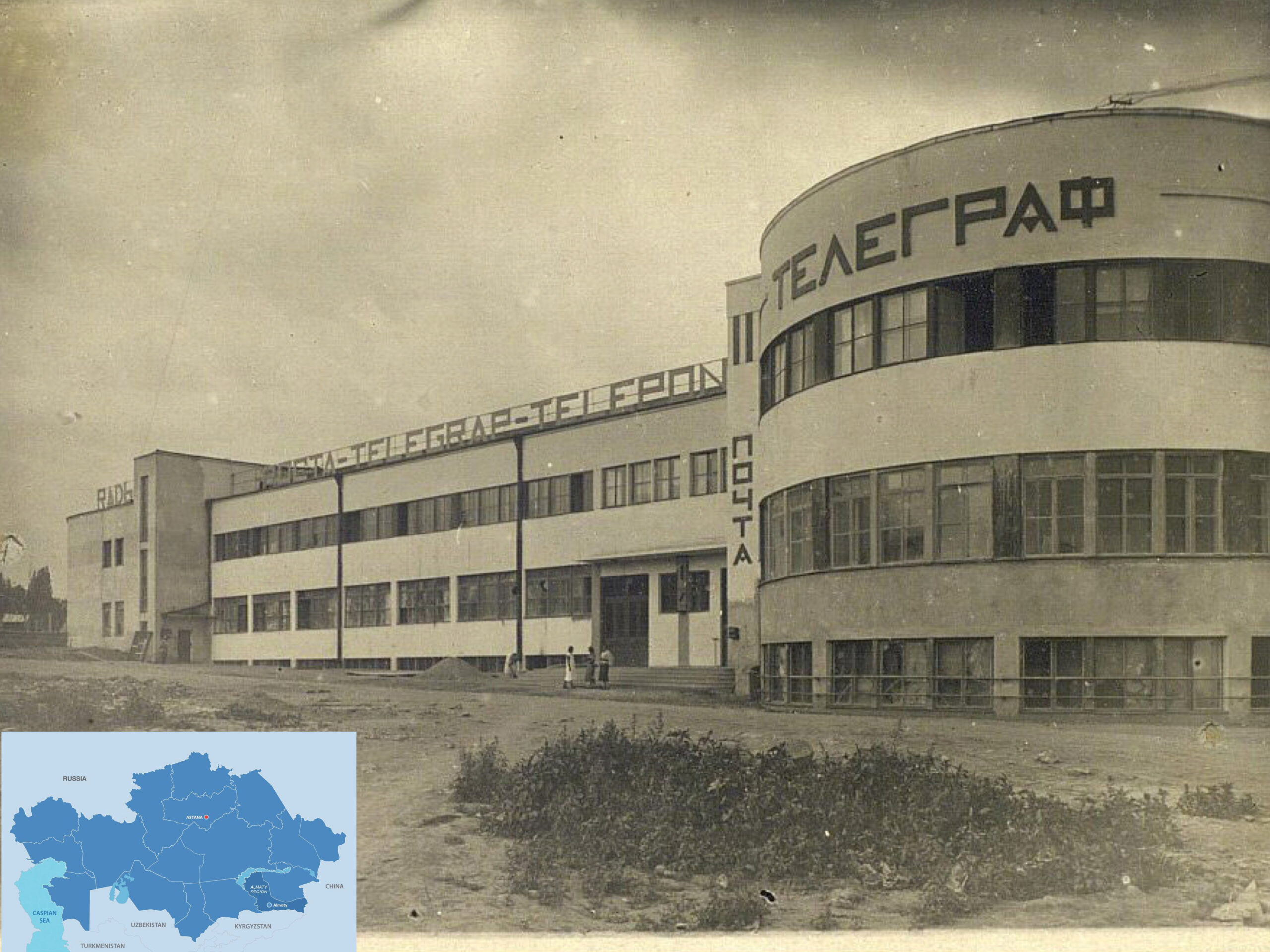
Almaty’s Central Post Office in 1934. Photo credit: pastvu.com Click to see the map in full size. The map is designed by The Astana Times.
One such landmark is Almaty’s Central Post Office, also known as the House of Communications, a complex that continues to host the city’s post office, while one of its later wings, along with the iconic clock tower, now belongs to the Kurmangazy Kazakh National Conservatory.
From capital ambition to urban landmark
The building rose between 1931 and 1934, at a time when Alma-Ata, then the city’s name, had just become the capital of then Kazakh Soviet Socialist Republic. Constructed as part of a newly envisioned administrative center, it embodied the optimism of a city assuming a new political and cultural role.
Known at the time as the House of Communications, the facility brought together the post office, telegraph, teletype and telephone services under one roof. In an era when communication symbolized modernity itself, the building reflected the new capital’s ambition to connect internally and to the wider world.
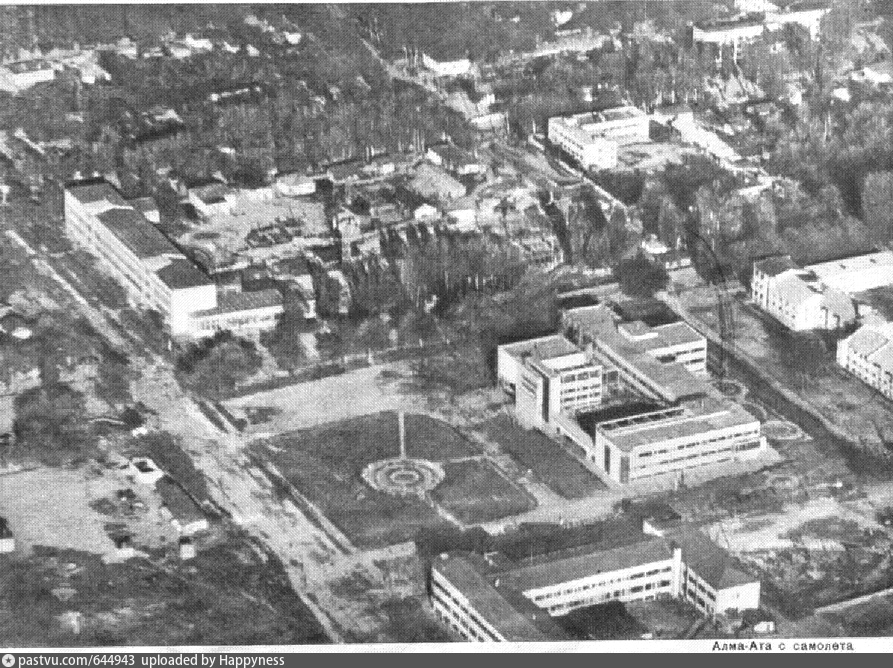
Red Square, Government House, House of Communications, Turksib Administration, 1936. Photo credit: “Fifteen years of the Kazakh SSR” book, National Academic Library of the Republic of Kazakhstan.
Designed in the spirit of Soviet constructivism, the project is most often attributed to architect Georgy Gerasimov, though some sources link it to Moisei Ginzburg and the Vesnin brothers, figures central to the architectural avant-garde of the 1920s and 1930s. The complex formed part of the city’s early administrative ensemble, alongside the government house and TurkSib administration, shaping what residents once called the Red Square of Alma-Ata.
The original facade color is unknown, though from the 1950s onward it remained within a gray tonal range. Wooden frames were used for ribbon windows. The single-pitched roof was hidden behind a high parapet on the eastern and northern facades. Along the frieze, inscriptions reading “telephone,” “telegraph,” and “radio” were initially displayed in Latin script, later replaced with Cyrillic lettering in the late 1940s. By the end of the 1990s, these inscriptions had been removed.
The clock that became a meeting place
In 1955, a major western extension was added along Abylai Khan Avenue. This included a four-story rectangular body and a five-story corner volume designed by architect Kim Do Sen.
In 1960, construction began on the clock tower atop the extension. The project was commissioned by the Ministry of Communications of the Kazakh SSR. Construction of the clock was completed in 1964, as recorded in the ministry’s capital construction plan documentation.
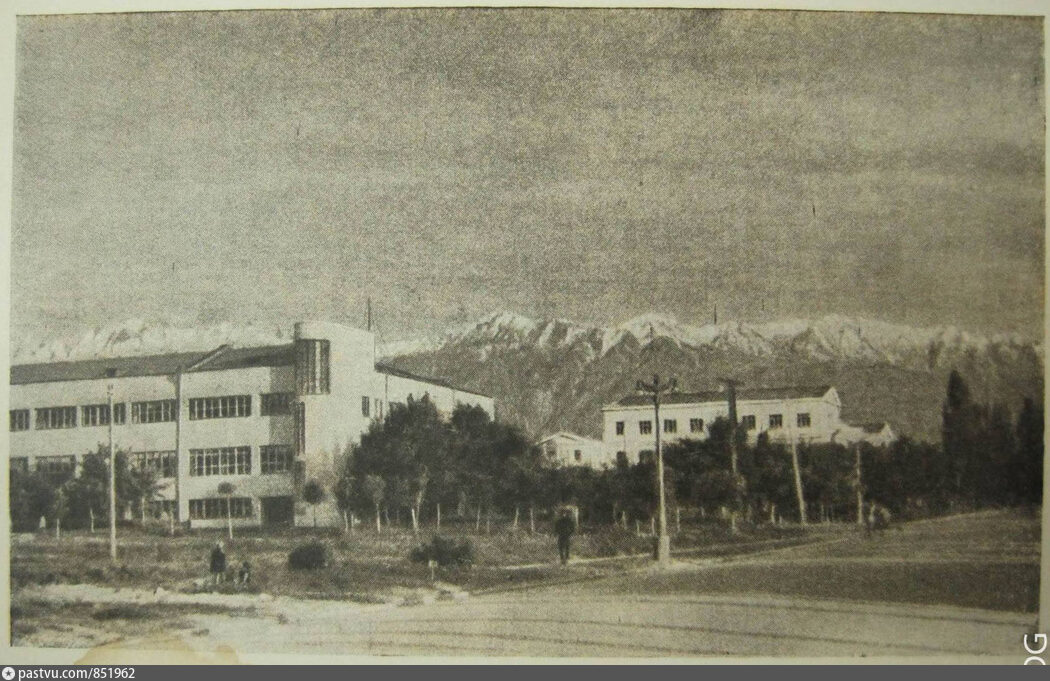
1948-1949. Photo credit: Almaty city archive.
The chimes were launched in 1963. The clock tower quickly became a popular meeting point and a romantic symbol for the public. Generations arranged meetings beneath it. Students, soldiers, musicians, couples on first dates, all passed through that shared space of anticipation.
Transformation and revival
On Dec. 19, 1999, by order of the then Ministry of Transport and Communications of Kazakhstan, the administrative building on Abylai Khan Avenue was transferred to the Kurmangazy Kazakh National Conservatory, along with the clock tower. While the western wing and tower became part of the conservatory’s facilities, the building continues to house the post office and its corporate directorate.
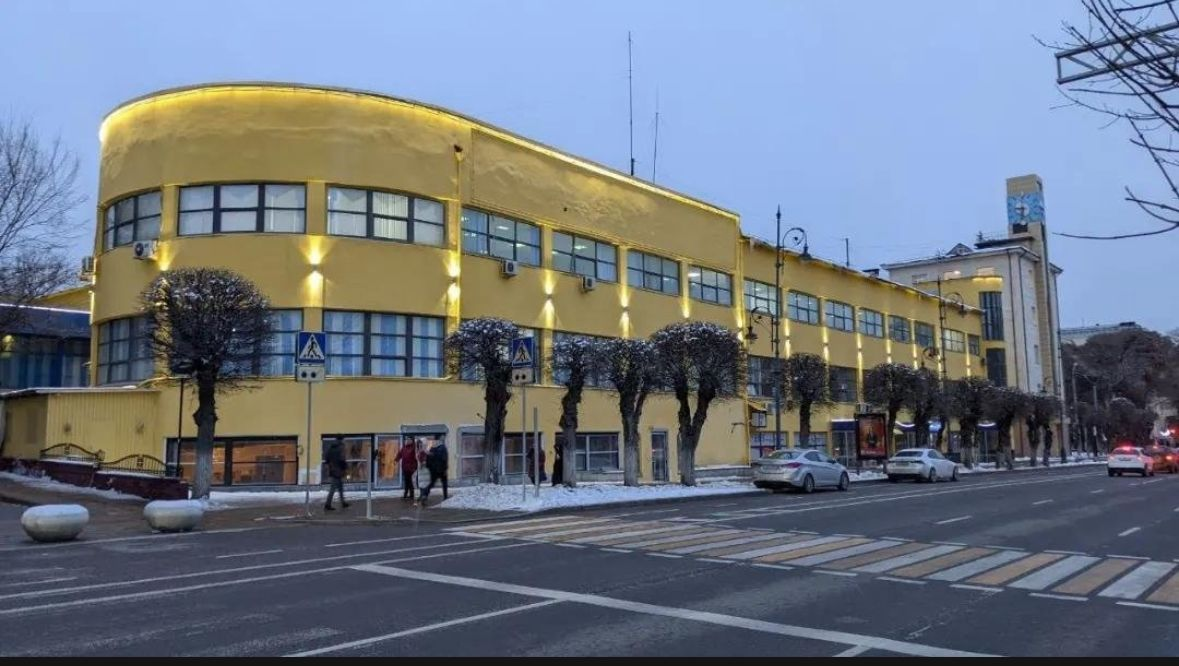
The former House of Communications, a complex that continues to host the city’s post office, while one of its later wings, together with the iconic clock tower, now belong to the Kurmangazy Kazakh National Conservatory. Photo credit: The Astana Times.
By the late 1990s, the clock had been silent for nearly a decade. Following the transfer to the conservatory, an initiative to modernize the mechanism was launched in 2003 with the support of a local bank.
A new clock system was manufactured by the Austrian firm Schauer & Sachs, founded in the early 19th century. The restored mechanism, weighing 47 kilograms, included four clock faces connected to a central control unit. It was equipped with GPS synchronization to ensure accuracy, automatic correction following power outages, and automatic transition between seasonal time changes.
The musical chimes
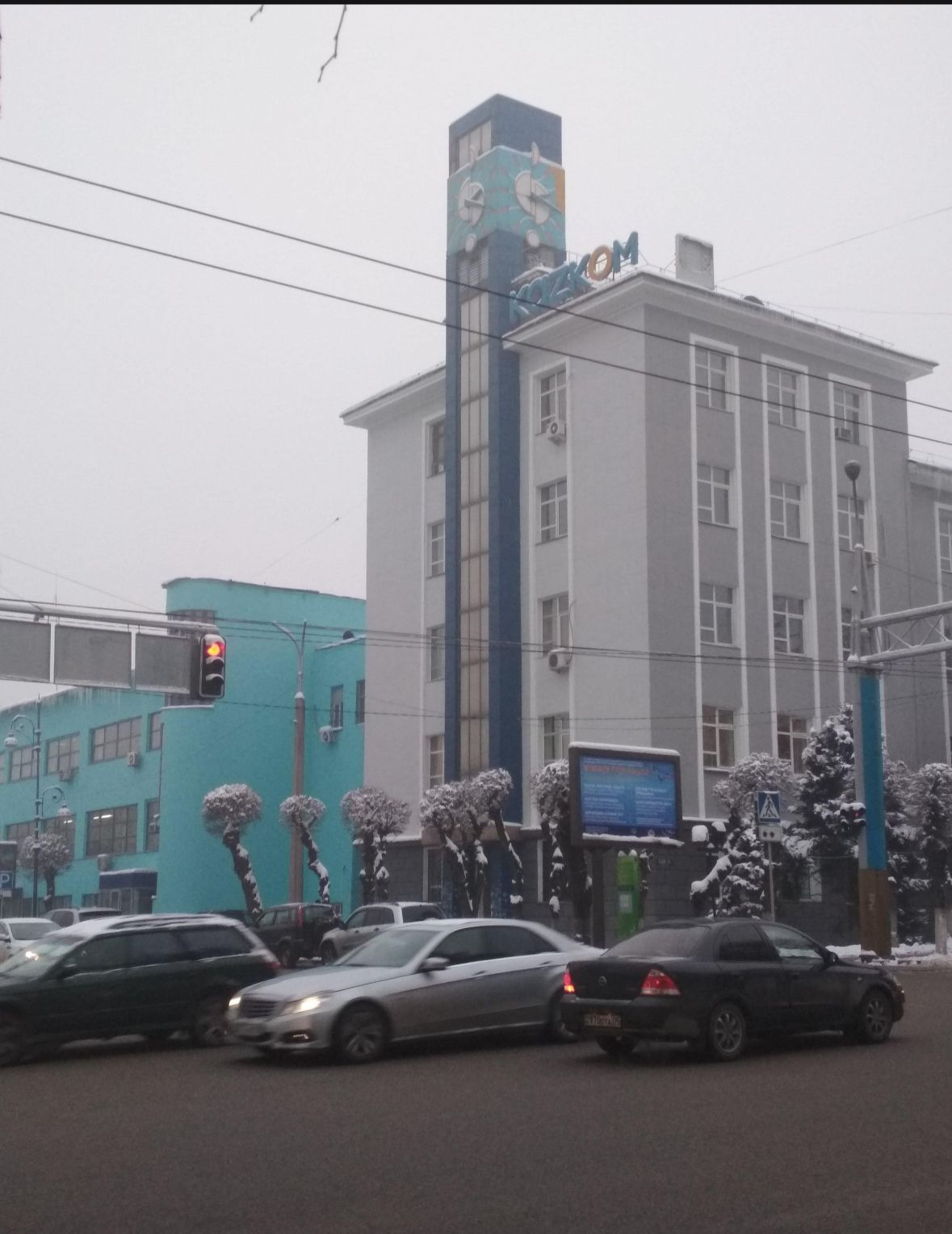
The former House of Communications, a complex that continues to host the city’s post office, while one of its later wings, together with the iconic clock tower, now belong to the Kurmangazy Kazakh National Conservatory. Photo credit: The Astana Times.
A new transformation began in 2009 with the launch of the Musical Clock for Our City project, dedicated to the 20th anniversary of Kazakhstan’s independence. The initiative brought together the conservatory, Kazkommertsbank, charitable foundations, and several cultural organizations.
The updated system introduced 13 Austrian-made bells connected to a computerized keyboard, allowing the performance of programmable melodies from world and Kazakh classical repertoires. GPS navigation ensured time precision, while LED lighting illuminated the clock faces at night, a feature previously absent. The design incorporated a stylized treble clef at the center of the dial, symbolizing the building’s cultural affiliation with the conservatory.
A living landmark
From its construction in 1931–1934 as a communications hub of the new capital, through its 1950s expansion, and the 2000s technological and musical rebirth, the former House of Communications reflects nearly a century of Almaty’s architectural and civic history.
Almaty has changed beyond recognition in many ways. New districts have emerged, architectural styles have shifted, and the city’s center has expanded outward. Yet in the golden square, time folds back on itself.
Cities rarely preserve their spirit in monuments alone. More often, it survives in places where people gathered and felt the city’s soul. In a city that continues to modernize, this complex remains one of the most enduring witnesses to its past.
