
ASTANA – The global political system is undergoing a profound transformation, calling for a shift from ideological globalism to a more pragmatic, sovereignty-based international order, Kazakh President Kassym-Jomart Tokayev writes in an article published on The National Interest on Feb. 18, ahead of his visit to the United States.
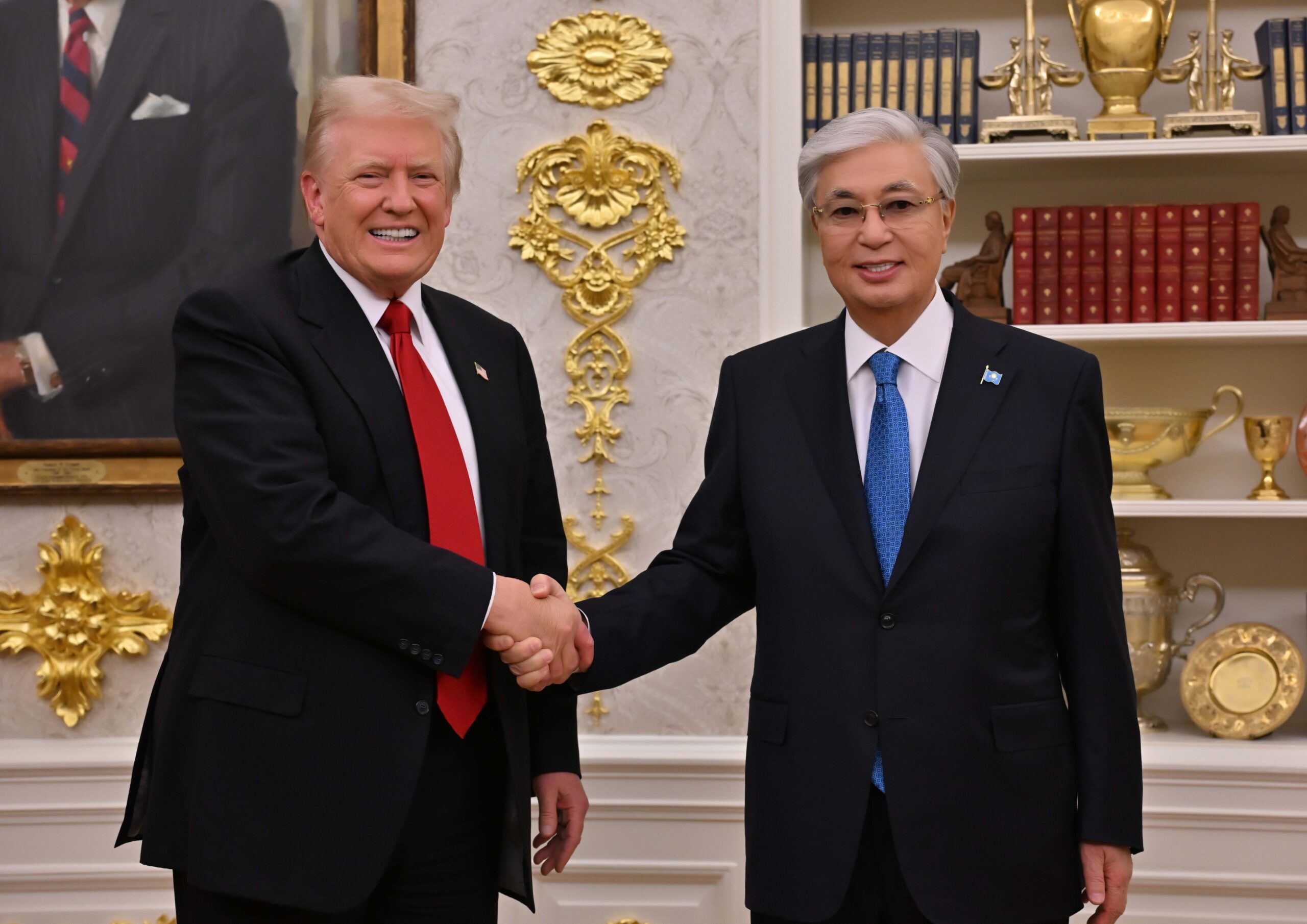
Donald Trump with Kassym-Jomart Tokayev in the Oval Office, Nov. 6, 2025. Photo credit: Akorda
He noted the international system is facing deep structural strains and a legitimacy crisis.
“The world is entering an era where stability has become one of the rarest strategic resources. Conflicts are multiplying, geopolitical rivalry is sharpening, and international institutions are increasingly strained by gridlock, polarization, and declining public trust,” Tokayev wrote.
President Tokayev writes that although globalism initially aimed to create an “interconnected and inclusive international order,” it gradually became distorted by excessive ideological assumptions. This, he writes, led to a widening gap between political elites and public expectations.
“However, over time, that concept became distorted. It evolved into a model built on excessive ideological assumptions: inclusiveness without responsibility, freedoms without limits, and moral superiority (or exceptionalism) that dismissed the views of sovereign-minded societies, pragmatic policymakers, and those guided by common sense,” the article reads.
According to Tokayev, this erosion of balance contributed to declining public trust and skepticism toward international institutions. He emphasized that the global debate is now shifting toward realism and national responsibility.
“The world is not moving away from cooperation. It is moving away from illusion. The new emerging doctrine is straightforward: order must be based on the rule of law, responsibility, predictable commitments, and respect for cultural and national identity. This is not isolationism. It is political maturity.”
Tokayev also highlighted the limitations of past conflict-resolution mechanisms, which often resulted in symbolic outcomes rather than tangible peace.
In this context, Tokayev describes the creation of the Board of Peace, initiated by Donald Trump and endorsed by the United Nations, as a practical step toward delivering results, notably in the Middle East.
The initiative advances a framework of peace through sustainable economic development, treating peace as a concrete project built on infrastructure, investment, and long-term stability.
Tokayev said that Kazakhstan’s decision to join the initiative reflects its consistent foreign policy approach: maintaining balanced relations, supporting a two-state solution, strengthening economic cooperation, and contributing to dialogue between the Muslim and Jewish worlds.
All these steps, Tokayev wrote, have strengthened Kazakhstan’s partnership with the United States. Kazakhstan and the United States have built a multifaceted partnership based on mutual respect and understanding. U.S. companies have long been among Kazakhstan’s largest investors, notably in the energy sector.
The cooperation is now expanding into critical minerals, digital infrastructure, advanced manufacturing, logistics, and innovation. A notable project is the development of one of the world’s largest tungsten deposits in partnership with American Cove Capital.
“Over the past years, we have pursued a strategy of modernization, diversification, and integration into global markets. We have strengthened the investment climate, improved regulatory frameworks, and expanded regional connectivity. As a result, Kazakhstan’s GDP per capita has reached $15,000, further cementing its position as the largest economy in Central Asia,” Tokayev writes.
He reiterated that Kazakhstan aims to become a major transit and logistics corridor connecting Asia and Europe, while building a modern economy grounded in technology, innovation, and human capital.
Tokayev stresses that digital transformation, public sector modernization, and adoption of technologies such as artificial intelligence are practical steps, not abstract goals.
“They are part of a national strategy to build a competitive state capable of meeting today’s challenges,” the article reads.
He also noted that Kazakhstan’s economic progress is accompanied by institutional reforms, as the country is moving away from a super-presidential model toward a governance structure with stronger checks and balances.
“This modernization agenda will soon reach an important milestone. Kazakhstan is preparing a national referendum on a new Constitution, aimed at strengthening public institutions, enhancing accountability, and ensuring more sustainable governance for the future,” Tokayev writes.
