
ALMATY – President Kassym-Jomart Tokayev outlined connectivity and economic cooperation as the main pillars of Kazakhstan–Pakistan relations in a Feb. 5 interview with The News Pakistan, emphasizing trade expansion, transport corridors and regional stability.
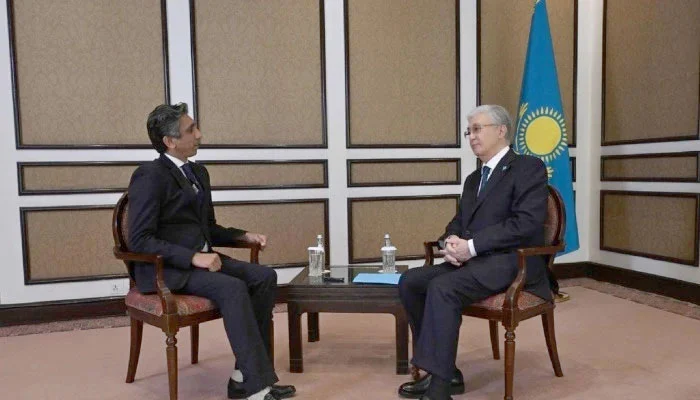
President Kassym-Jomart Tokayev outlined key areas of Kazakhstan-Pakistan cooperation in a Feb. 5 interview. Photo credit: The News Pakistan.
According to Tokayev, the partnership between the two countries is increasingly focused on delivering practical economic results.
“Connectivity has indeed become a top issue of our joint agenda. In this context, Kazakhstan is ready to participate in the development of the Kazakhstan–Turkmenistan–Afghanistan–Pakistan corridor, which we regard as strategically important for regional connectivity and access to South Asian markets,” he said.
Tokayev noted that Pakistan has shown a positive approach to close coordination on the project and stressed the importance of active, coordinated participation by all stakeholders to ensure the successful implementation of transit and transport initiatives.
Views on global issues
Speaking about the United States, he described President Donald Trump as a strong and forward-looking leader whose policies prioritize national interests and economic performance.
“I am a committed supporter of his emphasis on common-sense policies and the restoration of law and order. Likewise, in Kazakhstan, we pursue a firm law-and-order policy to make our country stronger in today’s complex global environment,” Tokayev said.
In the Middle East, Tokayev said Kazakhstan’s decision to join the Abraham Accords reflects its long-standing commitment to peace and dialogue. He stressed that Kazakhstan maintains good relations with Israel while also consistently supporting the Palestinian people and advocating a two-state solution.
“From the standpoint of national interests, joining the Abraham Accords lays a solid foundation for attracting investment, advanced technologies and tangible economic benefits,” President Tokayev said.
Addressing the Russia-Ukraine conflict, Tokayev reiterated Kazakhstan’s support for a political and diplomatic resolution.
“While Kazakhstan does not seek a mediating role, we are ready to offer our good offices, including providing a neutral platform for negotiations, should such an opportunity arise,” he said.
Multilateral initiatives
Tokayev also addressed new international diplomatic formats, including the recently established Board of Peace. According to him, the initiative is intended to complement, not replace, the United Nations.
“The Board of Peace is a timely and relevant initiative designed to deliver swift and effective results,” he said. “It is particularly significant that this initiative implements United Nations Security Council Resolution 2803, recognising that peace must be anchored in both international legitimacy and effective leadership.”
Speaking about Gaza, Tokayev noted that while recent peace proposals appear ambitious and development-oriented, their success ultimately depends on political will.
“Without genuine political will to move forward towards a two-state solution, no plan can be truly sustainable. This remains the only viable framework for breaking the recurring cycle of violence and instability,” he said.
On international law and border issues
Responding to a question about Greenland, Tokayev emphasized that any decisions regarding territories must be made in strict accordance with international law and in respect of sovereignty.
“There are many cases in international practice in which countries enter into long-term lease arrangements for specific territories or strategic infrastructure, often for shared, mutually beneficial objectives,” he said.
Tokayev suggested that dialogue and legally grounded arrangements could provide pragmatic solutions while preserving sovereignty, expressing hope that all parties involved in such issues would seek mutually acceptable outcomes through responsible statecraft.
Political and economic reforms at home
Tokayev also highlighted Kazakhstan’s domestic transformation, describing ongoing constitutional reforms as part of a broader effort to build a more balanced and accountable political system.
“Kazakhstan has moved away from a super-presidential system toward a presidential republic with consolidated checks and balances, grounded in a strong president, an influential parliament, and an accountable government,” he said.
Outlining the country’s long-term development path, Tokayev said Kazakhstan aims to build “a just, safe, clean, and progressive” state with a strong rule-of-law culture, while advancing digital transformation and attracting investment through a stable and predictable business environment.
