
ASTANA – Kazakhstan’s creative sector is strengthening international cultural ties through ballet, as the Kazakh National Academy of Choreography hosts exchange projects with artists and schools from Spain and South Korea, bringing together diverse dance traditions and training methods.
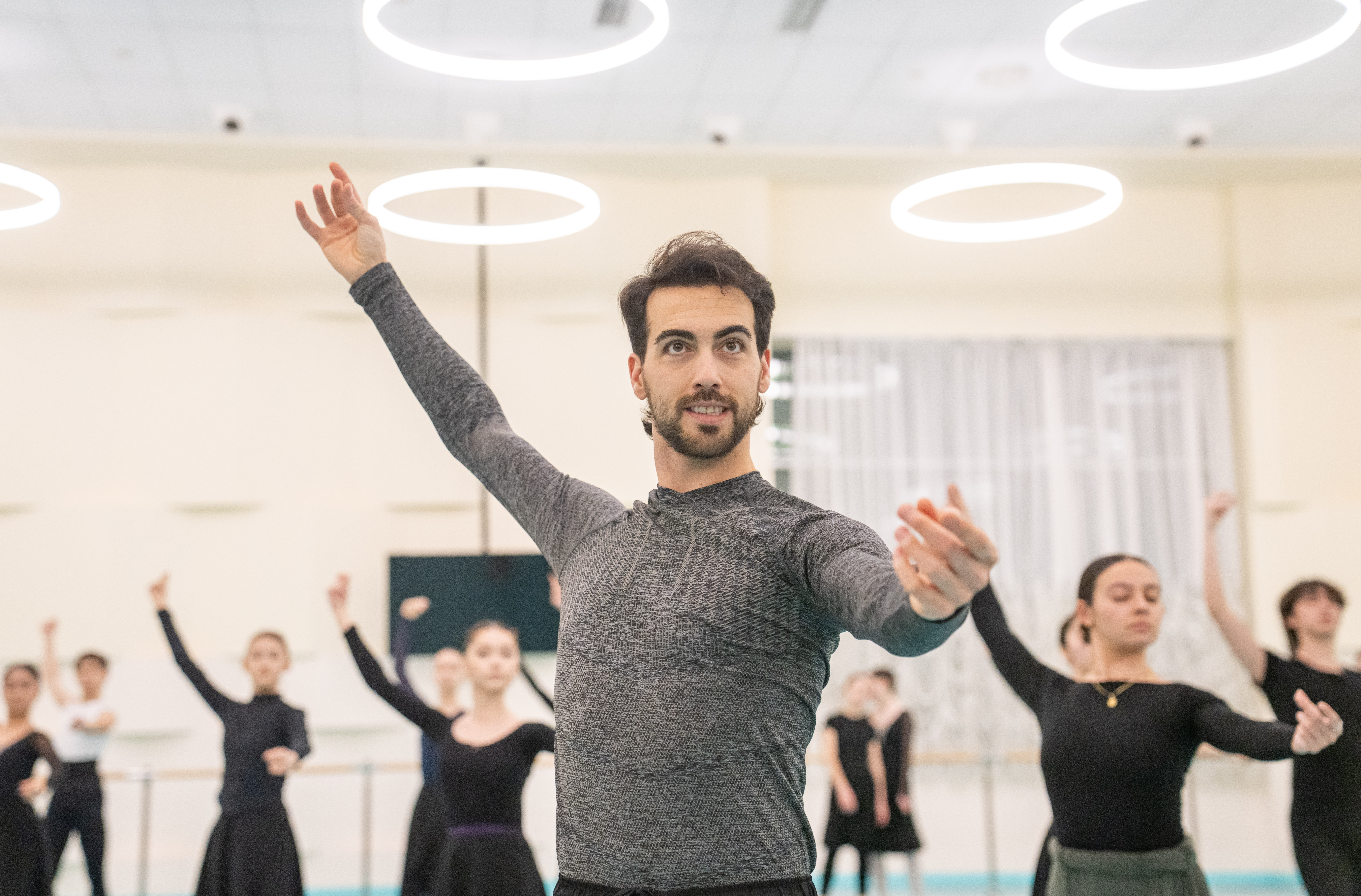
Spanish choreographer Carlos Romero during a lesson with the Kazakh National Academy of Choreography students. Photo credit: The Kazakh National Academy of Choreography
Spanish choreographer Carlos Romero is currently working with Kazakh students in Astana and preparing a second project in Almaty, blending Spanish dance styles with classical ballet training in what he describes as an intense but rewarding collaboration.
“This is my second time in Astana, and next week will be my first time in Almaty. We are working on two different projects during this visit,” Romero told The Astana Times.
Spanish choreographer Carlos Romero and The Astana Times journalist Aiman Nakispekova. Photo credit: The Kazakh National Academy of Choreography
In Astana, Romero is creating choreographic pieces with two student groups at a classical academy. The works incorporate Spanish character dance, elements of danza estilizada, which is a stylized Spanish dance, and rhythmic footwork known as zapateado. The five-day schedule is demanding, culminating in a final presentation.
“Normally, we develop this kind of choreography over three or four weeks. Here we had five days, so it’s intense and a big responsibility. However, the students are amazing, disciplined and committed,” Romero said.
In Almaty, Romero plans to lead a choreographic laboratory with the contemporary dance company. Unlike the structured project in Astana, the laboratory will focus on improvisation and idea development for a full performance planned for next year.
Romero’s projects in Kazakhstan grew out of a partnership between his Spanish dance school and the Spanish Embassy, a collaboration he described as a way to broaden cultural dialogue.
Romero commended Kazakh students for their focus and work ethic. Photo credit: The Kazakh National Academy of Choreography
“We wanted to internationalize our culture and also discover Kazakh culture. Sharing knowledge and traditions creates a real connection,” Romero said.
While the two countries approach dance in distinct ways, he said they share a classical ballet heritage, one that traveled across Europe before leaving its mark on Spanish dance.
Romero commended Kazakh students for their focus and work ethic, contrasting it with trends he observes among younger dancers in Europe.
“They have strong respect and concentration. They stay engaged and communicate directly. In Europe, especially among younger generations, we are sometimes losing this. I would like to bring this spirit back to Spain,” he said.
He said Kazakh training’s emphasis on refined posture, controlled movement and precision mirrors key elements of Spanish dance aesthetics.
Shared dance traditions
Alongside the Spanish collaboration, the Kazakh National Academy of Choreography is also hosting students from South Korea’s Lira Ballet Academy in Busan as part of a parallel exchange program.
Founded in 2017, the Lira Ballet Academy is a studio-based school with roughly 40 students aged 7 to 30. Lee Youha, the academy’s director, noted that they turned to Astana after pandemic travel restrictions disrupted training exchanges with Russia’s Novosibirsk ballet school.

Four students from South Korea’s Lira Ballet Academy take part in ballet classes in Astana. Photo credit: The Kazakh National Academy of Choreography
Russian colleagues recommended Kazakhstan as an alternative destination, prompting the academy’s first visit to Astana.
“The academy’s teachers work with great dedication and sincerity. Despite the language barrier, they demonstrate movements in detail, explain expressiveness and pay close attention to body mechanics and other essential aspects of ballet technique. Even after a few days, the students’ progress is visible,” Lee said.
She noted similarities between Kazakh and Korean dance traditions, particularly refined and expressive arm movements, and emphasized precision and delicacy as shared artistic values.
She said she hopes her students will one day take to Kazakh stages, continuing a cultural dialogue that now stretches beyond borders.
“Ballet education today combines classical foundations with contemporary development. It is important to preserve national identity alongside international ballet standards,” Lee said.
