
ASTANA — President Kassym-Jomart Tokayev has urged the Financial Monitoring Agency (FMA) to rapidly adopt artificial intelligence and digital tools to counter financial crime, warning that technological lag could pose serious risks to Kazakhstan’s economic and national security during a Jan. 28 meeting.
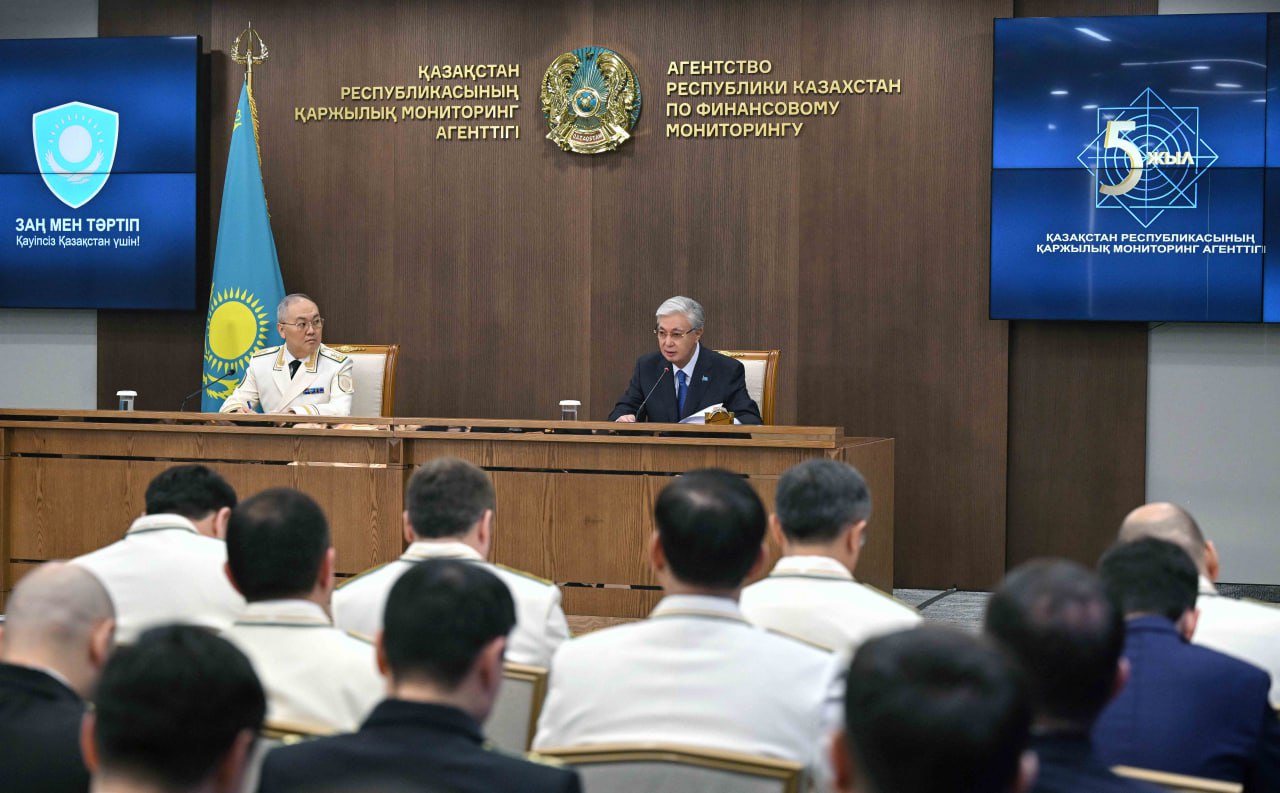
Photo credit: Akorda
Tokayev noted that the agency, established five years ago during a period of major national transformation, has become an independent and essential institution within Kazakhstan’s economic and national security systems, according to Akorda.
“Considerable work has been done in a short time, and valuable experience has been accumulated. This is the result of your professionalism and dedication,” Tokayev said, while stressing that complacency is unacceptable amid rapid technological change.
Adoption of AI in financial crime prevention
He warned that the growing use of digital technologies and artificial intelligence by criminal networks requires a fundamentally new approach to law enforcement work.
“Today, the confrontation between law enforcement agencies and the criminal underworld has moved into the technological sphere. Criminals are actively using artificial intelligence. If law enforcement agencies, including the FMA, fall behind technologically, this could threaten national security,” Tokayev said.
He emphasized the urgent need to scale up digital solutions and AI-based analytics, noting that modern financial crime prevention is impossible without them.
Strengthening prevention and oversight of financial crimes
President Tokayev also raised concerns about continued attempts to channel capital abroad through cryptocurrency schemes and about the large-scale embezzlement of funds allocated to social programs.
“Trillions of tenge intended for the country’s development are being stolen. This is unacceptable. The shadow economy causes enormous damage, and the fight against it must be uncompromising,” he said, stressing that public funds must be used exclusively for the benefit of citizens.
Tokayev instructed the agency to strengthen preventive measures, referring to the new law on crime prevention, which designates the FMA as a key body responsible for preventing economic crimes.
He cited damage figures of 325 billion tenge (US$650.4 million) in 2023, 4.4 trillion tenge (US$8.8 billion) in 2024, and 135 billion tenge (US$270.2 million) in 2025, underscoring that prevention and early detection remain far more effective than post-crime recovery.
Special attention, he said, should be paid to financial flows in education and healthcare, sectors of high public importance.
Tokayev also called for new approaches to combat financial fraud, including stricter measures against financial pyramid schemes. Despite investigations, website shutdowns, and outreach efforts, fraudsters continue to deceive citizens by disguising illegal schemes as legitimate financial products.
Tokayev proposed considering criminal liability for individuals who knowingly recruit others into pyramid schemes, assuring support for legislative amendments if initiated by the agency or the government.
Finally, he instructed the FMA, together with the Agency for Regulation and Development of the Financial Market and the National Bank, to strengthen oversight of questionable operations by commercial banks, citing cases involving massive cross-border financial transfers.
“The scale of abuse and theft of public funds is beyond comprehension,” Tokayev said.
