
ASTANA – Kazakhstan’s ongoing parliamentary reform could lead to consideration of a new Constitution, President Kassym-Jomart Tokayev said during a Jan. 19 meeting with the working group on the upcoming reform.
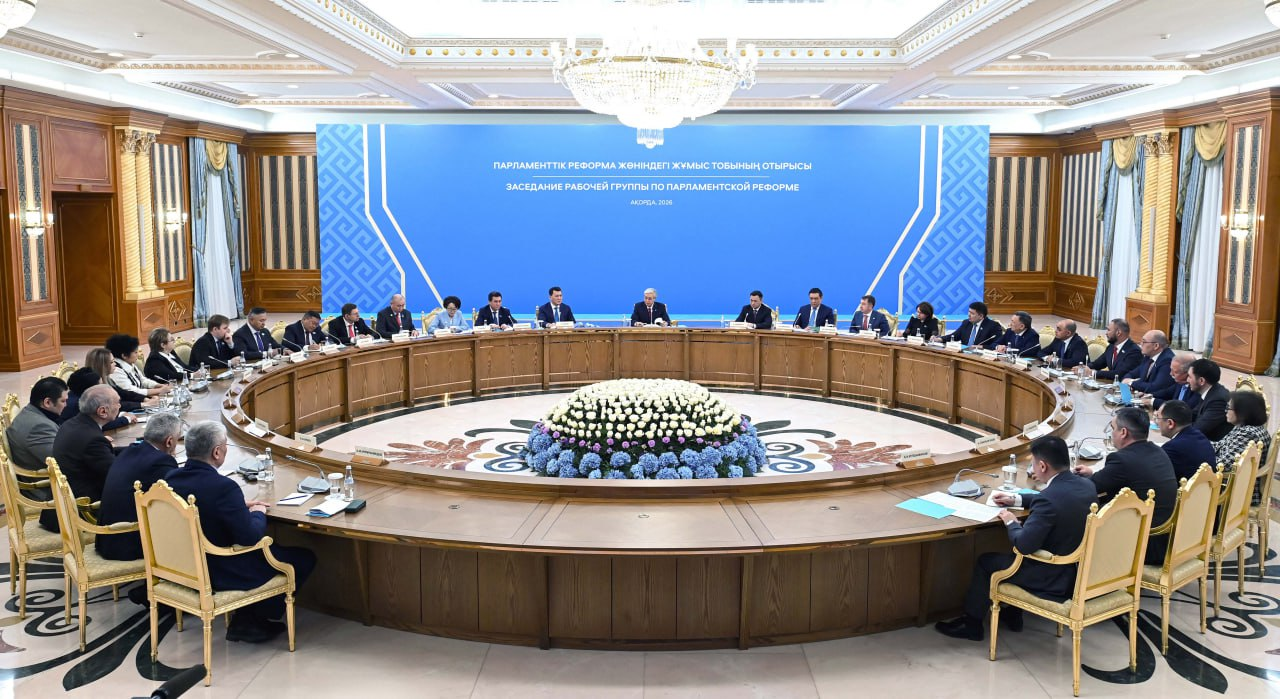
President Kassym-Jomart Tokayev chaired a meeting of the Parliamentary Reform Working Group in Astana, where participants discussed the key approaches and public feedback shaping Kazakhstan’s upcoming constitutional reform. Photo credit: Akorda
“The implementation of parliamentary reform will require revising several sections of the Constitution. Therefore, taking into account the amendments introduced earlier, the draft proposed by the working group allows us to speak, in essence, about considering a new Constitution of Kazakhstan,” he said.
During the meeting, State Counselor Erlan Karin briefed Tokayev on the working group’s activities, noting the substantial scope of proposed constitutional amendments aimed at transforming the structure and role of Parliament.
He outlined the group’s shared vision, emphasizing that the reforms are intended to modernize the political system in line with contemporary challenges, the Akorda press service reported.
Deputy head of the working group and assistant to the Kazakh President on legal matters Yerzhan Zhienbayev presented the main approaches to constitutional reform developed by the Working Group based on proposals submitted by citizens. He noted that since October last year, the group has examined a full range of issues related to the functioning of a new unicameral Parliament, including its size, term of office, electoral procedures, legislative mechanisms, and interaction with other branches of power.
Director of the Institute of Parliamentarism Natalia Pan reported on public input received through the e-Otinish and eGov platforms. According to her, over the past several months, all seven political parties, non-governmental organizations, business associations, legal scholars, and independent experts have submitted their initiatives regarding constitutional reform.
In addition to proposals specifically related to parliamentary reform, the working group received approximately 1,600 appeals from citizens addressing broader constitutional arrangements and improvements to political and public institutions.
Senator Nurlan Beknazarov, chair of the Senate Committee on Constitutional Legislation, the Judicial System, and Law Enforcement Agencies, also presented his ideas and proposals during the meeting.
Summing up the discussion, Tokayev noted that nearly six months have passed since the public debate on constitutional reform began, and that society has largely developed a clear understanding of the goals and objectives behind the transformation of the country’s highest legislative body.
President Tokayev stressed that he is closely following the public discussions that unfolded after his September state-of-the-nation address and is carefully reviewing expert opinions, draft amendments, and numerous citizen proposals.
Speaking about the depth of the planned reforms, Tokayev underscored that Kazakhstan faces a profound reconstruction of its institutional foundations and a systemic reconfiguration of the legislative branch.
“Tomorrow, at a meeting of the National Kurultai, I will present my specific ideas on this issue. In effect, a qualitatively new political model is taking shape in the country,” Tokayev said.
