
ASTANA – The Light Rail Transit (LRT) system is expected to complete its testing phase and enter full operation within the next few months, Astana mayor (governor) Zhenis Kassymbek said at a briefing at the Central Communications Service on Dec. 22.

The Light Rail Transit. Photo credit: ortcom.kz
The LRT has been operating in test mode since September. Kassymbek said all rail cars are due to be delivered by the end of the month, while interior finishing at stations is nearing completion.
Once fully launched, the system is projected to ease traffic congestion in the Esil and Nura districts, particularly along Kaldayakova, Syganak and Kabanbai Batyr avenues.
Public transport growth and traffic solutions
Kassymbek also outlined broader efforts to modernize the capital’s transport system. More than one million passengers now use city buses daily, while overall public transport ridership has increased by 37%.
“The bus lane network now covers 140 kilometers, and another 30 kilometers will be added next year. In 2026, we plan to create ten transport hubs to intercept external traffic flows and improve transfer speed within the city,” he said.
He noted that the city is preparing to develop multi-level high-speed transit roads to address growing congestion. Design work is scheduled for 2026, with construction expected to begin in 2027, starting with a project along Kabanbai Batyr Avenue to reduce pressure on Mangilik El and Kabanbai Batyr avenues.
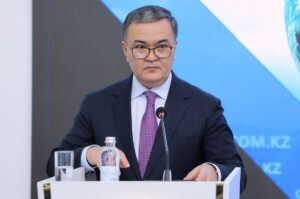
Astana mayor (governor) Zhenis Kassymbek during the briefing at the Central Communications Service on Dec. 22. Photo credit: ortcom.kz
Kassymbek also addressed residents’ concerns about frequent road closures during marathon events. He said no more than four marathons per year will be allowed in the city center.
“We are not against marathons – this is normal practice for large cities. But when streets such as Turkistan, Kunayev and Akmeshit are closed every weekend from May to October, residents understandably react,” he said.
He said organizers will be encouraged to use alternative routes, including forest cycling paths, bypass roads, the triathlon center and the river embankment, where there is no vehicle traffic.
Modernizing urban infrastructure
Kassymbek focused on rapid population growth, which continues to strain urban infrastructure. Two years ago, the city experienced water and heat shortages. Since then, the completion of Pumping and Filtration Station No. 3 and the construction of a new pipeline from the Astana Reservoir have added 60,000 cubic meters of drinking water per day. Current daily water consumption in Astana is approximately 350,000 cubic meters and is expected to meet demand for the next three to four years.
Construction of a fourth pumping station began this year and is expected to secure the water supply for the next decade.
The city is also expanding sewage treatment capacity, including the construction of the KOS-2 facility and local wastewater treatment plants in the Koktal, Ondiris and Industrial Park residential areas. These projects are scheduled for completion between 2028 and 2029.
“In the energy sector, new heat sources have increased system capacity by 34%, creating a reserve of 500 gigacalories per hour. Construction of the Telman gas turbine station is underway, while preparations have begun to expand CHPP-2 and design the second phase of CHPP-3,” said Kassymbek.
Gasification of the capital is nearing completion, with coverage reaching 95%. Gas is currently supplied to 14 residential areas, and full coverage is expected by next year.
