
OSKEMEN — The sacred land of the East Kazakhstan Region’s Ulan district hosted the Shygys Salburyny international festival on Oct. 8-11, bringing together 148 participants from seven countries. The event, which marked its fifth anniversary this year, celebrates falconry as a living national tradition and growing symbol of Kazakhstan’s cultural identity.

Photo credit: Nagima Abuova / The Astana Times. Click to see the map in full size. The map is designed by The Astana Times.
Over three days, hunters tested the skills of their golden eagles, falcons, and goshawks in front of more than 10,000 spectators. A total of 107 birds took flight above the steppe, with nine reaching the finals. Competitions highlighted mastery, training culture, and respect for hunting traditions.
Tradition as a national brand
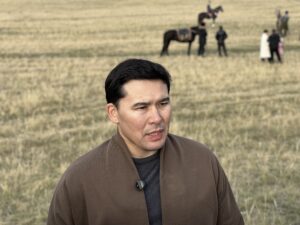
Minister of Tourism and Sports Yerbol Myrzabosynov. Photo credit: Nagima Abuova / The Astana Times
“This event is important not only for the region, but for the whole country. For three days, Burkit Tobe hill became an arena of sports competitions, friendship, and unity. Falconry, recognized worldwide, is becoming a true national brand of Kazakhstan,” said East Kazakhstan Region’s Akim (Governor) Nurymbet Saktaganov, addressing the public.
Minister of Tourism and Sports Yerbol Myrzabosynov shared the sentiment, stressing the state’s commitment to promoting traditional sports.
“Our national sports are being equated with Olympic disciplines under the president’s instruction. Last year, at the World Nomad Games in Astana, our falconry team showed excellent results. The state’s main goal is to present these sports on the world stage and develop them as tools of culture and education at home,” Myrzabosynov told the press.
Local cultural figure and Ulan district deputy Nurtai Tleuzhan also reflected on the festival’s symbolic meaning. Speaking to The Astana Times, he said the revival of national traditions after the pandemic gave communities new energy and marked the beginning of the festival’s growth in the Ulan district.
“Now we are promoting equestrian sports, togyzkumalak, archery – all of them. This was something that had been left behind among us. In the Altai mountain region, where birds make their nests and people ride horses, living in the mountains, for our young men not training horses or holding an eagle would no longer suit their courage and spirit,” he said.
International participation
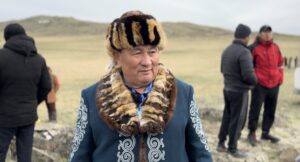
Mongolia Eagle Hunters’ Association Chairman Medeukhan Saidoldauly. Photo credit: Assel Satubaldina / The Astana Times
The festival attracted athletes from China, Hungary, Kazakhstan, the Kyrgyz Republic, Mongolia, Russia and Spain. Alongside the contests, the ethno-village at Burkit Tobe hill hosted 40 yurts, craft exhibitions, workshops, and reenactments of traditional Kazakh rituals, including betashar (bride unveiling), tusaukeser (child’s first steps), and besikke salu (cradle ceremony).
Mongolia Eagle Hunters’ Association Chairman Medeukhan Saidoldauly noted the festival’s expanded scale and stronger organization compared to past years.
“We came to this festival with about ten people, including four or five eagle hunters. Some also brought birds for the exhibition. Our falconry is in good shape now. The organization this time is on a much higher level compared to previous years. The birds are also excellent, and the number of participating hunters is very large. Now they have narrowed it down to nine birds, and one of our hunters is among them,” Saidoldauly told The Astana Times.
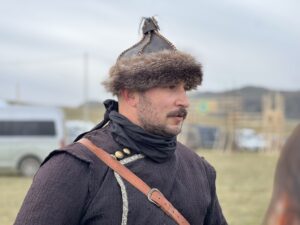
Hungarian falconer Gergely Laszlo Bodis. Photo credit: Nagima Abuova / The Astana Times
“This is Kazakhstan’s unparalleled art. We must develop it, because developing it means raising the spirit of the nation,” he added.
Speaking to The Astana Times, Hungarian falconer Gergely Laszlo Bodis described his first impressions of Kazakhstan, calling it “the motherland of falconry.”
“Hungarians were the first to introduce falconry to Europe, but today fewer than 100 people continue the practice because of the time it demands,” said Bodis.
“I have been in falconry for 20 years at home. I have 23 birds, including a golden eagle, a goshawk, and many falcons. I will try to bring my own bird with me next time,” he said.
Stories of growth and passion
For Ulan district governor Arman Bekbosynov, the festival’s growth from 15 participants in the village of Bozanbai five years ago to nearly 150 today symbolizes its success.
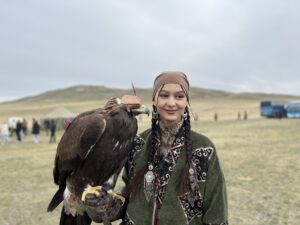
Kazakh falconer Ayazhan Daniyarkyzy. Photo credit: Nagima Abuova / The Astana Times
“This festival started five years ago in the village of Bozanbai. (…) Back then no one thought it would grow into such a major event, but now Bozanbai is called the village of eagle hunters,” Bekbosynov told The Astana Times.
Kazakh falconer Ayazhan Daniyarkyzy of Almaty also spoke about her personal journey. She began practicing falconry four years ago after being inspired by her archery teacher’s bird.
“My first bird was named Altyn, and now I work with Akzhal, who came to me just a month ago. He is still young but already shows good results. (…) My teacher had a bird named Abyroi [Honor], and I was inspired by how he worked with it. That’s how my journey started. Now, many girls are becoming interested in falconry, and I even have my own students in Almaty. My message to girls is simple: let’s develop and promote our national traditions,” Daniyarkyzy told The Astana Times.
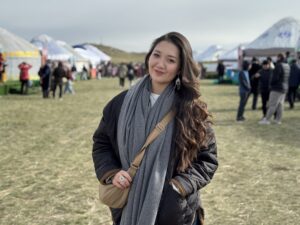
The Astana Times reporter Nagima Abuova at the Shygys Salburyny international festival on Oct. 11. Photo credit: Assel Satubaldina / The Astana Times
She also noted the deep emotional bond between the bird and the handler.
“At first, we train, not the wild, but tamed bird a little to get used to the person’s hand. (…) We just try to adjust them to each other physically, and then, emotionally. The bird and the eagle hunter must become very closely connected. That is why for some time, the bird and the hunter should be alone, as if conversing with each other, so that the eagle becomes attached to him. An attached eagle makes its special noise,” she said.
“I think such festivals are very necessary to promote our national character. It makes me very happy to see it flourishing more and more each year,” added Daniyarkyzy.
The competitions concluded with prizes awarded across several categories. Yerlan Kenzhetayev from the Akmola Region won in falcon hunting, and Omirkhan Bayetbai from the Almaty Region took first place in eagle and goshawk categories. Second place went to Berikbolsyn Babazhan of the Zhambyl Region. Third place was shared by Salimkhan Yergazyuly of the Zhetysu Region and Kenzhebek Baidolauly of Mongolia. All winners received monetary awards.
