
ASTANA – The UN Treaty on the Prohibition of Nuclear Weapons now has a majority of countries as either signatories or parties, reflecting the momentum in global nuclear disarmament and non-proliferation efforts, and marking a milestone that underscores the treaty’s growing influence, even as nuclear powers remain outside it.
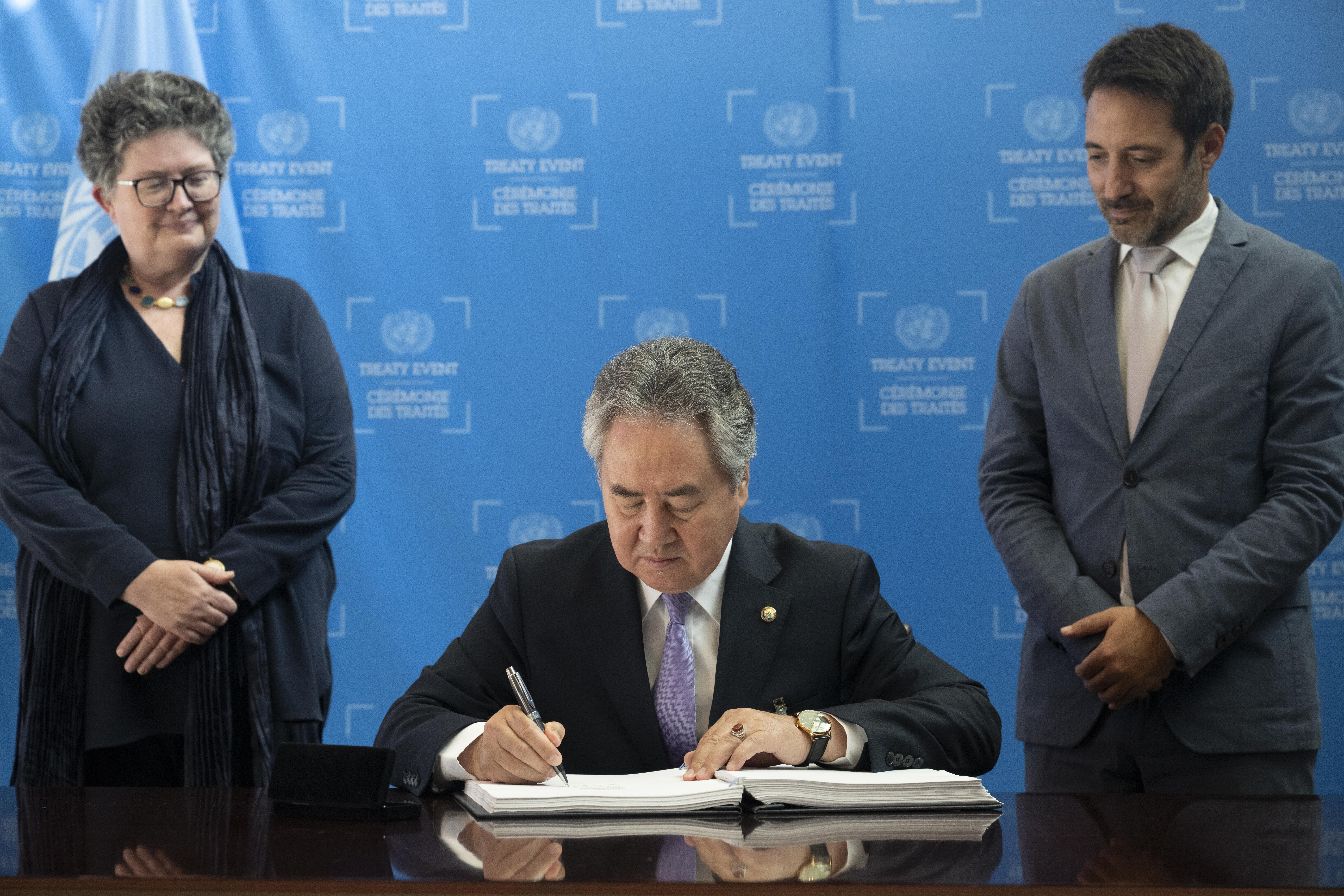
Kyrgyzstan’s Foreign Minister Jeenbek Kulubaev signing the TPNW. Photo credit Darren Ornitz/ICAN
The Kyrgyz Republic became the 99th country to sign TPNW following a high-level meeting on Sept. 26 as part of the UN General Assembly High-Level Week to mark this year’s International Day for the Total Elimination of Nuclear Weapons.
Adopted in 2017 and coming into force in 2021, TPNW bans not only the use of nuclear arms but also their development, possession, and testing. The accord was spearheaded by the International Campaign to Abolish Nuclear Weapons (ICAN), which was awarded the 2017 Nobel Peace Prize for its efforts.
“We believe security comes from cooperation and trust, not weapons. That’s why we decided to join the [TPNW]. We want a world free of nuclear threats for future generations,” said Kyrgyzstan’s Foreign Minister Jeenbek Kulubayev.
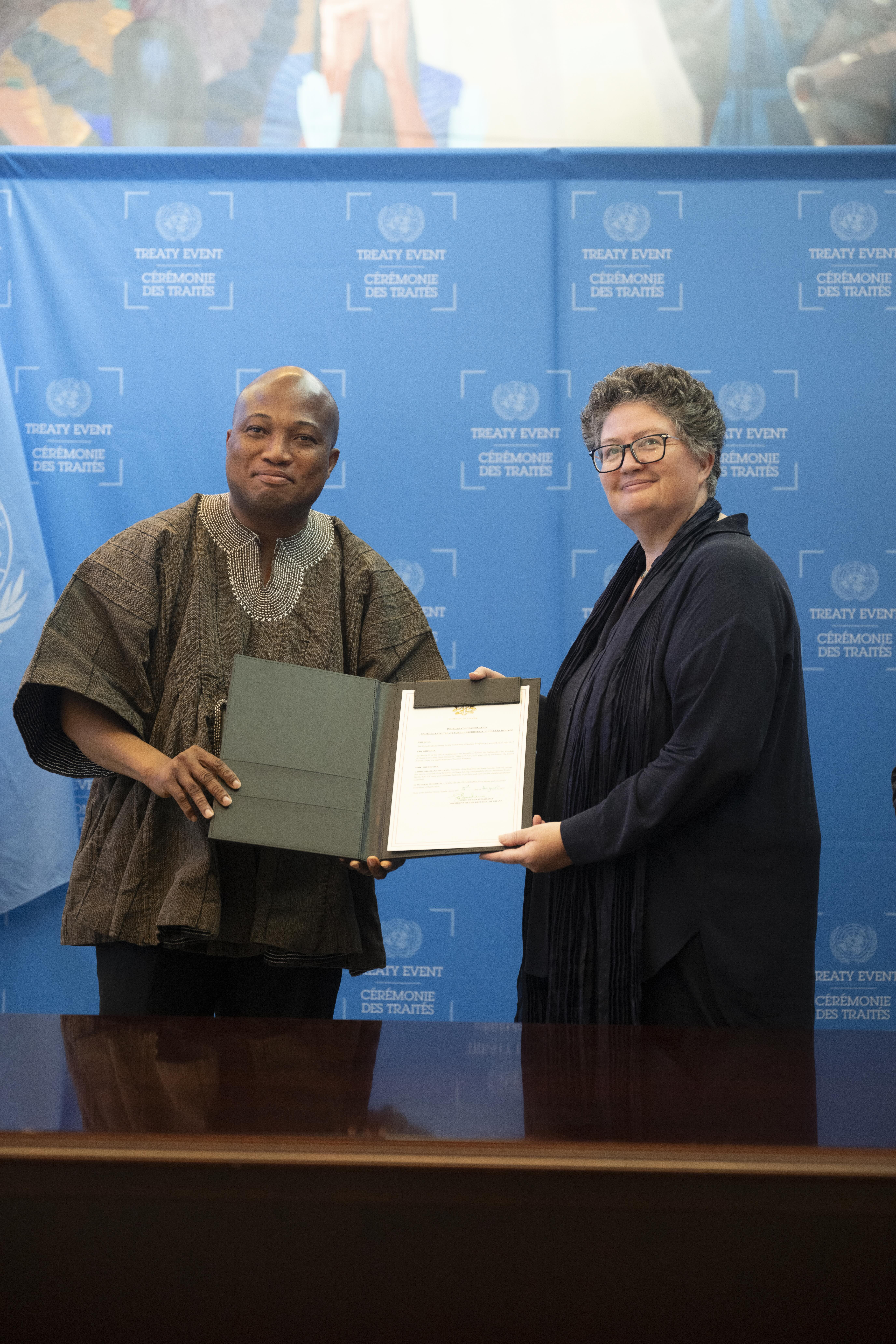
Ghana’s Foreign Minister, Samuel Okudzeto Ablakwa, depositing his country’s ratification of the TPNW. Photo credit: Darren Ornitz/ICAN
Ghana’s Foreign Minister Samuel Okudzeto Ablakwa formally deposited the country’s instrument of ratification.
“I warmly congratulate Kyrgyzstan and Ghana on their actions today. The TPNW is the best way to ensure real security from the existential threat nuclear weapons pose to the future of humanity, because as long as they exist, nuclear weapons are bound to be used, intentionally or by accident. The TPNW is the established pathway under international law to the fair and verifiable elimination of nuclear weapons, so the nuclear-armed states have no excuse to continue to defy the majority here at the UN,” said ICAN’s Executive Director Melissa Parke, commenting on the developments.
Parke said the growing reach of the treaty has challenged the dominance of nuclear-armed states and their long-standing reliance on deterrence. She added that countries maintaining or endorsing nuclear arsenals now represent a shrinking minority, with “no right” to endanger the future of the rest of the world.
“With Ghana’s ratification and Kyrgyzstan’s signature, last week, bringing the number of states signed on to the TPNW to a global majority, the basis for asking the global minority to change their pro-nuclear weapons policies, which threaten the survival of all states, grows stronger,” ICAN’s UN Liaison and General Counsel Seth Shelden told The Astana Times.
“Now, a global majority of states can work together, including across different treaty regimes and other international fora, to advocate for a nuclear-weapon-free world,” Shelden added.
He also pointed out the role played by Kazakhstan.
“Kazakhstan has long heralded the TPNW as consistent with, and complementary of, the Central Asian Nuclear-Weapon-Free Zone [CANWFZ] Treaty, a treaty whereby Central Asian states have undertaken not to manufacture, acquire, test, or possess nuclear weapons, but also a treaty that ‘stresses the need for . . . efforts to reduce nuclear weapons globally, with the ultimate goal of eliminating those weapons,’” he said.
Shelden suggested Central Asian countries are “increasingly persuaded” by Kazakhstan’s logic that the TPNW “furthers the zone’s ultimate objectives of a world free of nuclear weapons, and that no region can be safe from nuclear weapons used in another region.”
“In describing its decision to join the TPNW, Kyrgyzstan stated they decided to do so because it is ‘committed to ensuring that future generations live without the threat posed by weapons of mass destruction,’” he added.
Disarmament as a top priority for the UN
Disarmament has been a top priority for the UN. It became the subject to the General Assembly’s first resolution in 1946, which established the Atomic Energy Commission. The institution, however, was dissolved in 1952.
“The world is sleepwalking into a new nuclear arms race — more complex, more unpredictable and even more dangerous,” said Courtenay Rattray, Chef de Cabinet of the Office of the Secretary-General, who spoke on behalf of António Guterres at the Sept. 26 high-level event.
He warned that 80 years after Hiroshima and Nagasaki, nuclear sabre-rattling is “louder than it has been in decades.”
According to the UN, around 12,241 nuclear weapons remain in place throughout the world.
In August, Guterres announced the creation of an independent scientific panel to assess the effects of nuclear war. Togzhan Kassenova, a prominent Kazakh expert and a senior fellow at the University at Albany, is now part of a new 21-member scientific panel.
Nuclear disarmament doesn’t hinge on “right conditions,” said Rattray. “We know the total elimination of nuclear weapons will not happen overnight, but it will never happen if we keep waiting for the perfect conditions,” he added.
Kazakhstan’s Deputy Foreign Minister Akan Rakhmetullin also addressed the high-level event on Sept. 26 in New York. Opening his remarks, Rakhmetullin described nuclear weapons as the “gravest threat” facing humanity.
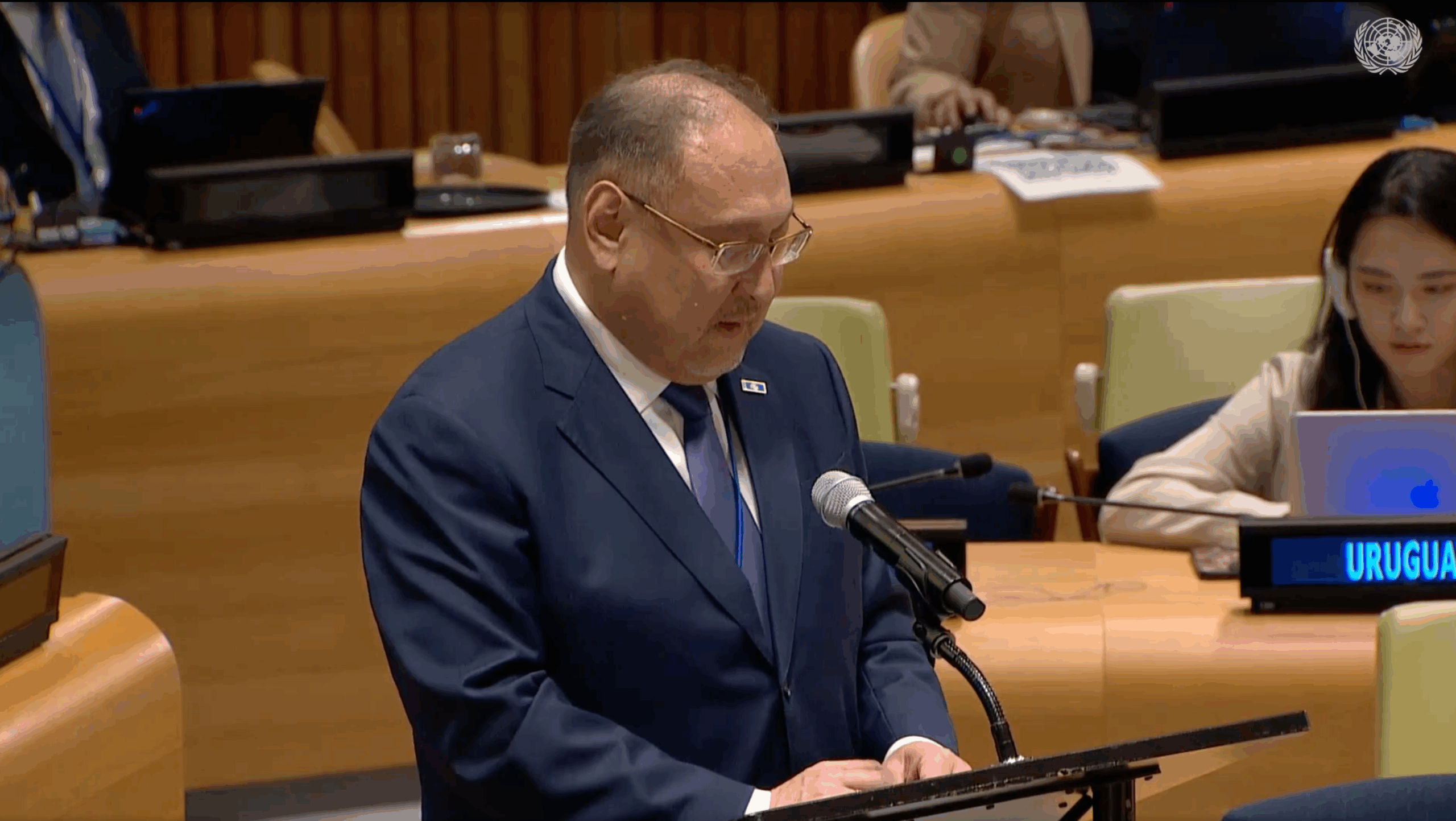
Kazakhstan’s Akan Rakhmetullin addresses a high-level event on Sept. 26 in New York. Photo credit: UN Web TV
“Global awareness has also been strengthened through the International Day against Nuclear Tests on Aug. 29, initiated by Kazakhstan, which underscores the devastating human and environmental consequences of nuclear explosions. Yet, today more than 12,000 nuclear warheads remain, many on high alert, while arms control frameworks that once provided stability are under severe strain,” he said.
He, therefore, stressed the need for “urgent collective action,” reaffirming Kazakhstan’s continued commitment to nuclear disarmament and non-proliferation.
The nation’s decision to voluntarily renounce once the world’s fourth largest nuclear arsenal and close the Semipalatinsk nuclear test site was an “act of principle” that defined the country’s national identity and role.
The Central Asian Nuclear-Weapon-Free Zone will mark its 20th anniversary next year, proof that even region bordering nuclear powers can “choose mutual trust and cooperation.”
