
ASTANA – The National Space Center in Astana has completed SANA-1, a unique research project, marking Kazakhstan’s first experiment on long-term crew isolation in conditions simulating a space mission.
The experiment studied the physiological, cognitive, and emotional adaptation of an all-female engineering crew. The team of engineers and researchers symbolizes Kazakhstan’s growing contribution to gender equality in science and technology.
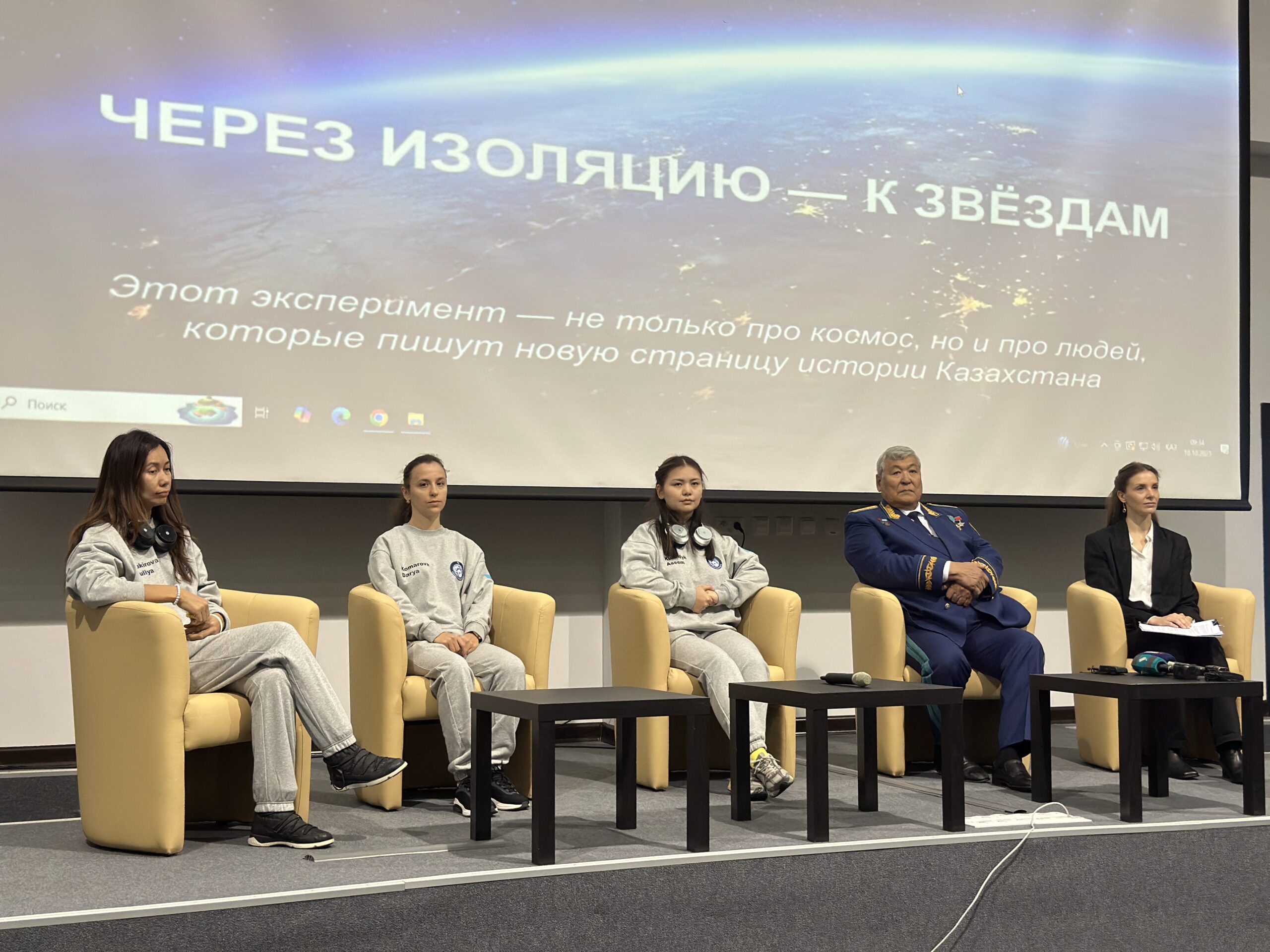
From left to right: Yulia Bakirova, Asem Kuandyk, Daria Komarova, Tokhtar Aubakirov and Alina Gutoreva. Photo credit: The Astana Times
The team concluded its mission Oct. 10, leaving the isolation module after ten days.
The project was led by Alina Gutoreva, PhD in psychology and associate professor in Cognitive Science at the Kazakh-British Technical University (KBTU). She serves as head of the university’s Artificial Intelligence Laboratory.
She emphasized that the project could pave the way for Kazakhstan’s own astronaut training program and greater participation of women in engineering and space sciences.
“Today, only about 12.5% of astronauts worldwide are women. Female dynamics in isolation remain one of the least studied areas of space psychophysiology. The SANA-1 team showed that empathy, leadership, and emotional support are key resources for crew resilience in isolation,” she said.
The study analyzed sleep patterns, fatigue, motivation, stress levels, and team interactions. Results indicated that participants’ emotional states stabilized toward the end of the mission and that they maintained strong cooperation, empathy, and stress tolerance. These are all critical qualities for future space crews.
Reflecting on her motivation, Gutoreva told The Astana Times that the project naturally evolved from her ongoing collaboration with Kazakhstan’s Aerospace Committee and her research on neurotechnology for aerospace systems, which she previously presented at the United Nations forum in Vienna.
The project was led by Alina Gutoreva, PhD in psychology and associate professor in Cognitive Science at the Kazakh-British Technical University. Photo credit: The Astana Times
“This project is another step toward creating a national astronaut training program in Kazakhstan. Our goal is to bring knowledge from space research back to society – to improve understanding of human cognition, behavior, and scientific practices,” she said.
She added that team members were selected through a closed process based on scientific and engineering expertise, as well as personality, stress resilience, and motivation.
“Motivation was crucial in total isolation. The participants wanted to test themselves and contribute to Kazakhstan’s science and technology,” said Gutoreva.
Preliminary findings revealed that sleep deprivation and stress significantly reduced cognitive performance during the mid-phase of the experiment.
“At first, everyone was enthusiastic, but by the third or fourth day, fatigue and stress increased, which affected test results. It clearly shows how stress and lack of sleep impact cognitive functioning,” she said.
Gutoreva also shared her personal aspiration to one day participate in such a mission herself.
“If you study human behavior in space, you should be ready to experience it. Since childhood, I’ve dreamed of exploring space. One day, I hope to see hundreds or even thousands of people in orbit – not just trained astronauts, but scientists, engineers, and ordinary people who can help humanity expand into space,” said Gutoreva.
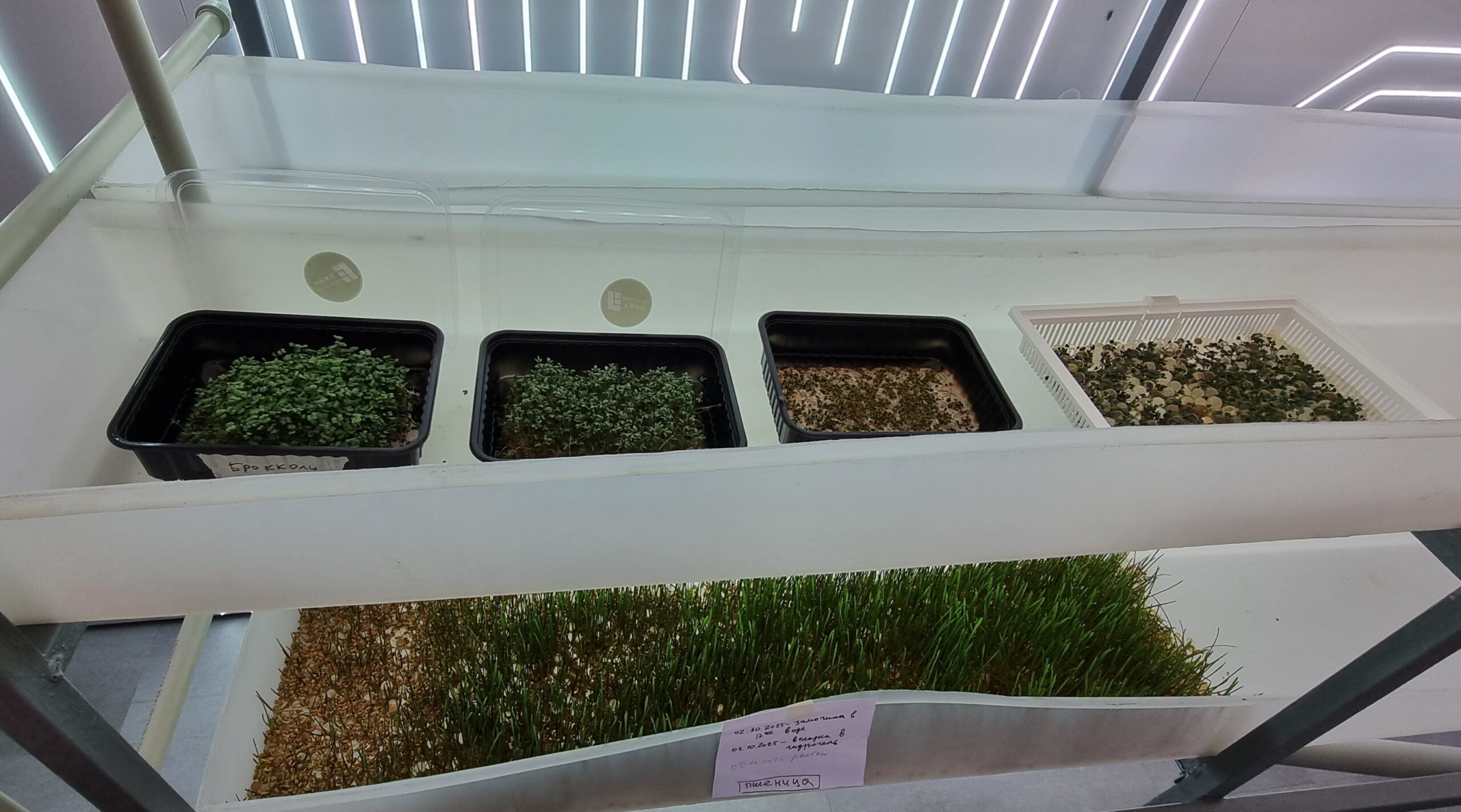
Clover sprouts, wheat, and broccoli that grew over the 10 days of the team’s planting experiment. Photo credit: The Astana Times
Tokhtar Aubakirov, Kazakhstan’s first cosmonaut and a national hero, congratulated the crew.
Aubakirov praised the initiative and the participation of women, noting that “female strength and resilience make them well-suited for the challenges of spaceflight.”
He commended the team for enduring the psychological and physical strain of isolation and highlighted the broader purpose of such studies.
“It must have been difficult to stay in a confined space for ten days, seeing the same faces every day, but the team passed this test with honor. These experiments are essential for science and for our future,” said Aubakirov.
He added that the project demonstrates Kazakhstan’s growing scientific potential and called for continued investment in similar initiatives.
