
Kazakhstan is trying to turn its reliance on foreign AI technology into leverage. It works with Washington and Beijing at the same time, which lets it seek a voice where the rules of the game are still open. On Nov. 6 it used the Aqaba Process to put its own AI security agenda in front of Central Asian leaders and King Abdullah II of Jordan. Tokayev and the King co-hosted the first Aqaba Process meeting ever held in Central Asia.
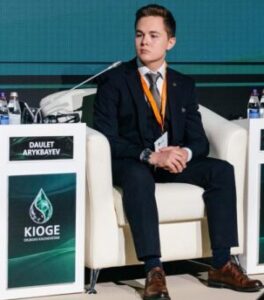
Allen Alekeyev. Photo credit: KIOGE Forum 2026.
Structural power still leaves Astana room to choose
AI capabilities are concentrated around two poles, the United States and China. Middle powers join the emerging hierarchy on terms they did not write. In States and Markets, political economist Susan Strange defined structural power as the capacity to set the frameworks within which other states and corporations operate. In this division of labor, a country like Kazakhstan supplies territory, energy and raw materials, and the core technologies stay outside its borders. Strange also argued that structural power does not remove choice. States still make their own decisions, though from options others have defined.
Kazakhstan uses this space more and more. Its national language model AlemLLM was launched in partnership with China’s 01.AI. Teachers across the country gained mass access to generative AI through OpenAI licenses. Working with both poles gives Astana a base for initiatives of its own. Its goal, in my view, is to build a narrative of agency in AI and back it with action. The production and knowledge structures are set abroad. Norms, institutions and venues for dialogue are still forming, and there Kazakhstan has a chance to shape the agenda.
The domestic foundation took two years. The government adopted the AI Development Concept for 2024-2029. The country launched the Alem.cloud supercomputer, created a dedicated ministry and passed the Law on Artificial Intelligence, the first of its kind in Central Asia. Tokayev set out the external principle in Shanghai, saying no country should remain solely a consumer of AI.
Astana gives each pole a different role
Kazakhstan is the only country known to have joined both the U.S.-led Pax Silica and China’s WAICO. That position has a cost. In August, Reuters reported a draft State Department letter warning that Pax Silica membership may be incompatible with rival frameworks. The letter, addressed to 35 partner countries, has not been sent and its wording may still change. It still shows how narrow Astana’s room to maneuver has become. Astana has not commented publicly and continues to work with both sides. It responds by splitting roles. It offers Washington norms and a platform to promote them, and it offers Beijing an institutional presence. Both offers support the same story, that Kazakhstan is a place where rules get discussed and written.
Pax Silica brings together countries around semiconductor and critical minerals supply chains. Kazakhstan joined on June 25. Its normative side is the Washington Model, a set of voluntary rules for safe AI development. Google, Anthropic, Meta, OpenAI, xAI and Nvidia signed it at the White House on Sept. 29. Kazakhstan has to negotiate with these same companies on labeling AI content and fighting deepfakes. Its AI law makes owners of AI systems responsible for labeling synthetic content, and the most widely used models for generating text, images and voices mostly belong to these firms. On Oct. 2, Tokayev proposed making the Washington Model the basis of a future UN treaty and ordered an initiative prepared for the G20 summit in Miami. The move also reassures Washington that membership in WAICO does not mean a tilt toward Beijing.
The Chinese track works differently. WAICO is an intergovernmental organization, so governments write its rules. Tokayev proposed holding its first meeting in Astana, opening its Central Asian office in Kazakhstan and launching a Kazakhstan-China Digital Bridge. The office offers something the American track lacks, a permanent institutional foothold that can channel Chinese investment and technical training. Alongside these proposals, Samruk-Kazyna announced on July 16 that it had signed 19 agreements with Chinese companies valued at $4.29 billion in total. The agreements covered digitalization, energy, transport, telecommunications and industry.
The Aqaba Process offers a venue no great power controls
King Abdullah II launched the Aqaba Process in 2015. It brings heads of state, intelligence chiefs, defense agencies and international organizations together to build a shared view of threats and agree on responses. Its agenda has moved from social media to drones and online gaming, and now to generative AI. In February 2026, participants met at the Royal Military Academy Sandhurst to discuss drone threats. In Astana, representatives of international organizations, the gaming industry and civil society joined the discussions.
Jordan runs the process, and none of the powers competing in AI leads it. The United States and China were also absent from the participants the organizers named for the Astana meeting, which suits Kazakhstan’s balanced approach to AI diplomacy. Astana gets a rare chance to discuss AI security with Arab and Western partners without choosing a side. Tokayev said the meeting should let Central Asia present its own vision of AI security. He called the theme “particularly timely” when he met the King on Nov. 5. Astana and Amman also agreed to expand cooperation in technology and defense.
Regional approaches will need time to converge
Uzbek President Shavkat Mirziyoyev offered to host a regional office of the UN Office of Counter-Terrorism, which would help Central Asian countries set up channels for reporting terrorist content and detect terrorist financing. He also proposed a program called “Enlightenment Against Ignorance in the Digital Age.” Tashkent is already setting up an SCO Universal Center for Countering Security Threats. Tajik President Emomali Rahmon proposed linking the Aqaba Process with the Dushanbe Process on countering terrorism and its financing. He also recalled a UN resolution that envisages the Dushanbe AI center as a regional platform for AI security. Turkmen President Serdar Berdimuhamedov attended after a personal invitation from Tokayev and spoke about preventive diplomacy and neutrality. Kyrgyz President Sadyr Japarov did not attend. Foreign Minister Jeenbek Kulubaev represented Kyrgyzstan and spoke about sharing experience.
These proposals reflect different national starting points. Uzbekistan also signed up to WAICO and applied to Pax Silica in August 2026, so Tashkent and Astana follow similar balanced strategies. Each capital is still building its own AI institutions, laws and partnerships, and bringing these national tracks closer will take time. The initiatives from Astana, Tashkent and Dushanbe can complement each other once the region agrees on how to divide functions among them.
Trust remains an open question. In the published speeches, no country linked the fight against extremist content to human rights safeguards, such as a judicial basis for takedown requests and protection of user data. Platforms and Western companies treat these guarantees as a main condition for long-term work in the region.
A joint regional position would turn agency into influence
Kazakhstan builds its agency narrative consistently. It offers each pole what that pole values, and the Aqaba Process adds a third, neutral venue. In Strange’s terms, this is still a choice within frameworks the hegemons have set. The model holds as long as Washington tolerates dual membership. If the draft letter becomes a formal requirement, Astana will face the choice it has so far avoided. A common regional position could strengthen its hand, and the Nov. 6 meeting laid groundwork for one.
Real agency in AI security needs coordinated regional steps. Central Asian capitals should first agree on a division of roles in AI, deciding which capital leads on which function. They should then add AI threats to the catalogue of risks and preventive measures adopted for the Consultative Meetings of Central Asian Heads of State for 2026-2028. Australia and Malaysia announced plans to host the next round of the process in 2027, focused on online extremism and emerging technologies. Central Asia should arrive there with joint proposals, including on Afghanistan. A common solution would make the region one actor that helps shape the global agenda.
The author is Allen Alekeyev, the deputy head of research at Nightingale Int. analytical center.
The article is published as part of the partnership between The Astana Times and Nightingale Int. analytical center.
