
ASTANA – Kazakhstan will hold an international symposium dedicated to the intellectual heritage of medieval philosopher Abu Nasr Al-Farabi (870-950) and theologian Khoja Ahmed Yasawi (1094-1166) on a rotating basis every two years, Vice President Erlan Karin announced at an international symposium in Almaty on Nov. 6.
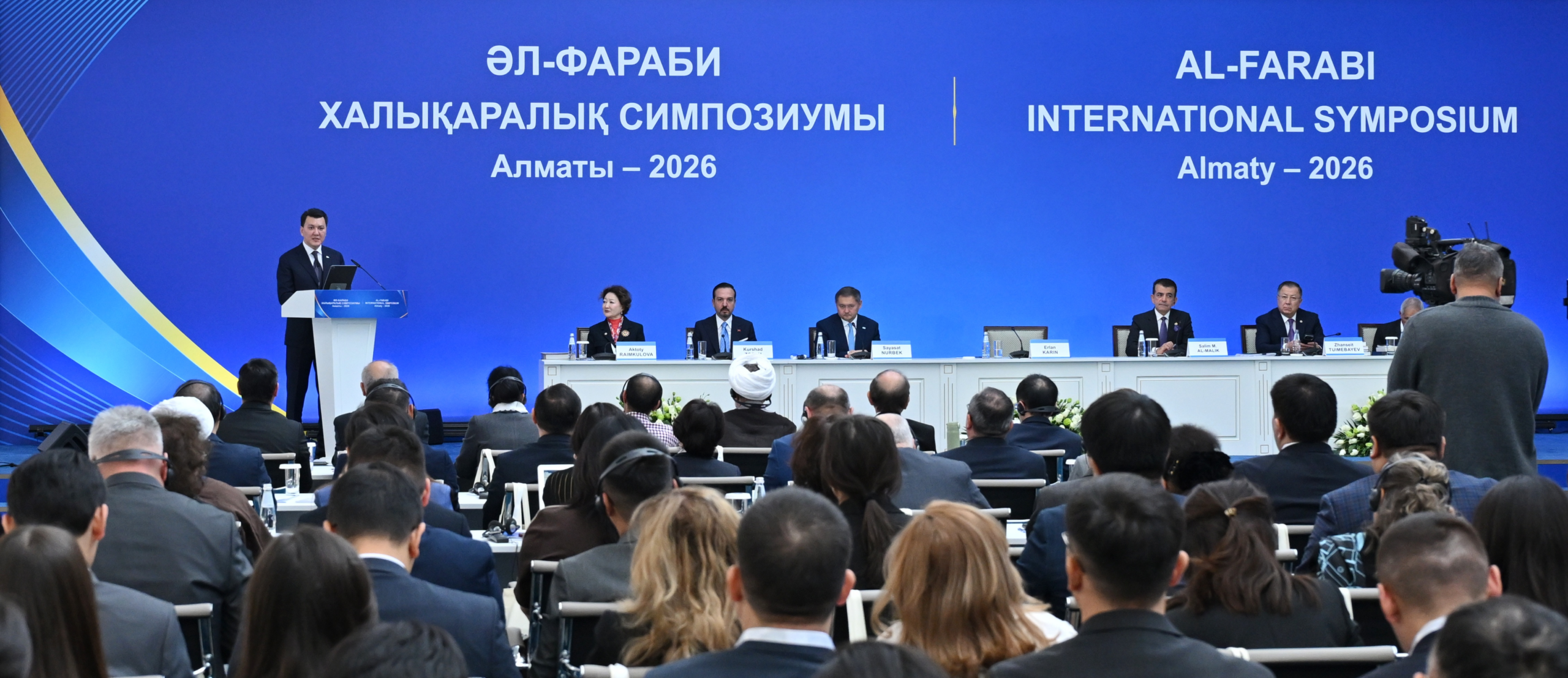
The symposium is dedicated to Al-Farabi’s philosophical and scientific legacy and is being held at Al-Farabi Kazakh National University. Photo credit: Akorda.
The symposium is dedicated to Al-Farabi’s philosophical and scientific legacy and is being held at Al-Farabi Kazakh National University. President Kassym-Jomart Tokayev proposed making such gatherings a regular event.
At the opening ceremony, Karin read out a welcoming address from Tokayev, who emphasized the importance of studying and promoting the ideas of great thinkers among younger generations and examining their relevance to contemporary science.
“Al-Farabi promoted enduring universal values and left behind a unique legacy. His teachings on the prudent individual and virtuous society will never lose their relevance,” Tokayev said in his address.
Speaking at the symposium, Karin said the philosopher’s ideas were particularly relevant in an era of globalization and technological progress. He also highlighted the intellectual contributions of Al-Farabi, Khoja Ahmed Yasawi and Abai, saying their legacy remains important for academic research and strengthening society’s moral foundations.
Karin said the symposia would alternate between Turkistan and Almaty, with each city hosting an event every four years.
“This means that the study of our strategic and spiritual heritage is moving to a systematic and institutional level,” he said, adding that Kazakhstan had embarked on a comprehensive effort to study and promote its historical and spiritual legacy.
Participants discussed Al-Farabi’s philosophical teachings in the context of global humanitarian dialogue and the promotion of universal values. More than 150 Kazakh and international scholars, researchers, experts and representatives of leading international organizations attended the event.
Kazakhstan discusses cultural cooperation with ICESCO
On the sidelines of the symposium, Karin met with Salim AlMalik, director-general of the Islamic World Educational, Scientific and Cultural Organization (ICESCO), to discuss cooperation on cultural heritage, education and scientific research.
Karin highlighted Kazakhstan’s new Constitution, which identifies the development of human capital, education, science and innovation as strategic priorities.
He also conveyed Tokayev’s appreciation for ICESCO’s support in promoting Al-Farabi’s legacy internationally and its decision to designate Turkistan as the Cultural Capital of the Islamic World for 2027.
The two sides discussed preparations for joint cultural events in Turkistan, as well as research and initiatives to promote the heritage of Al-Farabi and Khoja Ahmed Yasawi. They also considered including 10 new Kazakh nominations in the ICESCO Islamic World Heritage List and expanding joint scientific and educational programmes.
Karin outlined Kazakhstan’s priorities for cooperation with ICESCO within the framework of the Congress of Leaders of World and Traditional Religions. These include promoting Tokayev’s initiative to establish a Global Movement for Peace and implementing documents adopted at the Congress’s 24th Secretariat meeting.
The meeting also covered ICESCO’s participation in preparations for the 25th Secretariat meeting in 2027 and the ninth Congress of Leaders of World and Traditional Religions in 2028.
