
ASTANA — Kazakhstan’s accelerating urbanization is concentrating population growth in its largest cities, while smaller urban centers struggle to retain residents and attract investment. Experts say the challenge is to ensure that expanding cities create productive jobs and accessible public services rather than simply accommodate more people.
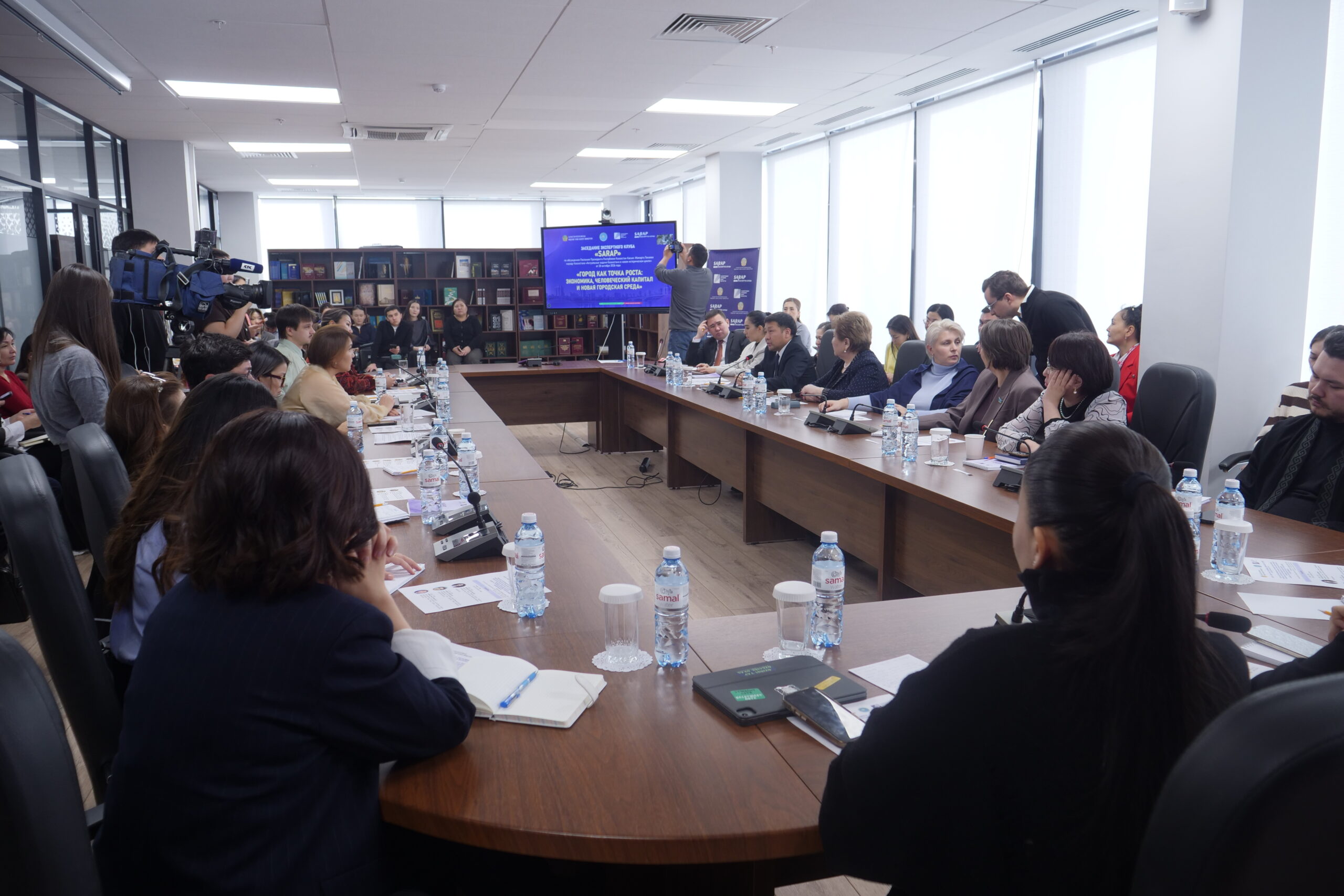
Participants discuss Kazakhstan’s urban development challenges at the SARAP expert club meeting in Astana on Nov. 6. Photo credit: Zhenisuly Zhandos / KIPD

Zhuldyzai Iskakova, chairperson of the Kazakhstan Institute of Public Development (KIPD). Photo credit: Nagima Abuova / The Astana Times
“Urbanization is taking place in every country, but in Kazakhstan it is happening at an accelerated pace. Astana and Almaty remain the main centers of attraction, as our experts have noted. (…) But urbanization is inevitable, and we must prepare for it,” said Zhuldyzai Iskakova, chairperson of the Kazakhstan Institute of Public Development (KIPD).
Iskakova spoke at a Nov. 6 meeting of the SARAP expert club, organized by KIPD, which brought together lawmakers, economists and urban planning specialists to examine urban growth following President Kassym-Jomart Tokayev’s State of the Nation Address and plans for nationwide infrastructure development.
Population growth and the economic divide
The growing concentration of Kazakhstan’s population in its largest cities is reflected in figures presented by Nurbolat Kurmetuly, director of the Center for Regional Studies and Quality of Life at the Economic Research Institute.
According to his findings, the combined population of Astana, Almaty and Shymkent increased by 721,800 between 2021 and 2025, including a positive net internal migration balance of 417,800 people. Astana alone recorded a positive net interregional migration balance of 87,500 in 2025, compared with a negative balance of 2,500 in 2015.
Shynar Tuleshova, head of the Demographic Research Department at the Center for Analysis and Forecasting of Demographic Processes under Kazakhstan’s Agency for Strategic Planning and Reforms, noted that migration to Astana currently exceeds that to Almaty, with approximately 100,000 newcomers registering in the capital annually.
Shynar Tuleshova, head of the Demographic Research Department at the Center for Demographic Analysis and Forecasting under ASPR. Photo credit: Nagima Abuova / The Astana Times.
“However, when we talk about migration, a person does not necessarily register as a city resident immediately after moving. Some register five or even 10 years later, while others continue living without registration. We can only see registered residents in official statistics, not those who remain unregistered,” she said.
Tuleshova added that migration to the Almaty Region has increased over the past two years, reflecting the metropolitan area’s expansion into surrounding settlements.
Population growth is also transforming surrounding settlements. In the Astana metropolitan area, the rural population of the suburban zone increased from 121,900 to 181,500 over five years, while employment remained concentrated in the capital. Kurmetuly noted a similar pattern around Shymkent, where employment increased primarily in the city itself and declined in some neighboring territories.
Nurbolat Kurmetuly, director of the Center for Regional Studies and Quality of Life at the Economic Research Institute. Photo credit: Nagima Abuova / The Astana Times
“In other words, cities are expanding outward rather than developing in depth. Population and housing are growing, but jobs, transport and social infrastructure are not keeping pace,” said Kurmetuly.
The geographical concentration of investment presents another challenge. According to Kurmetuly, more than 55% of Kazakhstan’s fixed assets are concentrated in the Atyrau Region, Astana and Almaty, while the southern macroregion, home to more than 30% of the country’s labor resources, accounts for less than 9%.
In 2025, approximately 1.29 trillion tenge (US$2.87 billion) was directed toward real estate activities in cities of regional significance, compared with 1.10 trillion tenge (US$2.4 billion) in manufacturing.
“Housing construction is necessary, but it produces a quick, one-time effect. Sustainable income for cities comes from industries and services that sell their products beyond the local market, including manufacturing, engineering, logistics, IT and technical services. These are the sectors that create quality jobs,” said Kurmetuly.
“Astana, Almaty and Shymkent are our national engines. There is no need to restrain their growth. But a country the size of Kazakhstan cannot depend on just three cities. We need a network of strong regional centers,” he said.
Can smaller cities become centers of growth?
Kurultai deputy Yulia Kuchinskaya, a member of the Committee on International Affairs, Defense and Security, also emphasized the need to strengthen alternatives to Kazakhstan’s largest cities.
Kuchinskaya noted that the country’s 90 cities should be assessed according to their ability to create employment, attract residents and provide conditions for long-term economic development.

Yulia Kuchinskaya, a member of the Committee on International Affairs, Defense and Security. Photo credit: Nagima Abuova / The Astana Times
“Large-scale construction is a very good project, and a very important one. It can give an impetus to economic development, but we must all understand that construction will eventually end. What happens after construction? Where will people work, what will they do, and what will happen to the economy?” she said.
She also noted that infrastructure improvements do not necessarily prevent rural depopulation, and residents who want to relocate may face financial barriers, including difficulty selling their homes.
“There are many villages in Kazakhstan, at least in the northern regions, where all the infrastructure is in place. There are roads, water and lighting, but there are no people. New residents are not moving there,” she said.
This challenge also showed up in Kurmetuly’s findings. He noted that several regional capitals continue to lose residents despite their administrative status, with Semei’s population declining by 7.2% over five years.
To retain residents, he emphasized the need for economic specialization, permanent employment and stronger links with surrounding rural communities, including agricultural processing and logistics.
Human capital and regional competitiveness
According to Kurmetuly, Kazakhstan has approximately 670,000 students, more than half of whom study away from their home cities or regions. Three-quarters of doctoral students are concentrated in Almaty and Astana.
The distribution of educational opportunities also influences migration, as students who move to larger cities often remain after graduation to pursue careers and establish families.
“Moving away to study often becomes a permanent move. A person earns a degree, finds a job, starts a family and does not return. That is why human capital is not simply a social characteristic of a city,” said Kurmetuly.
“What matters is not how much money was invested, but how many permanent jobs were created with wages above the regional average. (…) Link education to the local economy. And track a simple indicator: how many graduates are working in their home region three years later,” he said.
Rethinking urban planning and mobility
Experts also examined how existing cities can manage growth through changes in urban planning.
Nurkozha Yersaiyn, senior urbanist at the Astana Urbanism Center, presented polycentric development as a way to reduce congestion and improve access to essential services.
“Polycentrism means that a city does not have a single center. It is a multicentered city, where all districts develop at the same pace. To put it more simply, everyone should have a recreational space within walking distance of their home,” he said.
Yersaiyn noted that placing commercial facilities and employment opportunities closer to residential neighborhoods could reduce the need for residents to travel across cities for everyday activities.
“Widening roads or increasing parking spaces will never solve traffic congestion. We can see this in the southern states of the United States. Building major highways will never solve congestion; on the contrary, they make cities less comfortable for people,” said Yersaiyn.
According to the principles used by the Astana Urbanism Center, every public space should offer at least seven reasons for people to visit, accommodating different groups and activities. Even a small park should serve older residents, children, couples and other visitors rather than a single recreational purpose.
“We want to live in a comfortable city. The needs of people with limited mobility are particularly important. This includes mothers with strollers and people with mobility impairments. If these groups are comfortable, the city becomes comfortable for everyone,” he added.
Public expectations also extend to existing infrastructure. According to KIPD’s third-quarter 2026 survey, satisfaction with road quality increased from 40% in 2022 to 57.8% in 2026. However, the institute’s 2024 research found that 46.2% of respondents identified environmental concerns as a priority, while 36.3% viewed dense urban development negatively.
According to Iskakova, such findings could help authorities prioritize infrastructure projects based on residents’ needs, particularly as the country prepares for further construction. The broader question is how to ensure that infrastructure investment generates lasting economic opportunities across the country.
