
ASTANA — French companies operating in Kazakhstan plan to invest 1.5 billion euros (US$1.68 billion) and create more than 1,000 jobs over the next three years, according to a study presented by the French Embassy in Astana on Oct. 22, highlighting the country’s growing role as a regional production and business hub.
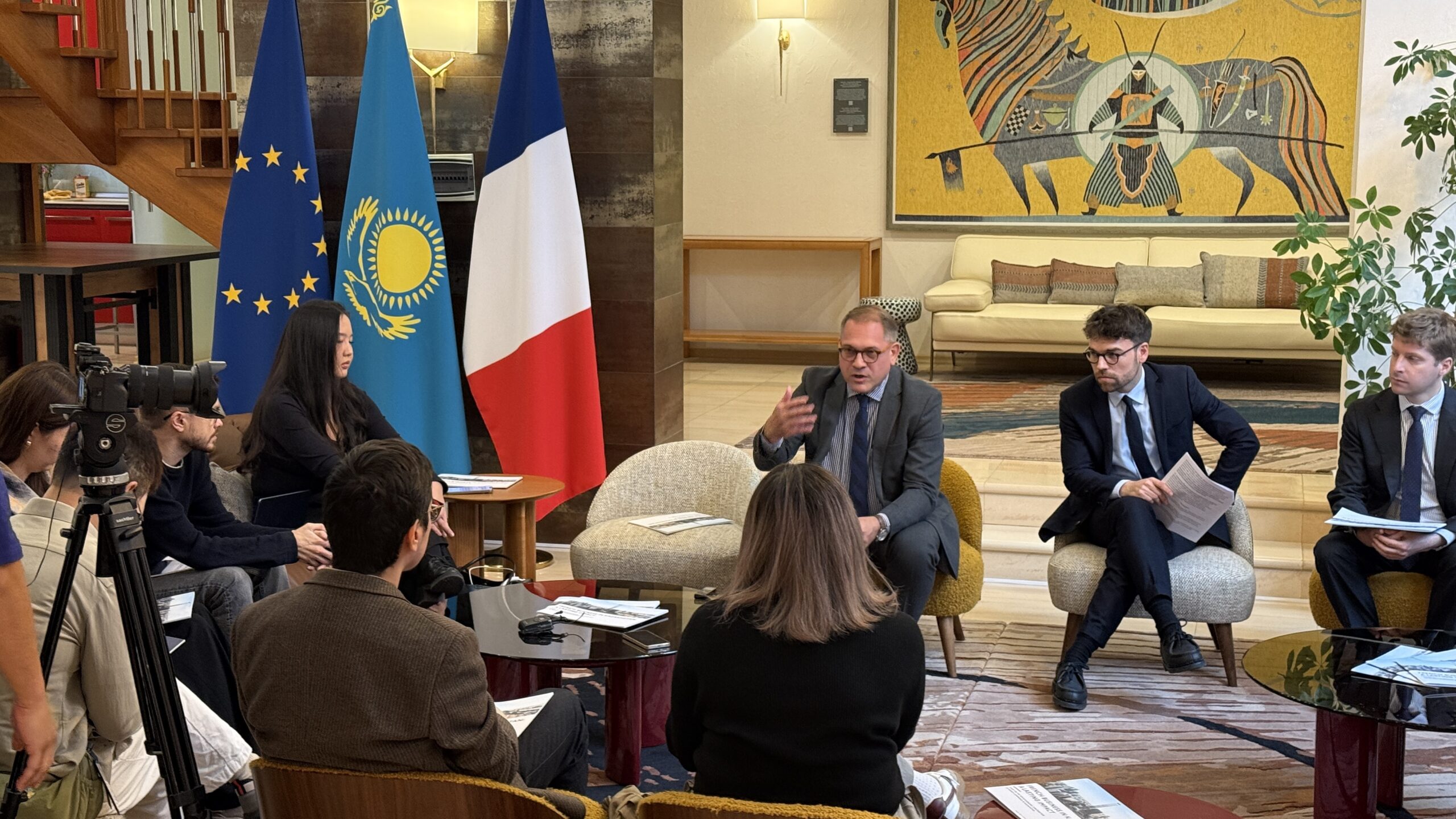
French Ambassador Sylvain Guiaugue presents the study in Astana on Oct. 22. Photo credit: French Embassy press attaché
The planned investments reflect France’s efforts to expand economic cooperation beyond oil and uranium into renewable energy, infrastructure, agriculture and technology, while strengthening local production and supply chains.
“French companies come to Kazakhstan with a long-term perspective. They invest in building new factories, create jobs and train young specialists. In other words, they contribute to the diversification of Kazakhstan’s industrial base,” French Ambassador to Kazakhstan Sylvain Guiaugue said during the presentation.
French investment expands across Kazakhstan
Conducted between March and June 2026, the study examines the economic contribution of French businesses in Kazakhstan, drawing on responses from 26 French and French-Kazakh companies.

French Ambassador to Kazakhstan Sylvain Guiaugue. Photo credit: Nagima Abuova / The Astana Times
Bilateral trade exceeded five billion euros (US$5.6 billion) in 2025, while accumulated French direct investment surpassed 12 billion euros (US$13.45 billion). The surveyed companies reported combined annual turnover exceeding two billion euros (US$2.24 billion), primarily in manufacturing.
Over the past decade, the participating companies invested approximately 2.5 billion euros (US$2.8 billion) in Kazakhstan. More than 80% of respondents are large enterprises, while 42% operate production facilities in the country.
French business activities now extend across all 17 regions of Kazakhstan, with an increasing focus on regional markets. More than 42% of respondents export products from Kazakhstan, while 38% consider the country their main operational center in Central Asia. Another 25% coordinate activities in the Caucasus from Kazakhstan.
Ludovic Lea, head of the French Embassy’s Economic Department. Photo credit: Nagima Abuova / The Astana Times
“What stands out most to me is the geographical reach of French companies. They operate throughout Kazakhstan and use their production facilities in the country to enter new markets. In doing so, they contribute to the diversification of Kazakhstan’s exports,” said Ludovic Lea, head of the French Embassy’s Economic Department.
This regional role is supported by expanding transport links, particularly the Trans-Caspian International Transport Route (TITR), or Middle Corridor, which connects Kazakhstan and Central Asia with European markets.
“Because of geopolitical developments, we see that the Trans-Caspian corridor is playing an increasingly important role in our relations. The corridor is developing, and it involves various forms of connectivity, including air and rail transport, as well as fiber-optic cables and internet infrastructure,” said Guiaugue.
“In this way, the Trans-Caspian corridor has become a very important link for trade between the European Union, Kazakhstan and Central Asia,” he added.
Opportunities for Kazakh businesses and workforce development
The expansion of French production in Kazakhstan is also opening opportunities for local suppliers and skilled workers. Guiaugue said major French investment projects create opportunities for Kazakh small and medium-sized enterprises (SMEs) to enter supply chains, as sourcing goods and services locally becomes increasingly attractive.
France is also seeking to attract more of its own SMEs. Business France, the French international business development agency, reopened its Almaty office in September to support French companies entering Kazakhstan and other Central Asian markets.
The effort accompanies broader diversification into renewable energy, hydropower, urban infrastructure, agriculture and tourism. One example is French company POMA, which secured a contract to construct cableways for the Almaty Superski mountain tourism project.
Alongside industrial expansion, workforce development remains a priority. The surveyed companies employ more than 12,000 people in Kazakhstan and plan to create over 1,000 additional jobs within three years, increasing demand for qualified local specialists.
To address emerging skills shortages, the Lumières Foundation was launched in May to strengthen cooperation between businesses and educational institutions.
“Kazakhstan’s economy is developing rapidly, including in new sectors where the necessary training is not always available at universities. Existing programs do not always meet companies’ needs. Through this foundation, we want to create flexible training programs that can quickly provide the skills employers require,” said Guiaugue.
“We can develop and implement such programs within one or two years. If those particular skills are no longer needed, we can close the programs and introduce new ones,” he added.
The foundation also aims to expand opportunities for Kazakh students to study in France and return to work in Kazakhstan, building on educational cooperation that includes 17 dual-degree programs and more than 40 academic projects.
Nuclear cooperation and Kazakhstan’s energy plans
France’s involvement in Kazakhstan’s nuclear sector is expanding from uranium production and nuclear fuel technology into engineering support for the country’s planned nuclear power plants.
The longstanding KATCO joint venture between France’s Orano and Kazakhstan’s Kazatomprom opened a new uranium processing plant at the South Tortkuduk site in July 2025. Guiaugue said the partners are already discussing the future of their cooperation beyond the project’s current operating period.
French engineering company Assystem has also been appointed technical adviser to Kazakhstan Nuclear Power Plants (KNPP), supporting engineering and project oversight for the country’s nuclear power program.
These developments come as Kazakhstan moves forward with plans to construct at least two nuclear power plants, creating potential opportunities for further French involvement.
“We know that at least two nuclear power plants will be built in Kazakhstan, and this is attracting interest from many companies, including French ones. There are contacts between our governments to explore whether we can expand cooperation in this area. But this is a very sensitive sector, and discussions are progressing step by step,” said Guiaugue.
Beyond industrial cooperation, the ambassador highlighted contacts with nuclear research institutions in Kurchatov and Almaty, and preliminary discussions between universities on training future nuclear industry specialists.
“We are also in preliminary discussions with universities to explore whether we can establish the necessary training programs. Kazakhstan will need qualified specialists in the future, either to participate in the construction of these nuclear power plants or to work at them once they are operational,” he said.
