
Over two days in Turkmenistan’s Avaza resort area, President Kassym-Jomart Tokayev took part in high-level meetings. On Oct. 8, the eighth Consultative Meeting of the Heads of State of Central Asia convened for the first time with Azerbaijan as a full participant. On Oct. 9, the CIS Council of Heads of State and the first Caspian Environmental Summit followed, part of a diplomatic week that Ashgabat presented as a showcase of its chairmanship.
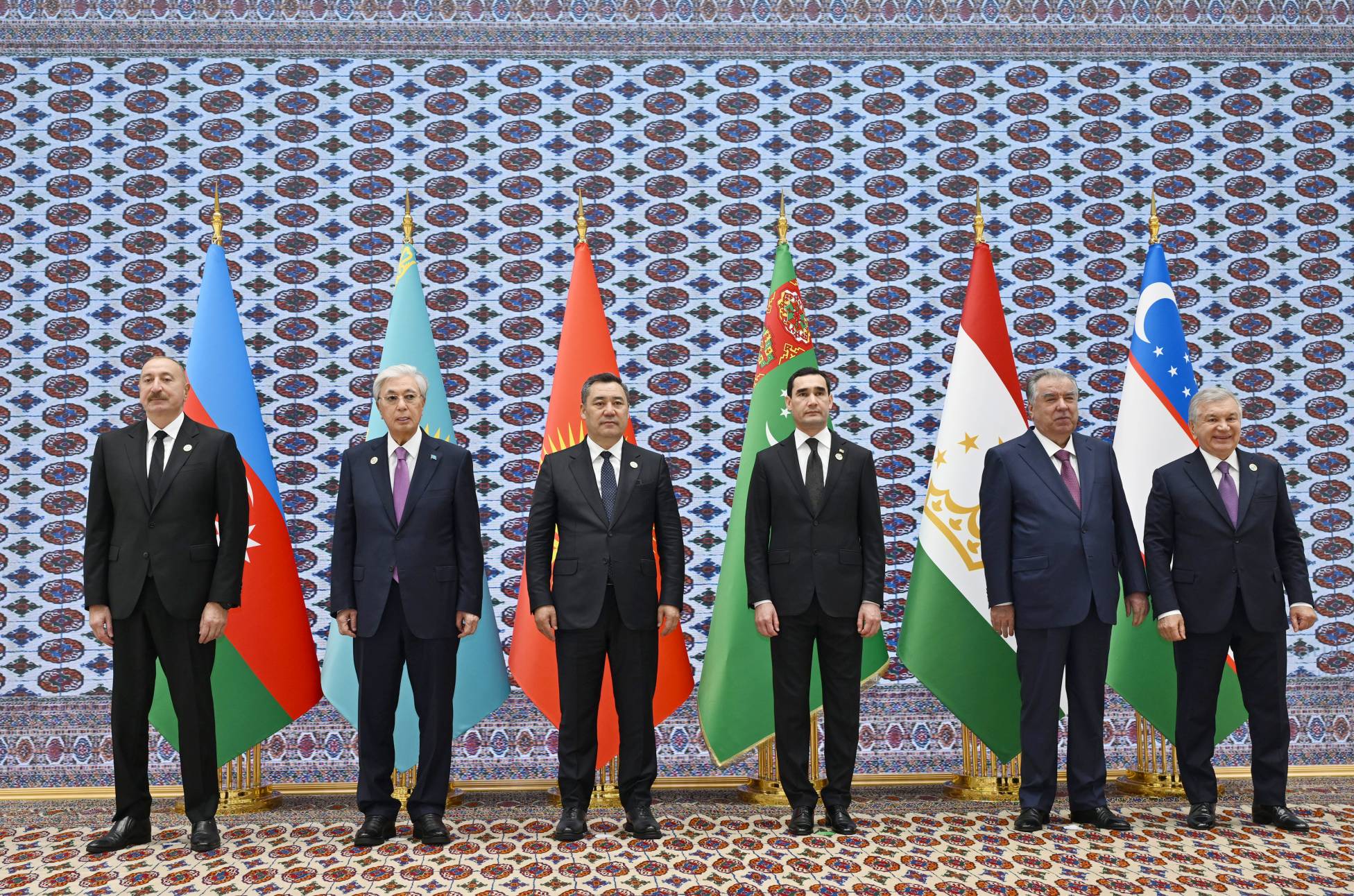
The 8th Consultative Meeting of Heads of State of Azerbaijan and Central Asia. Photo credit: Press service of President of the Republic of Azerbaijan.
Such trips are usually described through the lens of balanced diplomacy, with Astana balancing its neighbors, Moscow and Tehran. That framing holds, yet it explains little about why Kazakhstan needs so many platforms with overlapping membership, and why a president who regularly criticizes multilateral institutions for weak results keeps investing political capital in them.
The answer becomes clearer through the logic of Geo-Connectivity. In this framework, the resilience of a country’s external economic ties rests on four elements, namely goods, demand, infrastructure and the ability to secure access to that infrastructure. The first three create an economic link. The fourth determines the degree of dependence. For Kazakhstan, multilateral formats serve primarily as a tool for working on that fourth element. Through them, Astana shapes transit rules, route security and the availability of alternatives where its own leverage falls short.
Three platforms, three systems of dependence
Each meeting in Avaza corresponds to a distinct geographic system through which Kazakhstan connects to world markets.
The Consultative Meeting with Azerbaijan covers the western direction and the intraregional system. It includes the critical nodes of the Middle Corridor, the ports of Aktau and Kuryk on the Kazakh shore and Baku on the opposite one.
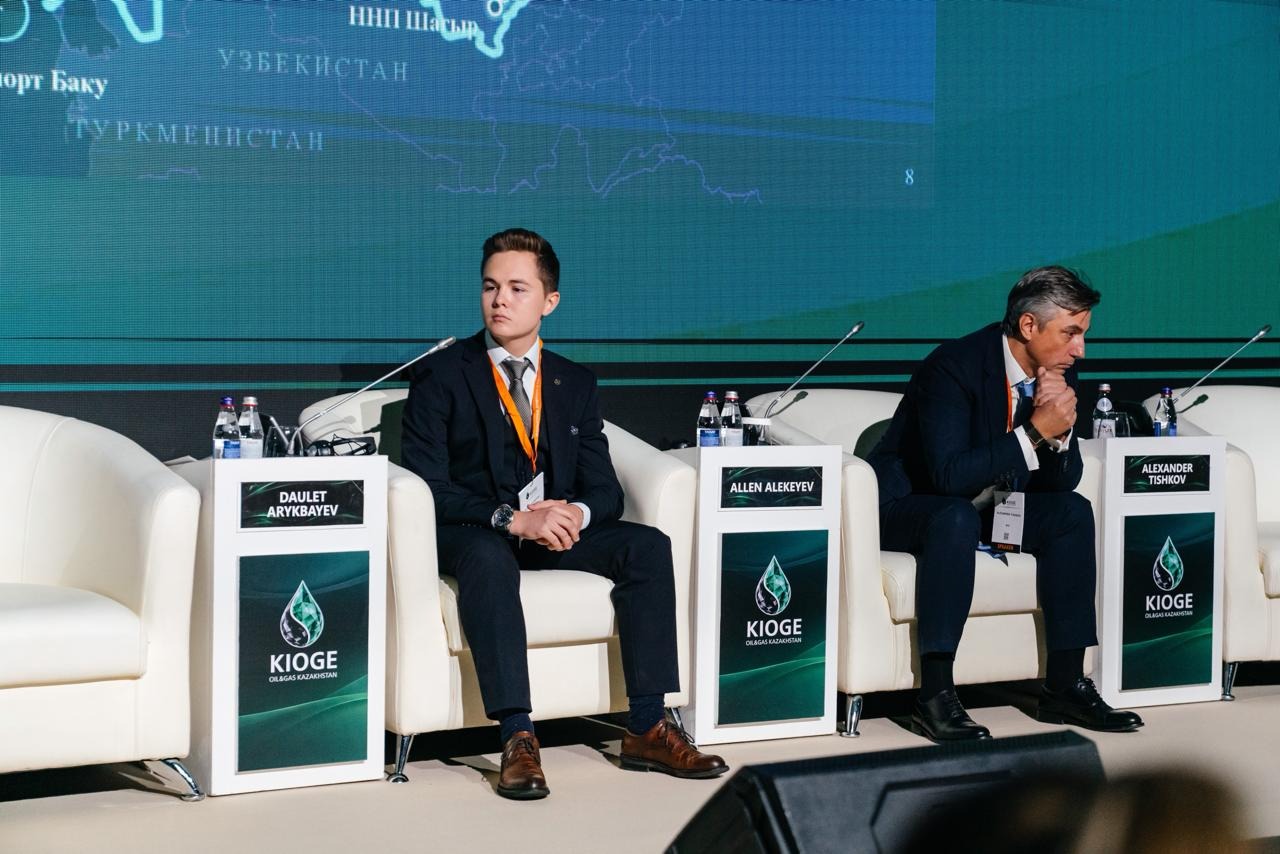
Allen Alekeyev (L). Photo credit: KIOGE Forum 2026.
Tokayev proposed discussing, at expert level, the integration of the Middle Corridor with the TRIPP route through Armenia, and he cited a World Bank estimate that cargo flows across the Caspian could quadruple by 2040. He also listed the domestic projects meant to feed this route with cargo.
The Moiynty-Kyzylzhar and Darbaza-Maktaaral lines are nearing completion, the Bakhty-Ayagoz section is scheduled to open in 2027, and work has started on the Aral-Caspian mainline. Regional observers described his speech as a combination of infrastructure planning and candid criticism of regional governance.
The CIS meeting serves the northern system. Most of Kazakhstan’s oil exports pass through Russian territory and ports. In 2025, 64.8 million of Kazakhstan’s 78.7 million tons of oil exports moved through the Caspian Pipeline Consortium, and disruptions in 2026 forced a downward revision of the production plan.
Good relations with Moscow do not fully insure this node, yet without a regular channel of dialogue Astana cannot manage the risks attached to it. Tokayev therefore used the same Avaza speech to reaffirm the importance of the North-South corridor. The CIS session brought together nine leaders of the Commonwealth and, for the first time in the organization’s history, Iranian President Masoud Pezeshkian was invited to its expanded session. The leaders planned to adopt a statement on the 35th anniversary of the CIS and documents on law enforcement, cultural and information cooperation and foreign policy coordination.
The Caspian Environmental Summit addresses a node shared by the western and northern systems. The sea’s level has been falling since the mid-1990s and in 2025 it reached a historic low below minus 29 meters on the Baltic datum.
Shallowing limits vessel draft in ports and threatens the capacity of the Middle Corridor. Tokayev warned at the 2025 SCO summit that the situation was approaching an ecological disaster and later called for an interstate program to preserve the sea.
The summit, held at the initiative of President Serdar Berdimuhamedov, gathered the leaders of all 5 littoral states, who were expected to adopt a declaration on the sea’s environmental problems.
It follows 20 years of the Tehran Convention, the region’s framework for protecting the marine environment. Russia, according to presidential aide Yuri Ushakov, attributes fluctuations in the sea level mainly to climate. For Kazakhstan, this is one of the risks it cannot reduce alone and can only share with partners.
Dovetailing as insurance for access
Researchers Aliya Tskhay and Filippo Costa Buranelli describe the behavior of Central Asian states in multilateral structures as “balancing regionalism” operating through bridging, dovetailing and branding.
Dovetailing borrows its name from a carpentry joint whose interlocking pins hold two parts together. States bring the same issues to different platforms, and separate formats lock into a sturdier structure.
In the logic of Geo-Connectivity, this mechanism has a practical purpose. When a critical dependency is anchored in several formats at once, access to it no longer hinges on the position of a single partner.
The Middle Corridor appears on Kazakhstan’s agenda in the Organization of Turkic States, in dialogues with the EU and China, in the SCO and now in the format with Azerbaijan.
The idea of an International Water Organization, which Kazakhstan advanced under the UN umbrella, in Avaza became part of a common Central Asian position alongside the Framework Convention on Water Use. Astana is assembling a Eurasian framework from multilateral platforms that holds its links to markets in place when individual routes fail.
Criticism as a demand for results
Tokayev has been consistent in his criticism of multilateral institutions. At the 80th session of the UN General Assembly in September 2025, he spoke of a real crisis of trust in multilateral institutions, proposed discussing a revision of the UN Charter and argued that responsible middle powers deserve a stronger voice in the Security Council.
During its SCO chairmanship, Kazakhstan advocated a stronger role for the organization’s Secretariat and Secretary-General, and it thanked SCO partners for supporting the transformation of CICA into a full-fledged international organization.
In Avaza, the same logic was applied to Kazakhstan’s own region. Tokayev stated that of more than 200 initiatives put forward since 2018, only a small share had been implemented, and he proposed that foreign ministries take inventory of them.
At the same time, he insisted on preserving the meetings as a platform for direct dialogue among leaders, free from excessive formalization.
This criticism fits the arm’s reach principle, under which a state concentrates resources where it can genuinely strengthen critical links.
The Consultative Meetings belong to this category. Kazakhstan’s weight there is at its highest, major external powers are absent, and the rules of transit between neighbors depend largely on the participants themselves.
This is why Astana demands an audit in this particular format while defending its informal character.
The fate of a 2023 agreement shows how difficult the task is. At the Fifth Consultative Meeting in Dushanbe, transport ministers signed the Agreement on Strengthening Land Transport Connectivity in Central Asia, which provides for a joint commission to monitor implementation and is listed among the summit’s 3 main documents. Uzbekistan approved it in October 2024, and Kyrgyzstan decided to accede in February 2026. An institution designed to secure access to regional infrastructure spent nearly 2.5 years in domestic procedures.
From a list of initiatives to a map of dependencies
The audit proposed in Avaza could become Kazakhstan’s first step toward a tool its foreign policy still lacks, namely a map of critical dependencies in which each initiative is assessed by the route, commodity or node it protects.
The plan to raise intraregional trade from about $13 billion to at least $20 billion, the linking of border logistics hubs with industrial cooperation centers and the new railway lines gain priority once it is clear which supply chain they make more resilient. The same test applies to newer proposals such as the regional AI partnership program and the declaration on responsible use of artificial intelligence, which still lack timelines and budgets.
The second task concerns early warning. Caspian shallowing, pipeline disruptions, instability in transit states and changes in access rules at foreign ports are discussed in different formats. Bringing these signals into a single monitoring system would allow Kazakhstan to use multilateral platforms proactively.
The author is Allen Alekeyev, the deputy head of research at Nightingale Int. analytical center.
Disclaimer: The views and opinions expressed in this article are those of the author and do not necessarily reflect the position of The Astana Times.
