
ASTANA – Thirty-five years after Kazakhstan closed the Semipalatinsk nuclear test site and began giving up the nuclear arsenal it inherited from the Soviet Union, the world is moving back toward a security environment in which nuclear weapons are again seen by some as an answer rather than a danger. That was one of the central concerns raised during the Sept. 22 online discussion dedicated to what Kazakhstan’s nuclear experience can teach the world today.
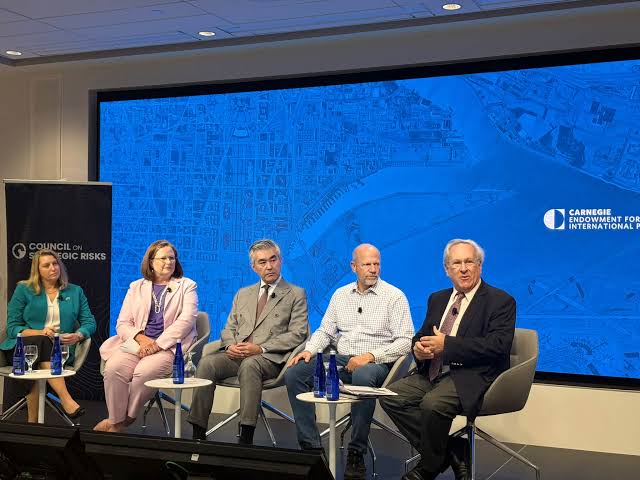
Photo credit: Embassy of Kazakhstan in Washington
Organized by the Carnegie Endowment for International Peace and the Council on Strategic Risks, the discussion brought together Kazakh and United States officials and experts who were directly involved in the nuclear threat reduction efforts of the 1990s. Their focus was not only on what Kazakhstan did after independence, but on whether the lessons of that period can still work in a world defined by geopolitical rivalry, weakening arms control and rapidly developing artificial intelligence.
The answer was not straightforward. The environment that allowed Kazakhstan and the U.S. to cooperate on eliminating nuclear dangers was unusually favorable. Today, major powers are again competing militarily, key arms control agreements have lapsed or been abandoned, and new technologies are making strategic calculations more complex. But Kazakhstan’s experience offers one lesson that remains relevant: security does not necessarily become stronger when a country possesses more nuclear weapons.
When a nuclear arsenal was seen as a risk, not an asset
When Kazakhstan became independent, it inherited the world’s fourth-largest nuclear arsenal. The country also inherited the consequences of the Soviet nuclear program. Between 1949 and 1989, the Soviet Union conducted 456 nuclear tests at the Semipalatinsk site, affecting approximately 1.5 million people. Kazakhstan closed the site on Aug. 29, 1991, and subsequently relinquished the nuclear weapons and delivery systems left on its territory.
For Laura Holgate, former U.S. ambassador to the International Atomic Energy Agency (IAEA), the significance of that decision goes beyond disarmament. She noted that Kazakhstan’s leaders recognized that the weapons were not necessarily an asset that would protect the newly independent country. They could instead make Kazakhstan more vulnerable to confrontation with other major powers.
“To recognize that that was a source of weakness or risk of insecurity rather than a source of security,” Holgate said, was an “incredibly bold and courageous decision.”
That point is particularly relevant today because nuclear deterrence continues to shape how states think about security. Magzhan Ilyassov, Kazakhstan’s ambassador to the U.S., recalled a conversation he had as a young exchange student in the U.S. in the early 1990s. Americans he met had grown up fearing that the Soviet Union might attack them. Kazakh Soviet people had grown up with a similar fear of the U.S. Yet on both sides, nuclear weapons were understood as defensive.
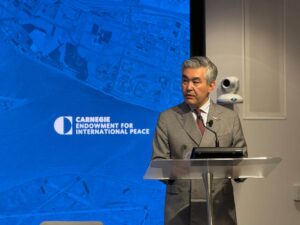
Magzhan Ilyassov, Kazakhstan’s ambassador to the U.S. Photo credit: Embassy of Kazakhstan in Washington
“I never thought that we would drop it on you. It was our defense,” Ilyassov recalled.
That contradiction remains at the heart of the nuclear debate: if every country sees its own nuclear weapons as defensive, but another country’s arsenal as a threat, the logic of deterrence can become an argument for more proliferation.
Ilyassov warned that the more countries come to believe they need nuclear weapons for deterrence, the more difficult it becomes to maintain the credibility of the system itself.
“The whole deterrence concept sounds solid,” he said, but the more countries seek nuclear weapons, “the whole deterrence thing starts losing its credibility.”
Corey Hinderstein, vice president for studies at the Carnegie Endowment, similarly noted that nuclear weapons should not be discussed as a stand-alone security issue. In countries where public support for acquiring nuclear weapons is rising, she said, the question changes when people are asked to consider what that choice would mean for national spending, alliances, economic stability and society.
“It’s not a nuclear trade-off. It’s a societal trade-off,” Hinderstein added.
That is one of the lessons Kazakhstan’s experience puts back on the table: nuclear disarmament was not simply about removing weapons. It was about redefining what security meant.
From a Soviet nuclear legacy to a role in global security
Kazakhstan’s decision did not end with the closure of Semipalatinsk. The country worked with the U.S. under the Nunn-Lugar Cooperative Threat Reduction program to dismantle nuclear weapons and delivery systems, eliminate nuclear infrastructure, seal test tunnels and secure dangerous materials.
One of the most significant operations was Project Sapphire in 1994, when nearly 600 kilograms of highly enriched uranium were removed from Kazakhstan: enough material for approximately 25 nuclear weapons. The operation was carried out through close cooperation between the two countries and was kept secret until the material had been safely transported.
Andrew Weber, former U.S. assistant secretary of defense for nuclear, chemical and biological defense programs, was directly involved in that effort. He described Project Sapphire as an example of what can happen when governments focus on solving a specific security problem rather than allowing political differences to prevent cooperation. The operation, he said, required technical and security cooperation over several weeks to safely package and transport the material.
For Corey Hinderstein, the broader lesson was that Kazakhstan’s leadership in the anti-nuclear field was not something imposed on the country by its Soviet past.
“The nuclear legacy was imposed on Kazakhstan from Moscow. Kazakhstan didn’t have to do what it did. It certainly did not have to give up its inherited nuclear weapons. But even once that moment and that decision came, nuclear leadership was selected, was embraced and has been sustained,” she said.
That distinction matters because Kazakhstan did not simply dismantle an inherited arsenal and move on. It continued to build its role in nuclear non-proliferation, including through the IAEA low-enriched uranium bank, its participation in international negotiations on Iran and its support for the global nuclear non-proliferation regime. The country’s experience could again become relevant in dealing with Iran’s nuclear material.
Ilyassov said Kazakhstan remains ready to provide a neutral venue and, if Washington and Tehran reach an agreement, potentially assist with the secure handling of Iran’s enriched uranium under international legal, technical and verification arrangements. Weber said such a process would need to involve international partners and UN and IAEA supervision rather than being treated as a unilateral U.S. operation. That willingness is part of what Weber described as Kazakhstan’s “tremendous moral authority” on nuclear issues.
The forgotten public movement behind the decision
The discussion also highlighted a part of Kazakhstan’s nuclear history that receives less international attention: the role of civil society. Ilyassov pointed to the Nevada-Semipalatinsk movement, which brought the consequences of nuclear testing into public debate and created pressure for political action. The movement, he said, did not itself make the political decision to close the test site. But it put the issue on the political agenda and made it impossible for politicians to ignore.
“That was a public driving force that actually didn’t make the politicians take the decision, but it put this topic onto the agenda,” Ilyassov said, adding that this grassroots dimension deserves renewed attention today.
Nuclear weapons have become strangely disconnected from everyday public debate despite their continued existence. Social media can turn relatively trivial subjects into global trends within hours, while nuclear disarmament rarely becomes a mainstream issue among younger generations or public figures.
“This is your world. This is real. These weapons exist,” Ilyassov said.
The challenge is therefore not only diplomatic. It is also political and societal: how to make nuclear risks visible enough for the public to understand the stakes before a crisis forces the issue back into the headlines.
AI makes human responsibility more important
The most difficult question for the future may be how nuclear security will work once artificial intelligence becomes more deeply embedded in military decision-making. AI can improve analysis of satellite imagery, identify unusual activity, support safeguards and help detect illicit networks. But the same technology can accelerate decision-making, amplify false information and make deception more convincing. In a nuclear crisis, that could reduce the time available for diplomacy and increase the consequences of a technical error.
For Kazakhstan, the lesson is not that AI should be excluded from nuclear security. It is that technology cannot replace the person who ultimately has to take responsibility for an irreversible decision. Ilyassov put the distinction bluntly: an algorithm can calculate the probability of escalation, but it cannot understand its human cost. It does not feel fear, grief or hesitation, and it cannot carry moral responsibility. That is why, he said, “meaningful human control” and clear accountability must remain central to decisions involving nuclear weapons.
The issue is becoming more urgent as the global nuclear consensus weakens. Hinderstein warned that the idea that “a nuclear war cannot be won and must never be fought” is itself losing ground. Discussions of limited nuclear war, tactical nuclear use and contained exchanges can make nuclear use appear more manageable than it actually is.
At the same time, countries without nuclear weapons are increasingly reconsidering whether they should acquire them, particularly when confidence in security guarantees declines. Hinderstein said that a broader public discussion of the economic, social and political costs of nuclear weapons could change that calculation.
That concern was echoed just days later at the UN General Assembly, where Kazakh Foreign Minister Mukhtar Tileuberdi linked the country’s nuclear disarmament experience to the current erosion of international trust.
“Our experience of renouncing the world’s fourth largest nuclear arsenal did not weaken our state. To the contrary, through international trust, it strengthens sovereignty, enhances security and promotes development,” he said.
For Kazakhstan, the experience of the 1990s offers a different reference point. She highlighted that the country did not have to keep the nuclear weapons it inherited. It chose to give them up. It did not have to become a long-term advocate of nuclear threat reduction. It chose to take on that role. And it did not do so through one decision alone. The process involved political leadership, public pressure, international cooperation and years of practical work.
The circumstances today are very different from those of the previous millennia. The U.S., Russia and China are strategic competitors, arms control mechanisms are under pressure, and AI is adding a new layer of uncertainty to nuclear decision-making. But the question raised by Kazakhstan’s experience remains much the same: whether security is best achieved by accumulating more instruments of destruction, or by finding ways to make those instruments less necessary. For Kazakhstan, the answer was decided 35 years ago. The discussion in Washington suggested that the rest of the world may need to revisit that choice.
