
ASTANA – Kazakhstan is heading into this year’s United Nations General Assembly debate with an expanding agenda that stretches from nuclear disarmament and peacekeeping to water security, artificial intelligence and sustainable development, as the country’s Foreign Minister Mukhtar Tileuberdi leads the country’s delegation in New York.
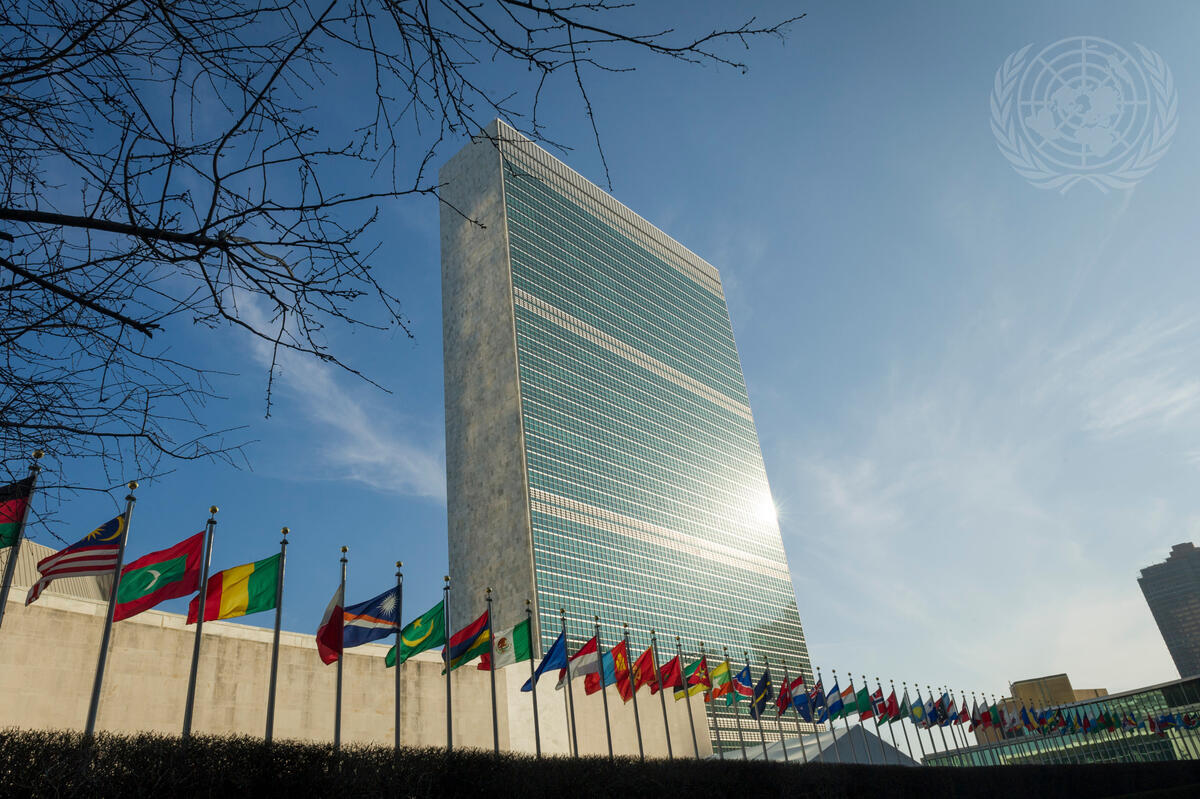
A high-level week began at UN headquarters in New York. Photo credit: igov.un.org.png
Foreign Minister Tileuberdi is representing Kazakhstan at the 81st session of the UN General Assembly, whose annual general debate opened Sept. 22 amid wars, geopolitical tensions and mounting pressure on the international system. He is expected to deliver Kazakhstan’s national statement during the debate.
The delegation is also expected to meet with UN leadership and heads of UN agencies, representatives of the OSCE and the International Committee of the Red Cross, among others.
Bilateral meetings are scheduled with foreign ministers of Armenia, Azerbaijan, Hungary, Jordan, Canada, Cyprus, Kuwait, Moldova, Poland, Russia, Slovenia, Ukraine, Switzerland, and El Salvador, among other countries.
Deepening engagement with UN
The high-level week comes as Kazakhstan seeks to build on more than three decades of engagement with the UN while broadening its traditional focus on nuclear nonproliferation into newer areas including digital cooperation, climate policy and regional water security.
Kazakhstan joined the UN on March 2, 1992, and opened its first UN representation in Almaty the following year. It later served as a non-permanent member of the Security Council in 2017-2018, becoming the first Central Asian country to hold a seat on the council.
Kazakhstan has also sought a broader institutional role within the UN system, serving on bodies including the Security Council, Human Rights Council and Economic and Social Council and securing seats on several UN commissions.
One of Kazakhstan’s most significant recent UN initiatives has been the creation of a regional UN center for the Sustainable Development Goals for Central Asia and Afghanistan in Almaty. Kazakhstan has presented the center as part of a broader effort to give the region a stronger institutional role within the UN development system.
Kazakhstan has also expanded its role in UN peacekeeping. According to the Foreign Ministry, 167 Kazakh personnel currently serve in UN peacekeeping operations, including a 139-member national contingent in the Golan Heights.
Kazakhstan’s priorities are increasingly reflected in its cooperation with the UN under a new 2026-2030 cooperation framework. The country’s Foreign Ministry identifies nuclear disarmament, sustainable development, peacekeeping, AI, volunteering, environmental initiatives and water as major areas of Kazakhstan’s UN activity.
Water security is emerging as another major component of Kazakhstan’s multilateral diplomacy. Astana has proposed establishing an international water organization within the UN system, reflecting growing concern over water scarcity and cross-border water management in Central Asia.
Reshaping of international system
That engagement is unfolding as the international system itself is being reshaped. Opening the General Assembly’s General Debate, UN Secretary-General António Guterres said power was shifting in three fundamental ways: among states, from governments toward powerful private corporations and individuals, and increasingly from humans to machines through artificial intelligence and autonomous weapons.
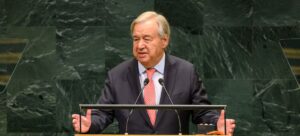
Secretary-General António Guterres addresses the opening of the General Debate of the UN General Assembly’s 81st session. Photo credit: UN Photo/ Loey Felipe
“Yet our institutions and systems of global governance continue to reflect the power realities and interests of a largely bygone age. That is the defining challenge before us,” he said.
The shift toward a multipolar world was irreversible, said Guterres, but there were two ways along this path.
One could be a “world of fragmentation and transactionalism,” which reflects the current realities. The other path, however, is towards what Guterres described as “networked multipolarity,” in which multiple centers of influence operate within common rules and international law.
“The greatest power is not the power to dominate. It is the power to build a future that works for everyone,” he said.
On climate change, Guterres described the crisis as a stark imbalance between generations and warned that the world is close to exceeding the 1.5-degree Celsius limit.
Speaking about artificial intelligence, Guterres warned that influence is becoming increasingly concentrated among those controlling data, computing power and algorithms
“The danger is not technology,” he said. “The danger is technology without accountability.”
Trump stresses power and technological competition
United States President Donald Trump offered a different emphasis, portraying artificial intelligence as a field of geopolitical competition. In his 37-minute address, he said the technology should instead be called “superintelligence” and stressed that leadership in the field would be central to future economic and strategic power.
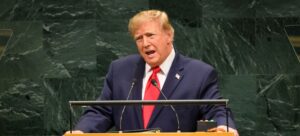
President Donald Trump addresses the General Debate. Photo credit: UN Photo/ Loey Felipe
Trump also referred directly to Kazakhstan while discussing the Gaza peace plan, thanking it among countries contributing to relief and reconstruction efforts. He later named Kazakhstan among states supporting the stabilization of Gaza through troops, police or training.
President Kassym-Jomart Tokayev signed the Board of Peace charter on Jan. 22 in Davos, Switzerland, alongside leaders and representatives from 18 countries.
The debate also underscored the immediate geopolitical pressures confronting the UN system. In his address, Trump defended recent U.S. military action against Iran and called for continued economic pressure on Tehran, while warning that Washington could take further action if diplomacy failed.
Trump said the U.S. would not “allow” Iran to acquire a nuclear weapon and urged other countries to support what he called the country’s “complete economic isolation.” At the same time, he said he believed an agreement with Tehran could eventually be reached.
Central Asia’s voice becomes stronger
During the General Debate, regional leaders also pressed for changes in the international system. Kyrgyz President Sadyr Zhaparov pointed to his country’s election to the UN Security Council for 2027-2028, saying support from 142 member states demonstrated Central Asia’s growing role in international affairs.
Kazakhstan became the first Central Asian state to serve on the Security Council in 2017-2018. Nearly a decade later, election of the Kyrgyz Republic for the 2027-2028 term extends the region’s representation on the council.
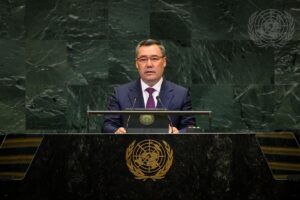
Sadyr Zhaparov. Photo credit: UN Photo.jpg
In his remarks, Zhaparov also called for reform of the UN and Security Council to better reflect current realities, while highlighting climate pressures facing mountain countries and the growing role of Central Asia in multilateral diplomacy.
Zhaparov also backed an expansion of Security Council membership and proposed a permanent public registry within the General Assembly to track countries’ implementation of UN resolutions and obligations.
“I believe that when cases of systematic non-implementation of United Nations’ decisions are considered, the permanent members of the Security Council should voluntarily refrain from using the veto,” said Zhaparov.
“If a mechanism designed to ensure the implementation of the organization’s decisions is systematically blocked by permanent members through the use of the veto, such practice would no longer be consistent with the spirit of the UN Charter and the principle of equal responsibility of member states,” he said.
The opening days of the General Debate have brought together several overlapping questions confronting the UN system. The issues at stake include how institutions should adapt to a more multipolar world, how states should respond to ongoing conflicts and how emerging technologies should be governed.
For Kazakhstan, those debates intersect directly with an agenda that increasingly combines its longstanding focus on nuclear security with peacekeeping, sustainable development, water cooperation and artificial intelligence.
