
ASTANA – South Korea and five Central Asian nations moved on Sept. 16 to deepen industrial and supply chain ties, seeking to combine Korean technology and manufacturing with the region’s critical minerals and push for more local processing and production.
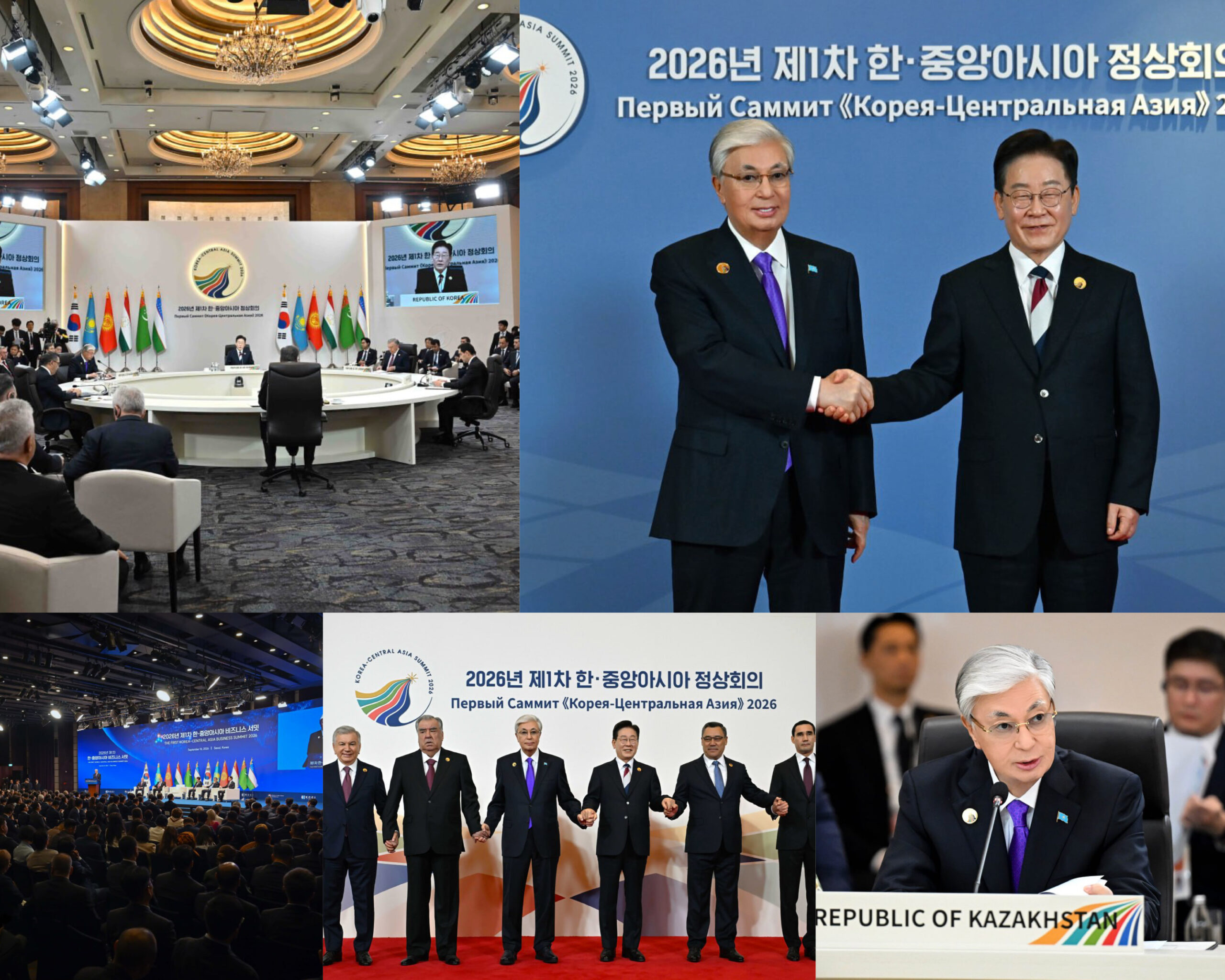
South Korea and five Central Asian nations held the first leaders’ summit in Seoul on Sept. 16. Photo credit: Akorda
Seoul hosted the first Korea-Central Asia summit at the leaders’ level on Sept. 16, where President Lee Jae Myung called for building “mutually beneficial” regional value chains, while Kazakhstan’s President Kassym-Jomart Tokayev proposed a new industrial and technological partnership focused on localization, technology transfer and exports to third markets.
South Korean President Lee Jae Myung said cooperation should move beyond individual projects and infrastructure construction toward jointly developing industrial capabilities and value chains. He described Central Asia’s resources and growing markets and South Korea’s manufacturing and technological capabilities as complementary, particularly as Seoul seeks to diversify its markets and supply chains.
For Central Asia, that objective is parallel to using foreign investment and technology to move further up the production chain rather than remaining primarily suppliers of raw materials.
Political upgrade
Tokayev commended more than two decades of the dialogue, saying the Seoul summit elevated the format to the “highest political level.”
“This is truly a culminating moment in our multifaceted cooperation, a testament to genuinely strategic relations and mutual trust. The current summit can rightly be described as a historic event,” said Tokayev.
The Korea-Central Asia Cooperation Forum was launched in 2007 and gained a permanent secretariat in 2017. The Sept. 16 meeting brought that dialogue to the presidential level for the first time.
The six countries adopted the Seoul Declaration setting out a longer-term framework for cooperation and agreed to hold leaders’ meetings regularly. Kazakhstan is expected to host the next summit in 2028.
Sabina Insebayeva, an assistant professor at the Department of Political Science and International Relations at Nazarbayev University, said the key outcome is “strategic rather than institutional.”
“You are right, much attention has been paid to the upgrade in format. But I think that misses the bigger point. The real outcome is strategic rather than institutional. What has really changed is how Seoul sees Central Asia,” Insebayeva told The Astana Times.
“Look at South Korea’s strategic environment. Its security rests on the United States. But with Donald Trump back in power, the alliance is changing. Seoul has to think harder about how much it can rely on the existing arrangement,” she added.
This “strategic environment” also involves balancing deep economic ties with China and growing cooperation between North Korea and Russia.
“Now, let’s look at where Seoul is putting its attention. The Korea-Central Asia summit is the only multilateral leaders’ level summit South Korea is hosting in 2026. That is significant for a country who traditionally focused its diplomacy on Northeast Asia. This fact tells us that Central Asia now has a different strategic value for Seoul,” she explained.
At the same time, Central Asian states are pursuing more diversified foreign policies and are increasingly reluctant to be viewed solely through the interests of larger powers, she said.
“And South Korea is responding to that. I think this is really important. Central Asia wants more choices, and South Korea wants more choices too. To me, that is the main outcome of the summit: Seoul is building its own relationship with an increasingly autonomous Central Asia,” said Insebayeva.
From critical minerals to deeper processing
Tokayev proposed a Central Asia-Korea industrial and technological partnership. It will be focused on localizing production, transferring technology, strengthening regional supply chains and exporting finished goods to third-country markets.
The summit gave that agenda an institutional framework. South Korea and the five Central Asian states signed a memorandum on industrial and supply chain cooperation, which covers manufacturing, infrastructure, critical minerals, energy and digital transformation and established a consultative mechanism among their industry ministers.
Tokayev called for deeper cooperation with South Korea on critical minerals, noting that all 10 minerals classified by Seoul as strategic are found in Kazakhstan.
He said the two countries should aim to build a full value chain, from research and extraction to advanced processing and the production of semiconductors, batteries, electric-vehicle components and robotics equipment. He also proposed creating a joint Kazakh-Korean company to support that effort and welcomed plans to establish a rare and rare-earth metals research center in Almaty.
“For now, this remains a proposal, alongside an agreement to establish the center, but together they provide a more concrete foundation for cooperation on critical raw materials,” said Aidar Kurmashev, head of the Asian Studies Department at the Kazakhstan Institute for Strategic Studies.
South Korea, whose advanced manufacturing industries depend heavily on imported energy and minerals, has put supply-chain diversification near the center of its engagement with Central Asia. Lee also called for cooperation across the critical minerals value chain, from exploration and refining to materials processing and finished products.
“The next step will be to determine which materials can be processed competitively in Kazakhstan and who would buy the finished products. A Korean partner could provide technology and access to industrial customers, while the Kazakh side would need to assess the resource base and the cost of energy and water. In such projects, a long-term supply contract could be decisive: without predictable demand, even modern equipment may not make the operation commercially viable,” he explained.
Tokayev pointed to the Kia Qazaqstan plant, launched last year with an annual capacity of 70,000 vehicles, as a model for deeper industrial cooperation with South Korea. He said a similar approach could be extended to other industries by combining South Korean technology with Kazakhstan’s manufacturing capacity.
The broader economic relationship already has significant weight. In 2025, trade between Central Asia and Korea surpassed $10 billion, with Kazakhstan accounting for nearly half of that figure, Tokayev said. He added that South Korea is among Kazakhstan’s top 10 trading partners and ninth-largest investors, with more than $12 billion in gross investment. More than 1,000 companies with Korean capital work in Kazakhstan.
Kazakhstan and South Korea also signed commercial agreements worth about $19 billion during Tokayev’s state visit to Seoul, a day before the regional summit.
Connectivity
The ambition also requires reliable routes to move what it produces to international markets. That places transport at the center of the same industrial strategy.
Tokayev said Kazakhstan aims to increase total transit volumes through its territory to 100 million tons and expand the capacity of the Trans-Caspian International Transport Route, or Middle Corridor, to 20 million tons.
He proposed linking the corridor more closely with other regional transport initiatives to create an integrated logistics chain connecting South Korea with Central Asia and Europe, including through greater cooperation between the Port of Busan and Kazakhstan’s Caspian ports.
Local processing becomes more commercially attractive if producers can reliably source inputs across the region and reach larger markets beyond individual Central Asian economies.
Lee also called for stronger railway, logistics and energy links alongside improvements in customs procedures, certification and intellectual property protections.
Energy security
The same push toward higher-value production extends to energy. Tokayev said Kazakhstan is ready to expand energy cooperation with South Korea, including by resuming energy supplies and increasing joint exploration and development of new deposits. But he also emphasized deeper processing, inviting South Korean companies to participate in Kazakhstan’s expanding petrochemical industry, including polypropylene and polyethylene production.
The two countries are pursuing large industrial projects. QazaqGaz, Hyundai Engineering and SICIM Kazakhstan signed an agreement during the visit to build a gas processing plant in western Kazakhstan. The facility is expected to process five billion cubic meters of raw gas annually, and
AI and technology cooperation
Kazakhstan and South Korea are expanding cooperation in artificial intelligence, research and higher education.
Alatau City is also emerging as a broader test of that partnership. During Tokayev’s visit, Kazakh and South Korean partners formalized plans for South Korea’s Korea Overseas Infrastructure and Urban Development Corporation (KIND) to help develop a master plan for the Alatau Smart City project in the Almaty Region. Three agreements were exchanged covering the master plan, investment cooperation and broader participation by KIND in the city’s development.
This is not the first project for the company in Kazakhstan. Earlier, KIND took part in the implementation of the Big Almaty Ring Road project.
The industrial strategy also requires skilled workers. Tokayev pointed to joint initiatives involving Woosong University branch in Turkistan, SeoulTech in Kyzylorda and the planned KAIST branch in Alatau City. He also proposed a regional AI Talent program with South Korea to train specialists across Central Asia and deepen links among universities, research institutions and technology companies.
Lee similarly put technology and skills within the broader economic strategy. The summit adopted a Korea-Central Asia initiative on AI, science and technology.
The emphasis on human capital is an important part of building a more sophisticated production chains: factories, processing facilities and technology projects require trained engineers, researchers and technical workers alongside capital and raw materials.
