
ALMATY – Kazakhstan is betting that Alatau City can evolve from a planned development outside Almaty into a regional economic hub. Backed by a special legal regime and billions of dollars in proposed investment, the project seeks to combine manufacturing, logistics, technology and finance with new transport and digital infrastructure, but its success will depend on whether ambition can be translated into sustained investment and effective governance.

Photo credit: The Almaty Region’s administration. Click to see the map in full size. The map is designed by The Astana Times.
The latest government review on Aug. 28 shows that the project is moving from planning toward implementation. Alatau City’s investment pipeline has expanded to 67 projects worth nearly $6.9 billion, with the potential to create around 55,000 jobs. Projects involving PepsiCo, Sunny Paper, Mars Petcare KZ, Griffin Logopark, DanaFlex and G-Trans Service are at different stages of implementation, while additional projects are being developed with Korean and Chinese partners.
The scale of the investment pipeline is only one measure of the project’s potential. The larger question is whether Alatau City can generate a new concentration of economic activity rather than simply shift some activity from neighbouring Almaty.
From a new city to a new economic center
The government has given Alatau City an unusually broad mandate. PepsiCo and Sunny Paper are in the active implementation phase, while work has begun on production and logistics projects involving Mars Petcare KZ, Griffin Logopark, DanaFlex and G-Trans Service. Other proposed projects include sustainable aviation fuel and green energy initiatives by Full Vision Capital, a branch of South Korea’s KAIST research institute, logistics and data-center projects involving CIMC and a high-tech agricultural complex by Sinomach.
Several Korean companies are also being considered for projects in investment, food production, hospitality, energy, urban air mobility, smart mobility and hydrogen technologies.

Yernar Serik. Photo credit:senate.parlam.kz
Yernar Serik, a trading and investment analyst, founder of the Tradereport Telegram channel, said Alatau City has the potential to become a new center of economic activity, particularly in sectors where Kazakhstan is seeking to diversify its economy.
“For Kazakhstan’s economy, where a significant portion of business, capital, and human resources is concentrated in Almaty and Astana, the emergence of another major center would be an important structural change,” Serik told the Astana Times.
“At the same time, I wouldn’t contrast Alatau City with Almaty. A more realistic model is a polycentric agglomeration, where Almaty remains the financial, educational, and cultural center, while Alatau gains its own specialization,” he added.
According to Serik, Alatau’s proximity to Almaty could itself become one of its advantages, providing access to the country’s largest consumer market, human capital, airport, universities and established business environment.
Geography is part of the proposition
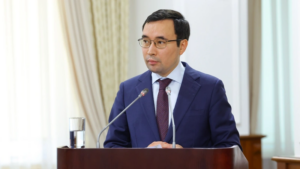
Alisher Abdykadyrov, Chief Executive Officer of Alatau City Authority, reported on the results of the work carried out on Aug. 28 meeting. Photo credit: PM’s press service.
Alatau City’s location is central to the government’s economic rationale. The city sits between Almaty and Konayev and close to the Almaty International Airport. The broader region is connected to major transport routes linking China with Central Asia, the Caucasus, Europe and the Middle East, including the Trans-Caspian International Transport Route.
That gives the project an opportunity to combine two roles that are often developed separately: a production center and a logistics hub. The proximity to Almaty also provides access to a large consumer market, financial services and an established labour pool, while the city’s location within the broader Eurasian transport network could help manufacturers connect more efficiently with export markets.
A legal experiment as much as an urban one
Perhaps the most distinctive feature of Alatau City is not its construction program but its legal framework. A constitutional law adopted on May 8 established a special legal regime under which Alatau City operates as a “city of accelerated development.” The legislation creates specific rules for public administration and allows a separate regulatory framework for areas including entrepreneurship, digital assets, finance, urban development and other aspects of the city’s development.
This makes Alatau City an institutional experiment as much as a construction project. The government is creating a separate administrative architecture through Alatau City Authority, alongside an Operational Committee and Regulatory Commission.
The long-term plans are equally ambitious. A development master plan to 2040 and a long-term development plan to 2055 are being prepared with international firms ARUP and BCG.
The limits behind the ambition
The scale of the project also raises a more fundamental question: can preferential regulation and large-scale infrastructure create a genuinely new economic center, or could some of the apparent growth simply reflect the relocation of existing economic activity.
Economist Anuar Nurtazin notes that the answer will ultimately depend on factors beyond the special status granted to the city. In a comment published on his Telegram channel, he questioned whether Alatau City’s location and institutional model are sufficient to overcome the structural advantages enjoyed by established global economic hubs.
He noted that major technological and financial centers have typically emerged around major ports, logistics hubs or established financial agglomerations, where capital, talent and trade already generate a natural flow of economic activity.
Nurtazin also cautioned against measuring the success of a special economic regime through the number of registered companies or investment announcements alone. Companies can relocate their activities within a country without necessarily creating significant additional economic value.
“If the key argument is a special regime, there is a risk of statistical growth without a genuine economic breakthrough,” he said, highlighting that the key indicators should instead include exports, technological supply chains, localization of production and productivity growth.
According to Nurtazin, such incentives are justified only when they generate measurable economic returns. Without transparent indicators for evaluating those returns, he said, a fundamental question remains: where is the line between a strategic investment and an expensive experiment?
“The sustainable development of cities depends on three factors coming together: the market, capital and institutional stability,” Nurtazin wrote.
Shenzhen, Dubai, Songdo: three models, three lessons for Alatau
While no model can be replicated directly, the experiences of Shenzhen in China, Dubai in the United Arab Emirates and Songdo in South Korea offer three different lessons about what can make or limit the development of a new economic center.
Shenzhen provides perhaps the most relevant comparison. Kazakhstan has explicitly said it is studying the Chinese city’s experience. During a June 9 meeting with Shenzhen Mayor Qin Weizhong, Kazakh Deputy Prime Minister Kanat Bozumbayev said the country was taking into account international practices, including Shenzhen, when developing Alatau City’s special legal regime and development model.
Shenzhen’s development was supported by proximity to Hong Kong, access to international capital and markets, large-scale infrastructure investment, manufacturing supply chains and the rapid concentration of companies and talent. Its experience suggests that a special regulatory regime can be an important catalyst, but it works most effectively when it is combined with strong market access and an expanding business ecosystem.
Dubai offers a different lesson, centered on international connectivity. The emirate built its economic position by combining infrastructure, global aviation and logistics links, investment-friendly business environments and specialized economic zones. Its experience is particularly relevant to Alatau’s ambition to use its location between major Eurasian markets.
Songdo in South Korea provides a more cautionary comparison. The planned smart city near Seoul was conceived as an international business and technology hub, built around advanced infrastructure, digital services and sustainability. For Alatau, this distinction could prove important. The city is pursuing similarly ambitious projects in smart mobility, artificial intelligence, digital infrastructure, data centers and tokenized assets.
Infrastructure before the city
The government is also trying to avoid one of the most common problems associated with large new-city projects: building housing and industrial facilities before the infrastructure required to support them is ready. Energy efficiency is also being incorporated at the planning stage.
Timur Tashmukhambetov, director of the Department of Design and Construction Standards at Alatau City Authority, said the city should integrate energy efficiency into its development from the beginning.
“For Alatau City, it is important to lay the foundations of energy efficiency already at the city design stage,” he said, pointing to technologies that can reduce energy losses, peak-load management and distributed renewable generation.
The approach is significant because a new industrial and digital center could create substantial additional demand for electricity. The ability to meet that demand efficiently could become an economic advantage.
What would success look like?
The $6.9 billion investment pipeline and projected 55,000 jobs provide an initial measure of ambition. But they will not, by themselves, determine whether Alatau City has succeeded. The city will also have to demonstrate that its special legal regime creates tangible advantages for businesses rather than simply another layer of administration.
That question is particularly relevant because the project’s stated horizon extends well beyond the current investment cycle. The master plan runs to 2040, while the long-term development plan is being prepared through 2055.
“Moreover, Alatau City should not be viewed as a project starting from scratch, but as a new attempt to implement a concept that has existed for almost two decades. Previously, it was called G4 City and involved four separate satellite cities. Today, these four specializations are combined within a single city, Alatau,” Serik said.
The challenge will be turning that institutional advantage into an economic one. If infrastructure arrives ahead of demand, the regulatory system remains predictable, investment projects move from announcements to operating businesses and the city develops a skilled workforce and international connections, Alatau could become an important new node in Kazakhstan’s economy.
“For me, the main criterion for a city’s independence will be a fairly simple indicator: who goes to work and where. If residents of Alatau travel to Almaty every day, we will primarily get a large suburb of the southern capital. But if people from Almaty and other regions start coming to Alatau for work, business, education, and technology, then we can talk about an independent economic center,” Serik said.
