
ASTANA – As artificial intelligence drives a new investment boom, the best strategy may be to resist the excitement and focus instead on the bottlenecks that could constrain its growth, according to Ben Powell, managing director and chief investment strategist for Asia-Pacific at the BlackRock Investment Institute.
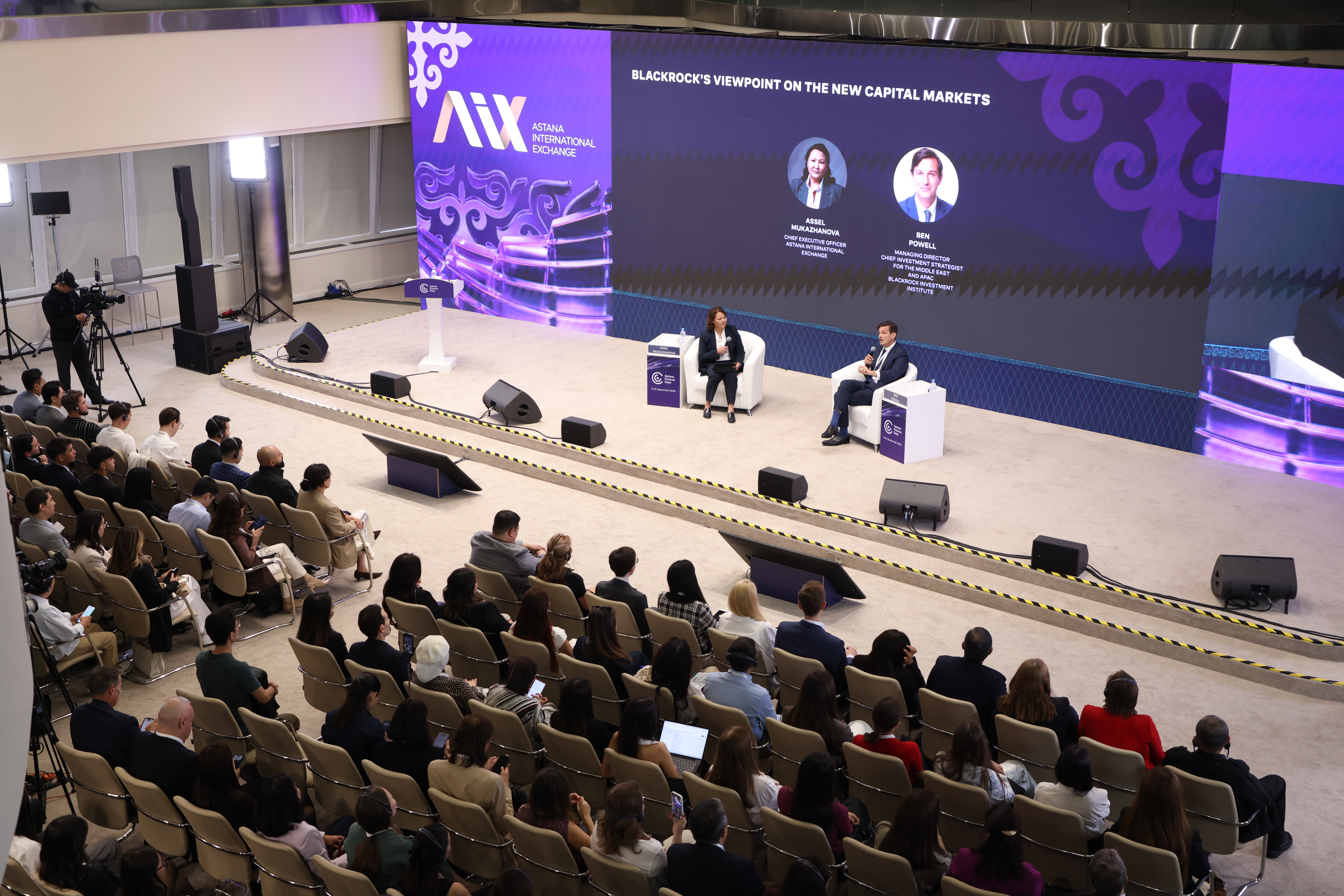
Speaking on Sept. 9 during a fireside chat, Powell said investors should “stay calm” and look for the physical constraints created by the rapid expansion of AI. Photo credit: AFD 2026
Speaking at the Astana Finance Days 2026 forum on Sept. 9 during a fireside chat moderated by Assel Mukazhanova, chief executive officer of Astana International Exchange (AIX), Powell said investors should “stay calm” and look for the physical constraints created by the rapid expansion of AI.
“I know it’s very exciting. But try to be more boring and focus on the constraint. Constraint is opportunity, actually. This is the philosophical approach,” Powell said.
For BlackRock, the current AI boom is not simply a story about technology companies and software. Powell said the most interesting investment opportunities are increasingly emerging from the infrastructure required to make AI possible, including power, semiconductors, memory and copper.
“We have a super boom, but we are short of copper. We are short of chip. We are short of electrician. Where we are very focused is trying to be a little bit ahead of the next constraint,” he said.
Among those constraints, power is currently the most significant opportunity, according to Powell, as the expansion of AI infrastructure drives rising demand for electricity and related infrastructure.
“Our favorite constraints at the moment is power,” he said.
Powell described AI as a major structural transformation of the global economy, noting that its significance may still be underestimated.
“We are turning sand into thinking,” he said, describing the technology as fundamentally different from conventional goods and services because intelligence can be applied across virtually every sector.
Yet for investors, he said, the task is to separate the scale of the technological transformation from the market excitement surrounding it.
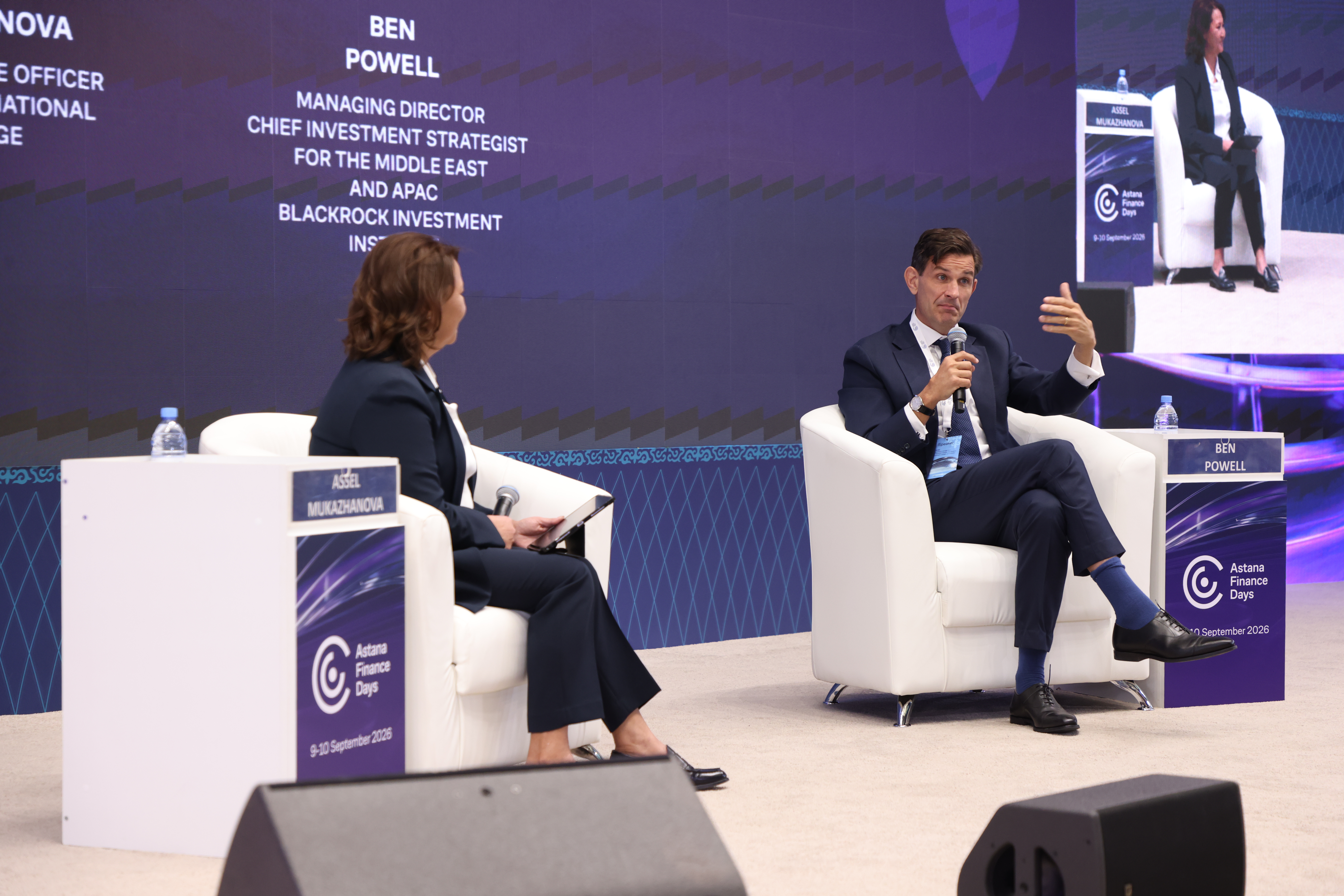
Powell also said the investment environment is becoming more encouraging in Kazakhstan, using the informal term “vibes” to describe a shift that is hard to capture through quantitative indicators alone. Photo credit: AFD 2026
The AI investment thesis was part of a broader discussion about a changing global investment environment, in which Powell said geopolitical fragmentation, higher inflation and interest rates are making markets more complex and forcing investors to become more selective.
“We expect there will be more geopolitical flashpoints. The world has become more complicated and, frankly, more dangerous,” he said.
Powell said this new environment is pushing investors toward more targeted decisions across geographies, asset classes and long-term themes, including AI.
Kazakhstan on BlackRock’s radar
Against this broader shift, Kazakhstan could have an opportunity to attract greater global institutional capital as its financial market develops, Powell said. BlackRock is watching the country’s regulatory direction, changing market infrastructure, liquidity and market breadth, he said.
“As the market becomes more liquid, we can invest more. It’s just a fact,” Powell said.
He described Kazakhstan’s potential transition to emerging market status as an important milestone, while stressing it would not mark the end of the country’s development as an investment destination.
“We are watching. When will Kazakhstan become an emerging market? It will be a great moment. We can have a celebration. It will be a great, important milestone. But don’t get confused. That is not the end of the story. The story continues forever,” he said.
Powell also said the investment environment is becoming more encouraging, using the informal term “vibes” to describe a shift that is hard to capture through quantitative indicators alone.
“It’s almost like a feel. Like the feel is getting better, and the young people, they call it the vibes. So the vibes are better. This is hard to quantify, but you can feel it,” he added.
Private markets move closer to the mainstream
The changing investment landscape is also expanding the role of private markets, according to Powell, as investors seek exposure to areas of economic growth not fully represented in public markets. Many AI companies, for example, remain privately held, meaning investors seeking exposure to the sector may increasingly need access to private markets, he said.
At the same time, governments facing balance-sheet constraints are creating greater demand for private capital to finance infrastructure and other long-term projects.
“The opportunity is going to grow because the governments are a little bit balance-sheet constrained. This is the polite way of saying they have no money, a little bit no money. So they need us,” Powell said bluntly.
Powell said private markets should increasingly be viewed as part of mainstream portfolio construction rather than as an “alternative.”
“I don’t care if we have 10% public equity, 60% public equity. I don’t care. I want a portfolio that makes sense,” he said.
Private credit is also likely to remain a structural growth area as financial systems diversify funding sources beyond banks, he said, while cautioning that investors must pay close attention to credit quality and underwriting.
Tokenization could change capital markets
Powell also sees tokenization as having the potential to fundamentally change financial markets, although the transition will take time. Tokenization could eventually allow investors to gain economic exposure to a much wider range of assets through digital instruments, he said.
“Intellectually, philosophically, I think it makes sense, and I think it will happen,” Powell said.
But realizing that potential will require regulatory frameworks and market infrastructure that can support tokenized assets. Powell said tokenized assets could become a more normal part of portfolios over the next five to 10 years as the regulatory and financial infrastructure develops. For BlackRock, the broader transformation is part of a long-term shift in how the firm approaches investment.
Powell said the company’s core philosophy remains focused on using technology to manage risk and help clients, while the tools available to investors have expanded from ETFs and public equities to private markets, infrastructure and digital assets. Technology and data, he said, will increasingly determine how asset managers operate in a more complex investment environment.
For Powell, that also means using AI himself. He said he uses an AI assistant during his morning commute to review information, process emails and prepare for the day, while BlackRock increasingly integrates AI into its operations. The underlying investment principle, however, remains surprisingly simple: as the AI boom accelerates, investors should not necessarily chase the excitement. They should look for what the boom cannot get enough of.
