
ALMATY – For centuries, the history of the Golden Horde has often been told from the perspective of the societies it encountered. French historian Marie Favereau is trying to turn that perspective around. Her book, now available in Kazakh, examines the Ulus of Jochi not as a peripheral chapter in European or Mongol history, but as a powerful Eurasian state with its own political institutions, commercial networks and multicultural society.
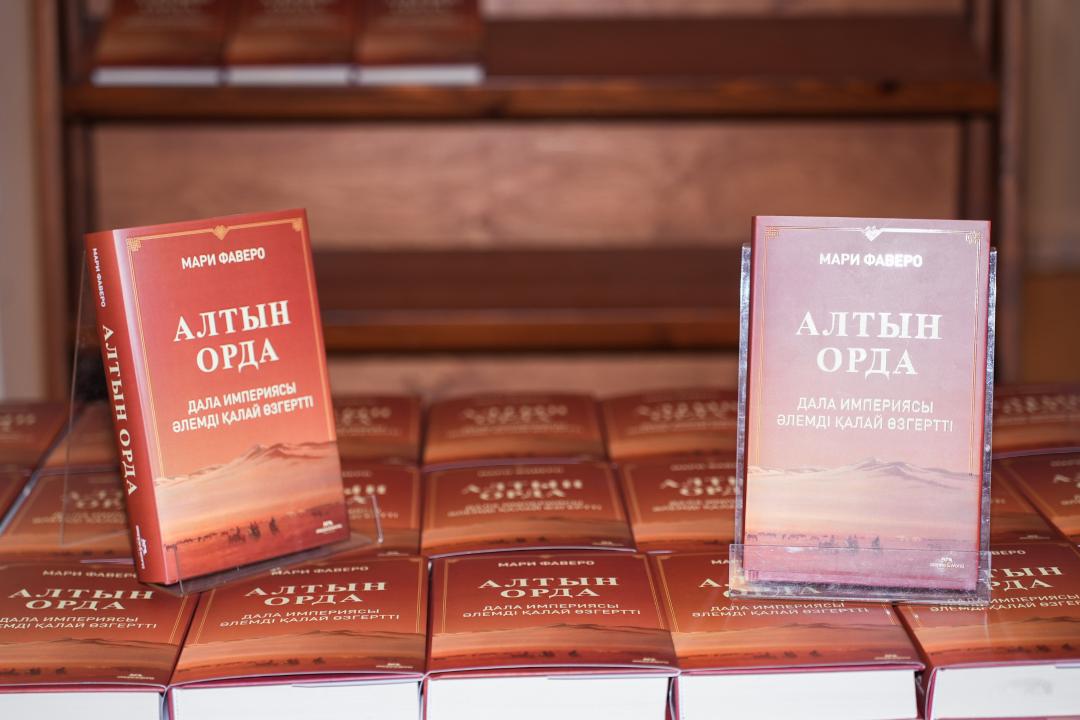
Photo credit: gov.kz
Favereau presented the Kazakh-language edition of her book “The Horde: How the Mongols Changed the World” at the Kazakh National Academy of Sciences in Almaty on Sept. 8. The event was organised by the Academy together with Steppe & World Publishing and the Embassy of France in Kazakhstan.
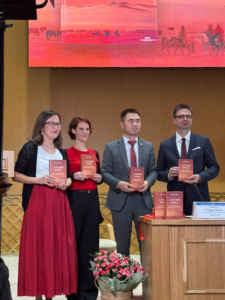
From L to R: Raissa Kader, founder of Steppe&World Publishing, Marie Favereau, Zhenisbek Tolen, head of the Center for Educational Sciences and Social Development at the National Academy of Sciences and French Consul General Maxime Gehringer. Photo credit: The Astana Times.
The publication comes at a time when Kazakhstan is placing renewed emphasis on the study of the Ulus of Jochi and the history of the Golden Horde. But Favereau’s work offers something more than another account of a familiar historical period: it asks readers to reconsider how the history of the steppe has traditionally been interpreted.
Looking at the steppe from within
Favereau’s interest in the Golden Horde began nearly 25 years ago, when she was a student at the Sorbonne in Paris. She recalled that when she proposed studying the Ulus of Jochi, her supervisor warned her that the subject would be difficult because France had few sources on the period. Rather than discouraging her, the response sent her in the opposite direction.
“I thought, I’m going to travel all around the world and I will gather all the archives, all the material, all the objects I can to document, to explain the history of Ulus Jochi,” Favereau said at the presentation.
Her research subsequently took her to archives and collections in Vienna, Venice, Genova, Istanbul, and Crimea, while academic cooperation brought her into contact with historians and researchers in Kazakhstan and Tatarstan.
That experience shaped the central approach of her work: understanding the Golden Horde on its own terms. Favereau said Western academic discussions of empire have traditionally focused on examples such as the Roman, Greek and Ottoman empires, while nomadic political systems have received far less attention.
“I had to write a book, a book that I would have needed as a student about Ulus Jochi, but from inside, from the nomadic perspective,” she said.
For Favereau, this distinction matters because the political and social structures of a steppe empire cannot simply be measured against those of Rome, Paris or Vienna. The Golden Horde was born as part of the Mongol Empire in the 13th century before developing into an independent political power under the descendants of Jochi, the eldest son of Genghis Khan. Its political organization, Favereau argues, was more complex than the image of a state ruled solely by a khan suggests.
The begs, nomadic elites, assemblies and negotiations all played important roles in political decision-making. Favereau also draws attention to the role of elite women in the highest levels of government.
“I really wanted to show in my book the importance of collective power, of assembly, of negotiations, of the place of elite women as the highest leader of the states,” she said.
An empire connected to a wider world
The book also challenges the perception of the Golden Horde as an isolated nomadic power. Its geographical position placed the Ulus of Jochi at the intersection of Central Asia, the northern Russian principalities and European trade routes. Its connections extended to the Black Sea and Mediterranean, while diplomatic correspondence reached Poland, Lithuania, France and England.
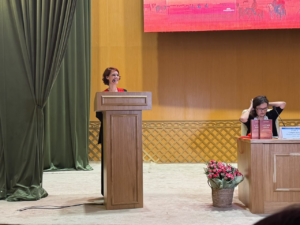
Marie Favereau. Photo credit: The Astana Times.
“It’s about diplomacy, letters exchanged with Poland and Lithuania, letters exchanged with Europe, letters exchanged with France and England,” Favereau said.
Trade was central to those connections. Italian merchants, the Byzantine world and the Mamluk Sultanate were among the partners involved in networks that moved goods, people, knowledge and cultural practices across Eurasia. Favereau highlights that the Jochids expanded the scale of existing Eurasian trade networks, including those associated with the Silk Road.
“The Jochis made the system bigger, because the scale is not the same,” she said, pointing to the vast territory controlled by the Golden Horde.
That perspective places the Golden Horde within global history rather than treating it exclusively as a regional phenomenon. Its importance, in Favereau’s interpretation, lies partly in the connections it created across political and cultural boundaries.
A multicultural society in the medieval steppe
The same approach applies to religion. Favereau challenges the idea that Islamization in the Golden Horde was merely superficial. She points to the conversion of Berke Khan and his relations with the Mamluk Sultanate, which developed into a broader exchange involving scholars, religion, literature, science and crafts.
At the same time, the Ulus of Jochi retained a tradition of religious diversity, with Christian, Buddhist and Jewish communities living within its territories. For a medieval empire extending across much of Eurasia, such diversity complicates the image of the Golden Horde as simply a military power built through conquest. It also highlights one of the broader arguments of Favereau’s research: nomadic societies should not be understood through stereotypes of political or cultural simplicity.
Why translation matters
The Kazakh edition gives that research a new audience. For Favereau, translation is not simply about making a text accessible. It is part of the scholarly exchange itself.
“Without translation, we are limited to our own circle,” she said.
She described translating historical concepts as a process of interpretation, requiring scholars and translators to consider how ideas developed in one linguistic and cultural environment can be understood in another.
“The translation in Kazakh language goes deeply to my heart,” Favereau said, highlighting that the translation also reflects a broader effort to bring international scholarship into Kazakhstan’s academic and educational space while strengthening dialogue between researchers working on the history of Eurasia.
Building bridges through history
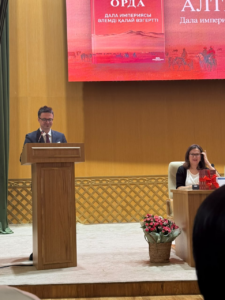
French Consul General Maxime Gehringer. Photo credit: The Astana Times.
French Consul General Maxime Gehringer said such exchanges have significance beyond the publication of a single book.
“Countries are not built through political dialogue, economic exchange alone. We depend on a better knowledge of one another,” he said.
He described cultural, scientific and academic exchanges as an integral part of the growing strategic partnership between France and Kazakhstan. Gehringer also highlighted Favereau’s long engagement with Central Asia, including her work as director of the French Institute for Central Asian Studies in Bishkek. He said her research contributes to continuing discussions in Kazakhstan and elsewhere in the region by bringing together different sources and perspectives on the history of nomadic societies.
“The authors present nomadic societies in all their complexity,” Gehringer said. “Political organizations, histories, trade and diplomacy are brought together within a vast space connecting Asia and Europe.”
A history beyond modern borders
Favereau’s book ultimately asks readers to reconsider where the history of the Golden Horde belongs. It is certainly part of the history of the Eurasian steppe and of the territories that include present-day Kazakhstan. But its networks extended far beyond modern national borders, linking Central Asia with the Middle East, Russia and Europe.
That makes the history of the Ulus of Jochi relevant not only to understanding Kazakhstan’s past, but also to understanding how political power, commerce, religion and cultural exchange operated across Eurasia centuries before the emergence of today’s states.
For Kazakhstan, having that scholarship available in Kazakh adds another dimension. It allows international interpretations of the Golden Horde to enter the country’s own academic and public discussion in the national language. For Favereau, that dialogue is part of what historical research is meant to achieve.
“Research and science is a trans-generation thing,” she said, reflecting on the scholars who influenced her work and the students who will continue it.
