
ALMATY – Kazakhstan is stepping up its partnership with the World Customs Organization (WCO) as part of a broader strategy to strengthen the country’s position as a key Eurasian transit hub. But while digital customs reforms could significantly reduce trade costs and border delays, experts say their long-term economic payoff will ultimately depend on infrastructure, regional coordination and the changing geography of global trade.
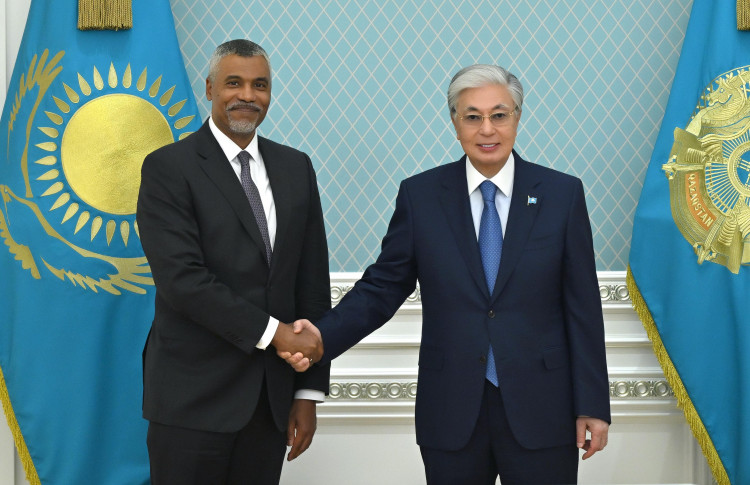
From L to R: WCO Secretary General Ian Saunders and President Kassym-Jomart Tokayev. Photo credit: Akorda.
The topic came into focus during a series of high-level meetings in Astana between President Kassym-Jomart Tokayev, Prime Minister Olzhas Bektenov and WCO Secretary General Ian Saunders on Sept. 8.
During the meeting, Tokayev said Kazakhstan is consistently developing a “smart border” model by introducing digital solutions to optimize customs procedures and improve freight transit across Eurasia. Saunders praised Kazakhstan’s progress in customs modernization and its growing role in developing the Trans-Caspian International Transport Route (TITR), also known as the Middle Corridor.
Customs modernization becomes part of a wider logistics strategy
Beyond the diplomatic symbolism, the meetings reflect a longer-term economic objective: transforming Kazakhstan from a transit country into an internationally competitive logistics platform.
Speaking in the meeting, Bektenov emphasized that resilient transcontinental trade has become one of the key drivers of Kazakhstan’s economic development. He noted that the WCO’s 2025–2028 strategic plan, Data-Driven Customs for a Connected World, closely aligns with Kazakhstan’s own digital reform agenda.
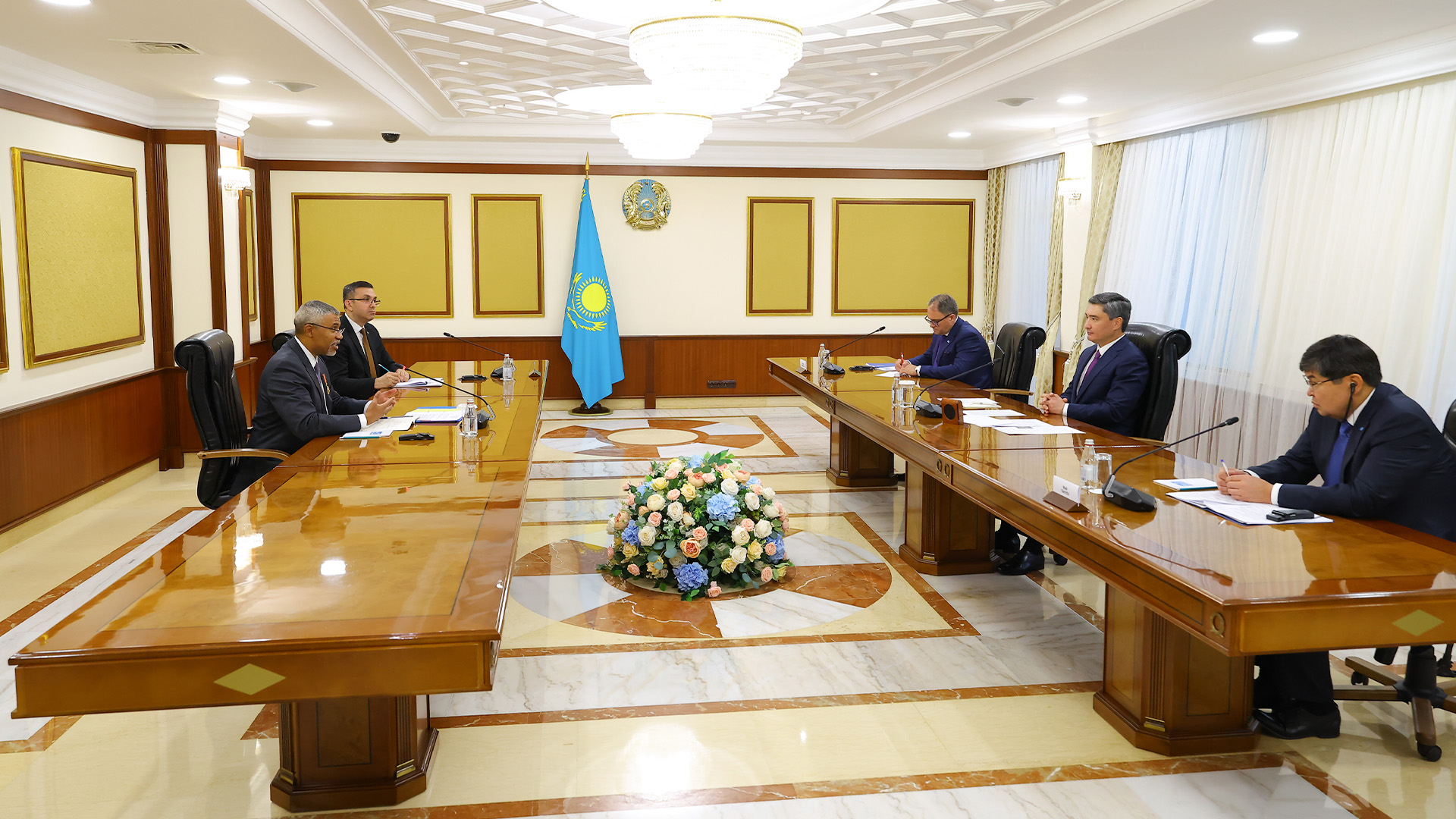
Prime Minister Olzhas Bektenov also met with WCO Secretary General Ian Saunders on Sept. 8 in Astana to review the progress in customs modernization. Photo credit: PM’s press service.
A central element of that strategy is the rollout of KEDEN, a unified customs system integrating declarations, transit procedures and border controls, alongside the Smart Cargo platform, which combines transport services, electronic permits and cargo tracking into a single digital ecosystem.
According to official data, 14.6 million tons of transit cargo passed through Kazakhstan during the first seven months of the year. Freight volumes along the Middle Corridor reached approximately 350,000 tons, with around 24,000 vehicles using the route.
Why digital borders matter
Farkhad Kassenov, head of the A+ Analytics research center, political scientist and international relations expert, notes that cooperation with the WCO should be viewed not as an isolated initiative but as one stage of Kazakhstan’s much broader transport and logistics strategy.

Farkhad Kassenov, head of the A+ Analytics research center, political scientist and international relations expert. Photo credit: Kassenov’s personal archive.
“Kazakhstan has been systematically synchronizing customs procedures, tariffs and border regulations with the countries participating in the Middle Corridor. This cooperation with the WCO is one of the stages of that much larger project,” Kassenov told The Astana Times.
The Middle Corridor has gained strategic importance as trade between China and Europe increasingly seeks alternatives to traditional northern routes passing through Russia. At the same time, Kazakhstan is also positioning itself within the developing North–South corridor, despite temporary disruptions caused by conflicts affecting the Middle East and maritime trade. According to Kassenov, removing bureaucratic barriers may prove almost as valuable as building new infrastructure.
“Digitalization can increase the speed of cargo movement by roughly 30% while simultaneously reducing logistics costs. When paperwork is synchronized and businesses use a single digital window, goods spend less time waiting at borders or in dry ports,” he said.
Digital gains cannot replace physical infrastructure
Yet customs reform alone will not solve every bottleneck. Kassenov notes that the Middle Corridor still faces structural constraints that digital systems cannot eliminate, including different railway gauges between China, Kazakhstan and Europe, as well as the natural limitations of crossing the Caspian Sea.
“There are real physical barriers. Different railway gauges require cargo transfers, while navigation across the Caspian is limited during storms and seasonal ice. Digitalization improves efficiency, but it must be accompanied by major investment in transport infrastructure,” he said.
Kazakhstan has already begun expanding ports in Aktau and Kuryk, while negotiations continue with Azerbaijan, Türkiye and China on improving rail connectivity across the corridor.
A changing geopolitical map of trade
The renewed attention to Kazakhstan’s transit role is also being driven by geopolitical shifts beyond Central Asia. According to Kassenov, growing strategic competition between China and the United States has increased Beijing’s interest in secure overland trade routes.
“The Middle Corridor was once viewed as an alternative route. By the end of this decade, it may become one of the principal land connections between East and West,” he said.
That evolution creates opportunities extending beyond transit fees. Kazakhstan is seeking to develop domestic manufacturing, processing industries and exports of higher value-added products, including critical minerals and industrial goods, that can move along the same logistics network.
A customs dilemma inside the EAEU
At the same time, Kazakhstan’s customs policy faces another question that is less visible in discussions about digitalization: whether the existing distribution of import customs duties within the Eurasian Economic Union reflects the current structure of regional trade.
Aidar Kurmashev, head of the Asian Studies Department at the Kazakhstan Institute for Strategic Studies, recently highlighted the issue in his Telegram channel. According to him, under the EAEU system, duties collected on imports from outside the union are distributed among the five member states according to predetermined shares. Kazakhstan’s share is 6.955%, compared with 85.065% for Russia, regardless of where the duties are actually collected.
“After 2022, trade flows changed significantly, the role of Kazakhstan in trade with China and other directions of foreign imports increased, while our share remained 6.955%,” Kurmashev wrote.
He argued that the issue raises a broader question about whether the formula still corresponds to the current structure of trade within the EAEU.
“If Kazakhstan previously benefited from the system, but now has been losing hundreds of billions of tenge for the third consecutive year, perhaps it is time to at least recalculate the economics of the existing mechanism,” Kurmashev said, highlighting that the figures refer specifically to distributed import customs duties and do not include import VAT.
Trade routes are changing faster than institutions
The EAEU perspective illustrates a broader challenge facing Kazakhstan as it tries to reposition itself within changing Eurasian trade networks. The geography of imports and transit has shifted since 2022, while Kazakhstan is simultaneously trying to deepen direct trade links with China, expand the Middle Corridor and strengthen its position as a logistics hub between Asia and Europe.
That makes customs policy increasingly relevant not only as an administrative function but as an element of economic strategy. Digitalization can make the movement of goods faster and more predictable. International standards can improve interoperability. Infrastructure investment can remove physical bottlenecks.
But the economic payoff ultimately depends on whether these elements develop together. As Kassenov put it, the Middle Corridor is moving from being an alternative route from the global lens toward becoming a potentially central Eurasian connection.
