
ASTANA – For decades, Kazakhstan has built its foreign policy around a principle central to its place in the world: maintaining productive relations with competing powers without becoming dependent on any one of them. This has allowed Astana to work with Russia, China, the United States (US), the European Union and others, even as those powers have competed for influence in Eurasia. AI may be about to test that model in an entirely new way.

Photo credit: AI-generated image/ The Astana Times
But the question may not be whether Kazakhstan will eventually be forced to choose between Washington and Beijing. A more consequential question is whether AI could encourage a different way of organizing international relations in the first place, one in which cooperation, interoperability, transparency and trust become as strategically important as alignment.
Kazakhstan is already at the center of that debate. It is participating in both the U.S.-led Pax Silica initiative and China’s World Artificial Intelligence Cooperation Organization (WAICO), two frameworks that reflect different approaches to the emerging AI landscape.
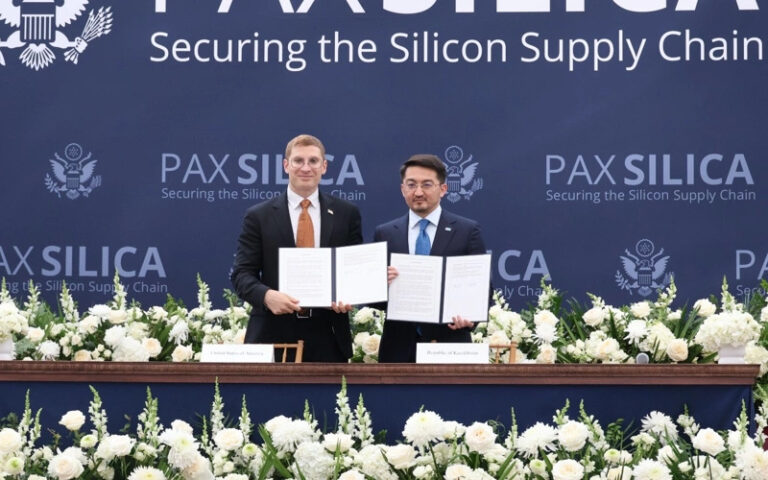
Zhaslan Madiyev took part in the summit hosted by the Donald J. Trump United States Institute of Peace, with support from the U.S. Department of State. Photo credit: Rustem Kozhybayev/Kazinform
The overlap has already attracted attention in Washington. Reuters reported in August that the U.S. State Department was preparing to tell countries participating in both Pax Silica and China’s competing AI framework that they would have to choose one side. According to a draft letter reviewed by Reuters, countries seeking to participate in Pax Silica would be expected to commit exclusively to the U.S.-led initiative, although Washington had not decided whether or when to send the letter. Kazakhstan was among the countries identified as participating in both.
That possibility reflects a familiar logic of great-power competition: as a strategic technology becomes more important, major powers seek trusted partners and become less comfortable with those partners maintaining deep ties to their rivals. AI, however, may ultimately make that logic harder to sustain.
Two visions of the AI era
Pax Silica is broader than an AI organization. Launched by the US in late 2025, it is built around securing supply chains that underpin the AI economy, extending from critical minerals and energy to semiconductors, advanced manufacturing, computing infrastructure and logistics. It emphasizes resilience, trusted partners and the protection of sensitive technologies.
WAICO, established in Shanghai on July 16 by 29 founding countries including Kazakhstan, presents itself differently. Beijing describes it as an international intergovernmental organization focused on AI cooperation and global governance.
At a July 17 press briefing, Chinese Foreign Ministry spokesperson Lin Jian said China would work with other countries on the basis of “extensive consultation and joint contribution for shared benefit” and seek greater coordination on AI development strategies, governance rules and technical standards. He said China was ready to work with all parties to respond to AI’s opportunities and challenges.
The wording is significant. Pax Silica emphasizes building a trusted technology ecosystem. WAICO is being presented as a platform for broader international participation and coordination. Neither approach is free of geopolitics. Both clearly serve national interests. But they suggest two different ways of thinking about the future of AI: one centered on technological security and trusted supply chains, the other on international cooperation and governance. The question for countries such as Kazakhstan is whether these approaches must ultimately become mutually exclusive.
AI is not simply another strategic industry. There is a temptation to compare AI with oil, gas or telecommunications, all of which have at different times become arenas of strategic competition. The comparison is useful, but incomplete. Oil was a strategic resource. Telecommunications infrastructure created long-term dependencies. AI increasingly encompasses both, while adding another layer: computing, data, software, research and models that can affect almost every sector of the economy.
The AI “stack” begins with critical minerals and energy and extends through chips, computing capacity, data, models and applications. That means competition over AI is simultaneously competition over infrastructure, supply chains, standards, investment and technological capabilities.
But the same characteristics also make AI unusually dependent on cross-border cooperation. No country is likely to control the entire AI ecosystem alone. Research, capital, talent, energy, data and hardware move across borders, while AI applications are increasingly integrated into global industries. That creates a paradox. AI’s strategic importance gives governments a reason to build separate, trusted ecosystems. Its inherently interconnected nature gives them a reason to preserve interoperability between those systems. Kazakhstan is now sitting directly in the middle of that tension.
Kazakhstan’s position
For Astana, participation in both Pax Silica and WAICO fits a foreign policy built on preserving options rather than narrowing them. Kazakhstan needs access to advanced technologies, computing infrastructure, investment, expertise and markets. It also possesses resources and geographic advantages that make it relevant to the emerging AI supply chain.
Alexander Dergay, founder and managing partner of Orbis Nova, has described WAICO as part of China’s broader effort to expand AI cooperation and capacity building across the Global South. He says that the organization is designed around openness and inclusivity while also helping Beijing deepen technological ties with participating countries.

Umarov, a fellow at the Carnegie Russia Eurasia Center says Kazakhstan is unlikely to make a clean choice even if Washington puts pressure on Astana. Photo credit: Umarov’s personal archive
That combination is important. China does not necessarily need countries to make dramatic declarations of political allegiance if its companies, infrastructure, technologies and standards are already becoming embedded in their economies. Temur Umarov, a fellow at the Carnegie Russia Eurasia Center who focuses on Central Asian countries’ domestic and foreign policies and China’s relations with Russia and Central Asia, says Kazakhstan is unlikely to make a clean choice even if Washington puts pressure on Astana.
“If the US puts Astana in front of an ultimatum in the spirit of the Cold War, it will be a step backwards for American foreign policy in Central Asia,” he wrote on his Telegram channel.
For Umarov, this would run against the region’s basic logic, where successful external partners have historically had to coexist with Russia and China rather than try to displace them.
“Instead of ultimatums in the face of a ban on cooperation with the United States or anyone else, Beijing usually uses the tools it already has,” he said.
Those tools, he says, include Chinese corporations, technology, investment and digital infrastructure, making a sharp technological break with China difficult and, from Kazakhstan’s perspective, unnecessary. His conclusion is deliberately unsentimental.
“Astana and its neighbors in the region will simply do what they are good at — quietly feeding each of the great powers the illusion of their exclusive loyalty while cooperating with everyone,” he said.
That may be precisely what Kazakhstan has done successfully for years. But AI could require something more sophisticated than strategic ambiguity.
The American dilemma
A senior fellow at the Hudson Institute Ken Moriyasu offers a different reason for why Washington may ultimately find it difficult to force Kazakhstan into a binary choice. He describes Kazakhstan as one of the most important “swing states” in the U.S.-China competition and argues that its flexibility is itself strategically valuable to the US.
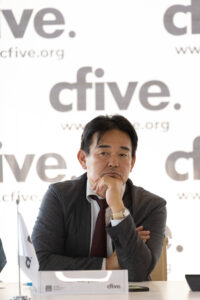
Moriyasu said forcing Kazakhstan to choose could undermine one of the very characteristics that makes the country useful to Washington. Photo credit: CFive platform
“This very flexible stance of Kazakhstan is very beneficial for the US strategy,” he said to the Astana Times.
From that perspective, forcing Kazakhstan to choose could undermine one of the very characteristics that makes the country useful to Washington.
“And if the US tries to force Kazakhstan to choose sides, then that really goes against the multi-vector foreign policy, the balancing act, which keeps Kazakhstan very relevant,” he said.
Moriyasu notes that Kazakhstan’s ability to maintain influence with China can itself serve American interests in Eurasia.
“Keeping Kazakhstan a trusted ally and partner in this endeavor is more important than forcing it to choose sides in Pax Silica,” he said.
His argument raises an important question for Washington. Is the objective to build an exclusive American technological bloc, or to preserve a wider strategic balance in which countries such as Kazakhstan can engage China while maintaining close ties with the US? Those two goals may not always lead to the same policy.
The real issue may be bigger than Pax Silica or WAICO
The deeper issue is not formal membership but whether competing AI ecosystems can coexist. Can Chinese models run on U.S.-designed infrastructure? Can data move between systems without creating risks of leakage, surveillance or technology transfer? And who decides what qualifies as a trusted system?
Those questions may matter more than Kazakhstan’s continued membership in both frameworks. AI could therefore force governments to rethink strategic autonomy. Great-power rivalry will remain, but the technology also creates a need for rules that preserve interoperability between competing systems. China’s language around WAICO reflects that logic, emphasizing coordination on AI strategies, governance rules and technical standards. Beijing’s approach is clearly geopolitical, but it also shows how cooperation can become a tool of influence without requiring exclusive blocs.
A new geopolitics of AI
Kazakhstan could translate its balancing diplomacy into a new model of technological governance: neither treating every Chinese technology as a threat nor opening strategic systems indiscriminately, but setting transparent rules for foreign technology, data access, system isolation and security standards.
That would allow Astana to work with competing ecosystems on its own terms and give Washington and Beijing a different basis for competition: whose technologies are more secure, innovative, accessible and trusted. For Kazakhstan, the goal would no longer be to prove loyalty by choosing one side, but competence by managing relations with both.
However, the stakes extend beyond Kazakhstan. AI depends on a network of minerals, energy, chips, computing, data, models and applications. Dividing that network into exclusive spheres could reduce its value. That does not eliminate the need for restrictions around critical infrastructure, advanced chips, sensitive data and dual-use technologies. But it does challenge the assumption that major-power rivalry must force smaller countries into one camp.
Kazakhstan may be an early test of whether a middle power can connect competing technological systems while maintaining enough transparency, security and trust to keep them compatible. Its objective would not simply be to maintain good relations with everyone, but to create rules under which everyone can work with Kazakhstan without requiring exclusive allegiance.
For Washington, that means choosing between treating Kazakhstan as a prize in a contest for technological loyalty and recognizing its value as a connector. For Beijing, it means showing that openness and cooperation can produce trust rather than dependence. And for Astana, the opportunity is to demonstrate that strategic autonomy is not about staying outside the system. It may be about becoming the country in the middle that knows how to make different systems work together.
