
ASTANA – Kazakhstan should consider raising taxes on wealthy individuals, revise parts of its new Tax Code to address business concerns, and encourage banks to provide more long-term loans to businesses, President Kassym-Jomart Tokayev said in his annual state-of-the-nation address on Oct. 28.
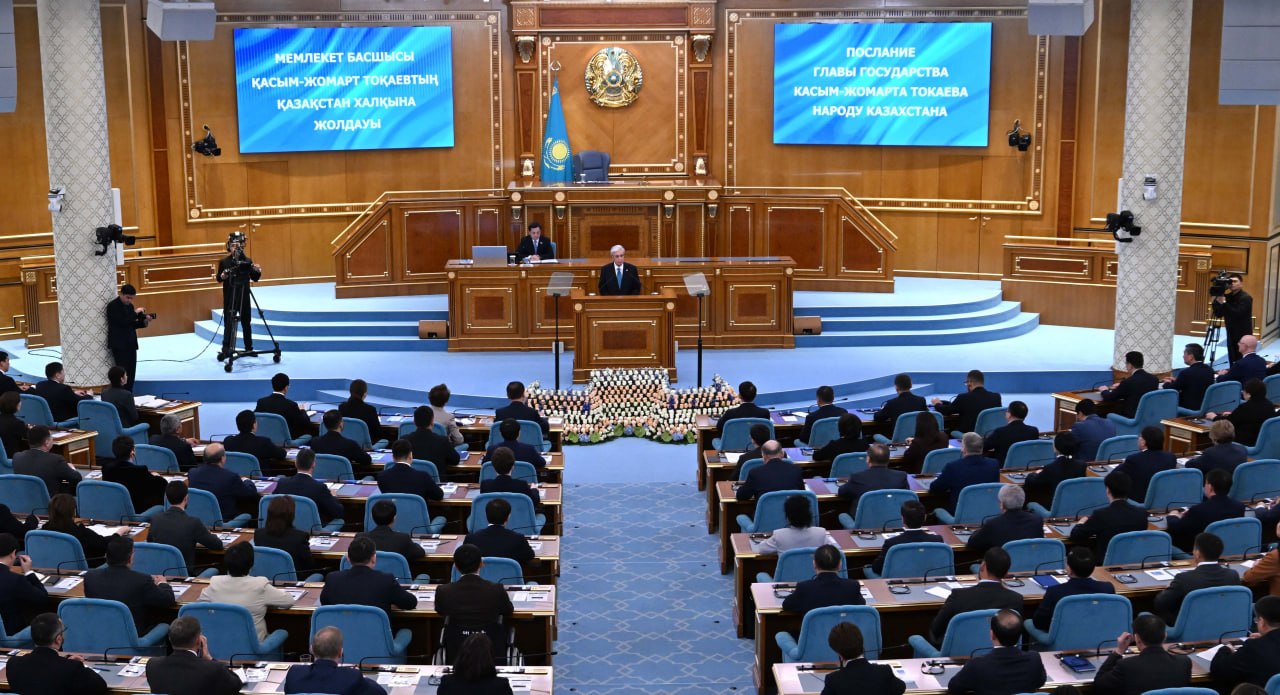
Photo credit: Akorda.
Tokayev outlined priorities for macroeconomic policy, including fighting inflation, improving public spending and increasing investment in the real economy. He stressed that economic policy should ultimately be measured by its impact on people’s prosperity and economic activity.
“Our main goal is therefore to increase household incomes. To achieve this, we must first systematically combat inflation,” he said, describing inflation as “a silent enemy that steadily undermines the well-being of our citizens.”
He called on the government and the National Bank to coordinate efforts to contain and reduce inflation, pursue balanced fiscal and tax policy, and create conditions for stronger production capacity and higher business productivity.
Higher tax rate for wealthy individuals
Tokayev also called for a discussion on introducing a higher tax rate for individuals with substantial wealth, framing the proposal as a matter of fairness rather than a restriction on private property.
“I believe the time has come to discuss introducing a higher rate for those with substantial wealth,” he said.
He stressed that the proposal would not involve restricting legally acquired assets, which he said would contradict the Constitution. Instead, he stressed that citizens should make a fair contribution to the country’s development in proportion to their means.
“This is about a proportionate and fair contribution by every citizen to the development of our country. This is about fairness,” Tokayev said.
The government and the Kurultai, Kazakhstan’s national legislature, are to examine the proposal and submit recommendations.
The president also linked fair taxation to transparency and digitalization. He called for advanced technologies, including artificial intelligence, to improve tax collection, reduce the shadow economy and lower corruption risks.
Banks urged to finance the real economy
Tokayev said Kazakhstan’s financial system remained resilient, with bank assets exceeding 75 trillion tenge (US$164.6 billion) and deposits reaching a record 52 trillion tenge (US$114.1 billion). About 78% of deposits are held in the national currency, which he cited as evidence of the tenge’s growing value.
The next priority, he said, is to channel these accumulated financial resources into the real economy.
“The most important task now is to direct accumulated financial resources toward the development of the real sector of the economy,” Tokayev said.
He called on the National Bank to play a more active role in initiatives supporting economic development while continuing to safeguard price and financial stability. President Tokayev also urged commercial banks to increase investment lending to businesses, describing it as their core responsibility. According to him, Kazakhstan’s demand for long-term financing exceeds the capacity of the state budget and development institutions.
“Banks must take the most active part in investment lending to businesses. This is their main mission,” Tokayev said.
He called for regulatory conditions that would encourage lending, including more effective management of excess liquidity in the banking system. He also proposed new mechanisms for long-term financing of key economic sectors involving banks, development institutions, international financial organizations and the Unified Accumulative Pension Fund.
According to him, the forthcoming Capital Market Law should provide concrete mechanisms to mobilize additional financing and strengthen investment discipline.
AI to help improve public spending
Tokayev identified better budget management as another priority for long-term macroeconomic stability. The Budget Code adopted last year has improved the management of public funds and strengthened financial discipline, he said. However, government expenditure continues to grow, making better budget planning and oversight increasingly important.
He proposed using artificial intelligence to identify unjustified or inefficient spending and called for the full digitalization of the state treasury system. The government should establish an automated system for managing public funds based on unified methods and standards, Tokayev said, adding that he expects concrete proposals from the government and the National Bank.
Targeted changes to Tax Code
Tokayev said Kazakhstan’s new Tax Code laid the foundation for a comprehensive overhaul of the tax system but acknowledged that implementing it created difficulties for businesses. Large-scale reforms inevitably reveal problems that are difficult to anticipate during drafting, he said, noting that companies were struggling to apply certain provisions.
“The Tax Code is not dogma, nor is it sacred scripture, and it must not be detached from reality,” Tokayev said.
“Our legislation has become so cumbersome and difficult to understand that it has turned into a real headache for entrepreneurs,” he added.
He instructed the government to address contradictions, eliminate ambiguous interpretations and remove disproportionate burdens on entrepreneurs. Tokayev emphasized that the government must carefully consider the changes to avoid repeatedly changing the rules for entrepreneurs.
