
Domestic political, economic and security dynamics in Afghanistan directly impact countries in close proximity to Kabul. This includes Central Asian states, which find themselves impacted by the ongoing Qosh Tepa Canal project. It originates from the Amu Darya River in Afghanistan’s Balkh province and extends to Jawzjan, Faryab while finishing at the Andkhoy district. Conceived in the 1970s under President Daoud Khan, feasibility studies were conducted in 2020, a year before the U.S. withdrawal from Kabul in 2021. Since then, the interim Taliban government prioritized its development as an integral, water driven project to address food security shortages amid dwindling reserves and massive poverty.
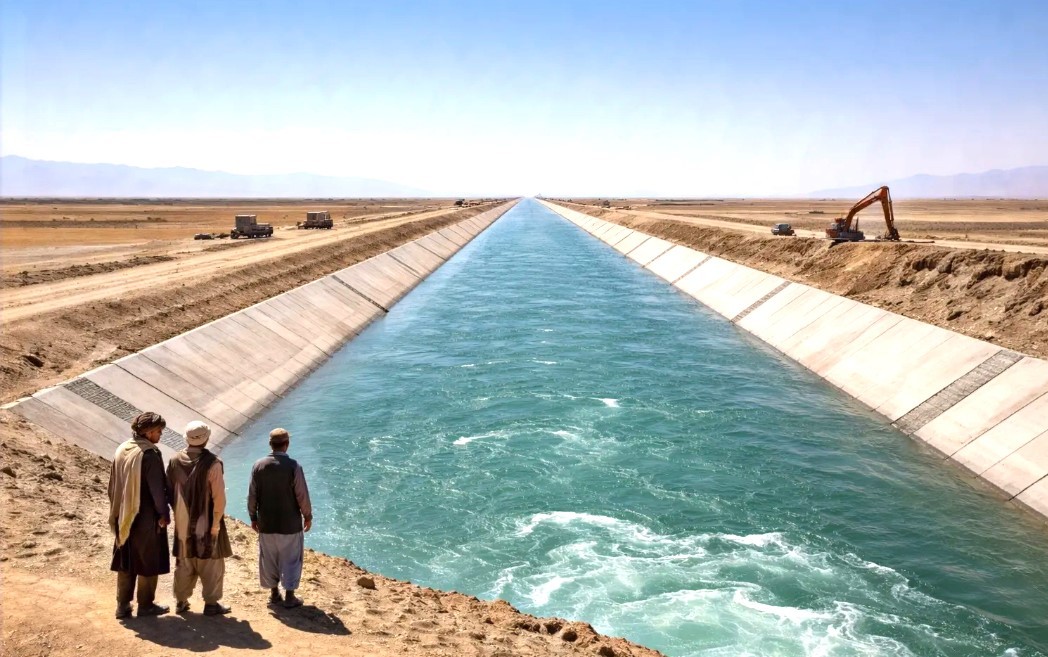
Photo credit: The Times of Central Asia/Stephen M. Bland
Spanning 285 kilometers, a width of 100 meters and depths of 8.5 meters, the Qosh Tepa’s intake is located adjacent to Uzbekistan’s Surkhandayra region near Termez. It is financed entirely through Afghan revenues generated from customs and taxes with Phase II of the project dealing with excavation witnessing significant progress. As per Kabul’s National Development Corporation, excavation reached 98% completion while structural construction of canal embankments and slope readiness stood at a readiness of 90.5%. Institutional shifts have also been underway in Phase 1.
However, despite assurances from the Taliban that regional cooperation for Qosh Tepa needs to take place, the project has resulted in lingering mistrust between Afghanistan and downstream riparian states. The Taliban has opted for unilateral measures on water management resulting in large amounts of water being potentially lost to sandy soils in the absence of concrete walls and reinforced banks. The unilateral completion of the Qosh Tepa clearly constitutes an existential water security threat as it alters the balance of influence of countries along the Amu Darya River basin. While Central Asian states have a vested stake in witnessing Afghanistan’s domestic prosperity and water security, the unilateral pursuit of Qosh Tepa intensifies water stress levels for the Central Asian states along the northern border.
Alarm bells rang as early as March 2026 when Uzbekistan’s water resources minister cautioned that Afghanistan’s annual withdrawals of approximately four billion cubic meters could translate into significant agricultural risks for Tashkent. Uzbekistan remains particularly vulnerable as large swathes of its agricultural land remain dependent on Amu Darya water in regions of Karakalpakstan and Khozerm.
Lack of unfettered access to critical water supplies during peak periods would hence, entail significant losses to Uzbekistan’s crop yields which, in turn, increases operational costs for water management and negatively impacts rural areas acting as agrarian ecosystems. This is significant in the year 2026 as the Amu Darya River remains integral for localized irrigation systems otherwise damaged due to the decades long dryness of the Aral Sea which initially lied between Kazakhstan and Uzbekistan. The Tuyamuyun Reservoir for example fell by more than 600 mcm with volumetric depletion resulting in larger salination risks. Additionally, unilateral pursuits from Kabul come amid Central Asian states having to contend with rising temperatures, glacial melts, possibilities of Glacial Lake Outburst Flooding (GLOF) and seasonal variations as existential threats. Amid this backdrop, Kabul continues to invest in capacities beyond water historically allocated to it in the absence of being a party to post Soviet regional water sharing mechanisms.
Turkmenistan’s case is another pertinent one in this regard. As another increasingly dependent country, on the Amu Darya River for agricultural sustenance, reduced access to water increases competition for Ashgabat between three key nodes of its local economy including production of crops, agricultural settlement needs and environmental requirements. These issues can potentially be addressed through pursuing bilateral technical cooperation with Afghanistan towards more durable and predictable water mechanisms for irrigation efficiency in downstream networks. This however, remains dependent on the Kabul regime being open to pursuing bilateral cooperation with states directly affected which has so far remained elusive amid the unilateral pursuit of the Qosh Tepa Canal. Fluctuations due to seasonal flows, jolts to reservoir operations and hydropower development challenges also remain integral for countries such as Tajikistan that are heavily reliant on agricultural sectors and remittances to support local economies. The Qosh Tepa Canal, however, makes existing frictions with Afghanistan over water allocations more pronounced given that Dushanbe has to balance its energy requirements with declining water levels.
With almost half of the project complete and maximum completion slated for 2028, downstream countries are clearly facing multidimensional challenges from Kabul’s unilateral pursuits. The threat remains palpable despite calls for regional cooperation. Central Asian governments can hence propose the establishment of an Amu Darya Dialogue with Afghanistan for permanent contact groups with relevant ministries and technical experts. There is also a need to negotiate a practical water management mechanism for dispute resolution with proper monitoring of the Qosh Tepa to avoid discrepancies. These measures however, remain dependent on Afghanistan being open to pursuing this project through multilateral frameworks (which it has politically), but is concomitant with its unilateral pursuits.
For all five Central Asian states however, the water security threat is real and the key is to act now.
The author is Hamzah Rifaat, the president of Initiate Futures, a policy think tank. He is also an author for the Trends Group in Abu Dhabi and is cooperating with Nightingale Int.
Disclaimer: The views and opinions expressed in this article are those of the author and do not necessarily reflect the position of The Astana Times.
