
ASTANA – S&P Global Ratings improved its assessment of Kazakhstan’s banking industry risk and upgraded or raised the outlooks on several financial institutions, citing stronger supervision as credit growth and banking-sector profits slowed in the first seven months of 2026.
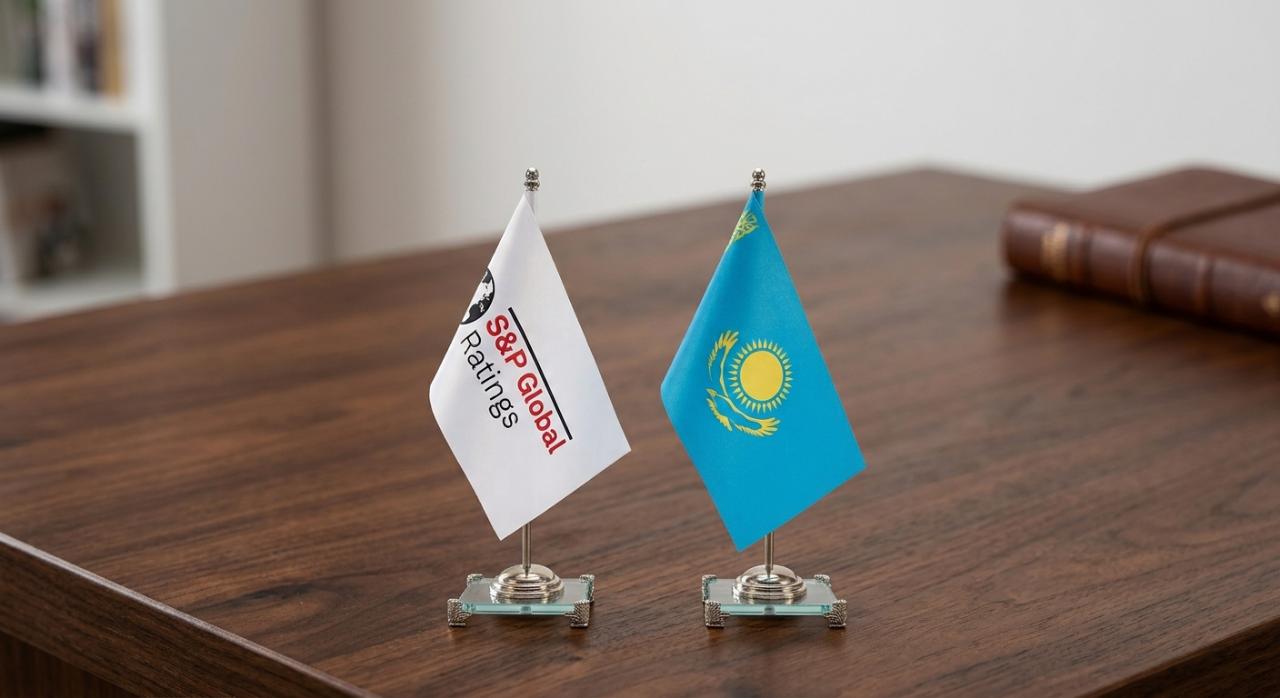
Photo credit: the Agency for Regulation and Development of the Financial Market.
In its Sept. 4 release, S&P said stronger supervision, banks’ capital buffers and Kazakhstan’s sovereign strength should help preserve financial stability during economic downturns. The agency raised Bank CenterCredit’s long-term issuer credit rating to BB+ from BB and assigned positive outlooks to Halyk Bank, Nurbank, Freedom Holding Corp. and four of its core subsidiaries. It also raised national-scale ratings on Nurbank, Freedom Finance and Freedom Bank Kazakhstan.
S&P improved its assessment of Kazakhstan’s banking industry risk to 6 from 7 under its Banking Industry Country Risk Assessment, or BICRA, framework. The economic-risk score remained at 7, while the starting point S&P used to rate Kazakh banks remained unchanged at BB. Scores range from one to 10, with one representing the lowest risk.
The revision, according to the agency, reflects the “number of initiatives undertaken by the Kazakh regulator to enhance supervision of the financial institutions in Kazakhstan over recent years.”
Among the highlighted improvements are regular systemwide asset-quality reviews, the adoption of the Supervisory Review and Evaluation Process, or SREP, and measures to curb banks’ risk appetite, particularly in the rapidly expanding retail lending segment.
The agency also said stronger oversight should help banks withstand periods of heightened uncertainty stemming from geopolitical risks and their potential effects on commodity prices, supply chains, economic activity and credit conditions.
S&P also revised the trend for Kazakhstan’s economic risk assessment to positive while leaving its score unchanged at 7. The change indicates that the score could improve if inflationary pressures ease and banks’ asset quality strengthens.
“This reflects our expectation of a resilient macroeconomic perspective with solid GDP growth over the next couple of years and reducing risks for the banking system,” S&P said.
The agency said an improvement would require evidence that economic imbalances, particularly elevated inflation, are putting less pressure on banks and nonbank financial institutions. Any improvement would also depend on stronger asset-quality indicators, which it considers a weakness of Kazakhstan’s banking sector, supported by more effective regulatory oversight.
S&P said Kazakhstan’s banks could benefit as inflation slows and the National Bank gradually cuts interest rates. Annual inflation declined from 10.2% in July to 9.8% in August, while the National Bank has lowered its base rate by a total of 1.25 percentage points since the beginning of the year.
The agency expects inflation to ease to 7-9% in 2027 and 2028, and slower price growth could leave households with more disposable income and make it easier for borrowers to repay their loans, reducing risks for banks.
S&P pointed to closer coordination between monetary, fiscal and macroprudential policies. However, it expects the tenge to weaken gradually in the second half of 2026, particularly if the central bank continues cutting rates.
Credit growth slows
The latest sector data present a mixed picture: banks accumulated more assets and deposits, but lending growth slowed. According to the Halyk Finance analytical center, banks’ assets, loan portfolios and deposits increased in July. However, growth in corporate and retail lending since the beginning of 2026 was slower than in the same period last year.
Banking-sector assets rose 6.9% from the beginning of the year to 75.6 trillion tenge (US$166.2 billion) in July. Liquid assets accounted for 35.4% of total assets, up from 34.1% a year earlier.
The total loan portfolio expanded 5.2% in the first seven months of 2026 to 45.5 trillion tenge (US$100 billion), compared with 10.5% during the same period last year. Corporate lending fell 0.7% in July but remained 4.7% higher than at the beginning of the year.
Retail lending grew 5.5%, roughly half the 11.2% increase recorded in January-July 2025. Consumer lending grew 4.6%, compared with 13.8% in January-July 2025.
In terms of business lending, loans to large companies, which accounted for 36.1% of the total volume of business lending, fell 5.9% from the beginning of the year, while lending to small and medium-sized businesses rose 11.9%. Deputy National Bank Governor Akylzhan Baimagambetov said the composition of lending was becoming more balanced as banks directed more financing toward businesses rather than household consumption.
“The share of SMEs and individual entrepreneurs in corporate lending reached 69%. For the past 12 months, 22 trillion tenge [US$48.4 billion] in loans have been issued to businesses, which is 16.8% more than the previous year,” said Baimagambetov.
“Thus, the lending structure gradually becomes more balanced: business lending outpaces consumer lending. This reflects the impact of previously adopted prudential measures and signifies reallocation of credit resources from consumption toward financing of the production activities, rather than a reduction in the overall availability of borrowed funds,” he said.
Deposit trends
Deposit data also indicated stronger demand for tenge-denominated savings. According to Halyk Finance, banks’ total deposit portfolio increased 1.5% in July and 6% from the beginning of the year to 50.9 trillion tenge (US$111.9 billion). That marked faster growth than the 2.7% recorded in the first seven months of 2025.
The growth was concentrated in tenge-denominated deposits, which increased 2.3% in July and 8.7% from the beginning of the year. Foreign-currency deposits fell 1.5% for the month and 3.9% since the start of 2026. Dollarization fell to 19.1% from 22.2% in July 2025.
Overall corporate deposits rose 3.1% from the beginning of 2026 to 22.5 trillion tenge (US$49.5 billion), compared with a 0.9% decline a year earlier. Corporate tenge deposits increased 2.8% in July and 4.9% from the start of the year, reaching 17.2 trillion tenge (US$37.8 billion).
Retail deposits grew 8.5% from the beginning of the year, accelerating from 5.7% in January-July 2025. Tenge-denominated retail deposits rose 1.9% in July and 11.6% from the start of the year, while foreign-currency deposits fell 2.1% for the month and 5.6% over the seven-month period.
Profits decline but remain strong
The banking sector reported net profit of 1.4 trillion tenge (US$3.1 billion) in January-July, down 14.9% from the same period in 2025, according to the Agency for Regulation and Development of the Financial Market.
S&P said Kazakh banks have “demonstrated their capacity to generate earnings.”
“This could help create a buffer against risks in an external operating environment that remains uncertain and volatile,” said the agency.
“We expect the sector will demonstrate a similar magnitude of earnings generation in 2026-2027, with an average net interest margin fluctuating at about 6% and return on average equity of 20%-25%. This is on the back of slower but continued solid loan growth, operating efficiencies, and cyclically low loan losses,” said the agency.
The bank rating actions followed S&P’s August upgrade of Kazakhstan’s sovereign rating to BBB from BBB-, with a stable outlook.
